Tichy Harald, Hellwig Maria, Zopf Lydia M
Department of Neurobiology, Faculty of Life Sciences, University of Vienna Vienna, Austria.
Front Physiol. 2016 Dec 27;7:645. doi: 10.3389/fphys.2016.00645. eCollection 2016.
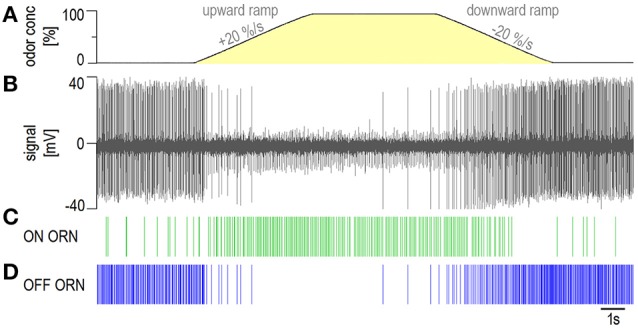
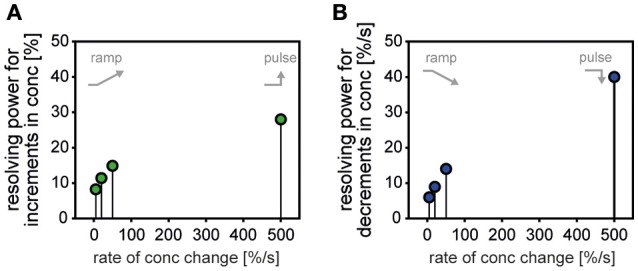
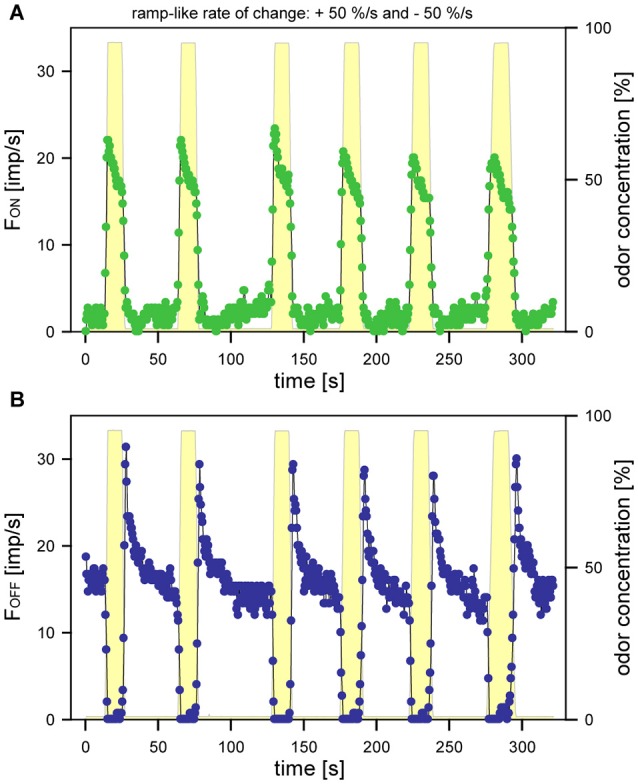
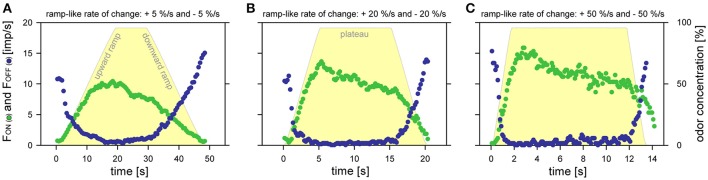
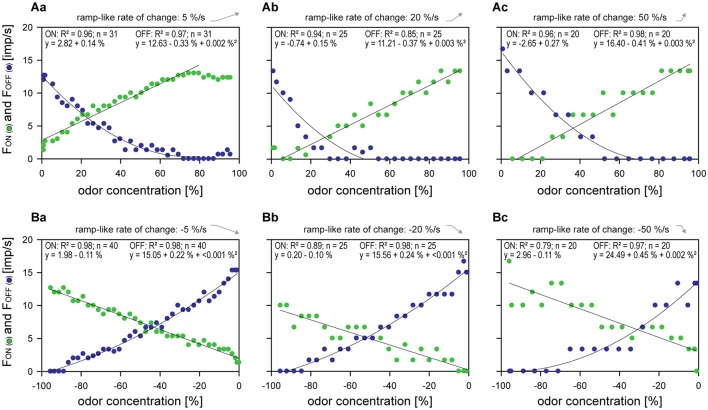
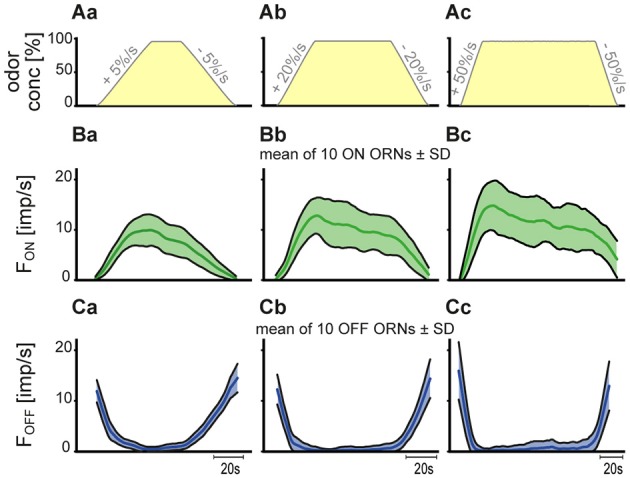
The response characteristics of olfactory receptor neurons (ORNs) and their corollary, the differential sensitivity and the resolving power, are fundamental to understand olfactory coding and the information extracted from a fluctuating olfactory signal. Previous work has focused on the temporal resolution of odor pulses presented for very brief periods at varying concentrations. The time course of the odor pulses as a stimulus parameter has not been considered. The present study investigated the precision of the ON and OFF ORNs on the antennae of the cockroach to discriminate increments and decrements of continuously rising and falling odor concentrations. Stimulation consisted of ramp-like upward and downward concentration changes in a trapezoid fashion. By varying ramp steepness, we examined the effect of the rate of concentration change. Both ORNs were clearly dependent on continuously rising and falling odor concentrations. As the rate of upward and downward concentration changes increases, differential sensitivity improves. Since the scatter of responses around the stimulus-response functions also increases, the resolving power for concentration increments and decrements deteriorates. Thus, the slower the rate of concentration change, the higher the precision in differentiating small concentration changes. Intuitively, the inverse relationship between the rate of concentration change and the resolving power is not surprising because accuracy requires time. A high degree of precision at slow concentration rates enables the cockroach to use information about the onset and offset slopes of odor pulses in addition to the pulse height to encode the spatial-temporal structure of turbulent odor plumes.
嗅觉受体神经元(ORN)的反应特性及其必然结果,即差异敏感性和分辨能力,对于理解嗅觉编码以及从波动的嗅觉信号中提取的信息至关重要。先前的工作主要集中在以不同浓度在极短时间内呈现的气味脉冲的时间分辨率上。气味脉冲作为刺激参数的时间进程尚未得到考虑。本研究调查了蟑螂触角上的ON型和OFF型ORN区分持续上升和下降的气味浓度增量和减量的精度。刺激由梯形的类似斜坡的向上和向下浓度变化组成。通过改变斜坡陡度,我们研究了浓度变化率的影响。两种ORN都明显依赖于持续上升和下降的气味浓度。随着向上和向下浓度变化率的增加,差异敏感性提高。由于刺激-反应函数周围的反应离散度也增加,浓度增量和减量的分辨能力下降。因此,浓度变化率越慢,区分小浓度变化的精度越高。直观地说,浓度变化率与分辨能力之间的反比关系并不奇怪,因为准确性需要时间。在缓慢的浓度变化率下的高精度使蟑螂能够除了利用脉冲高度之外,还利用气味脉冲的起始和结束斜率信息来编码湍流气味羽流的时空结构。