Claus Jules J, Staekenborg Salka S, Holl Dana C, Roorda Jelmen J, Schuur Jacqueline, Koster Pieter, Tielkes Caroline E M, Scheltens Philip
Department of Neurology, Tergooi Hospital, Blaricum, The Netherlands.
Department of Neurology, Alzheimer Center, VU University Medical Center, de Boelelaan 1118, 1081 HZ, Amsterdam, The Netherlands.
Eur Radiol. 2017 Aug;27(8):3147-3155. doi: 10.1007/s00330-016-4726-3. Epub 2017 Jan 12.
To provide age-specific medial temporal lobe atrophy (MTA) cut-off scores for routine clinical practice as marker for Alzheimer's disease (AD).
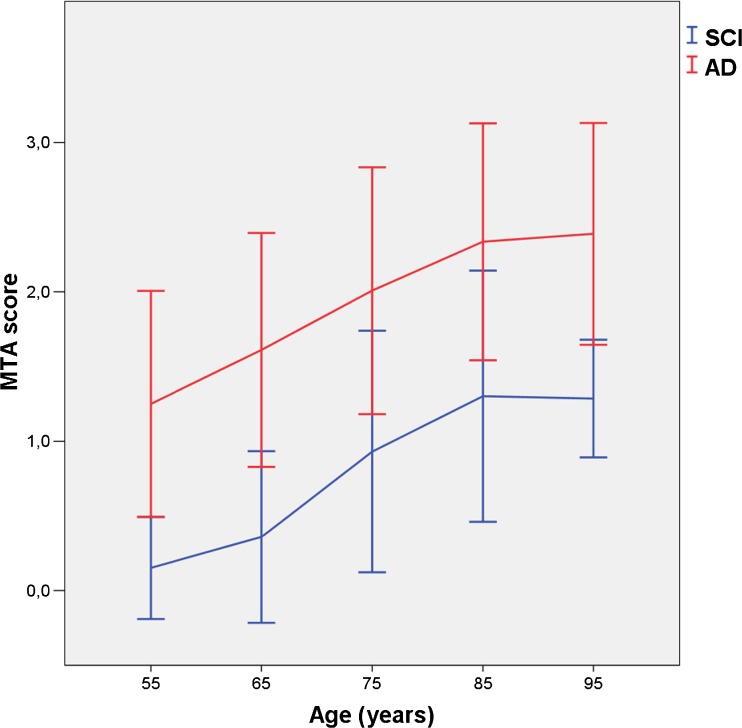
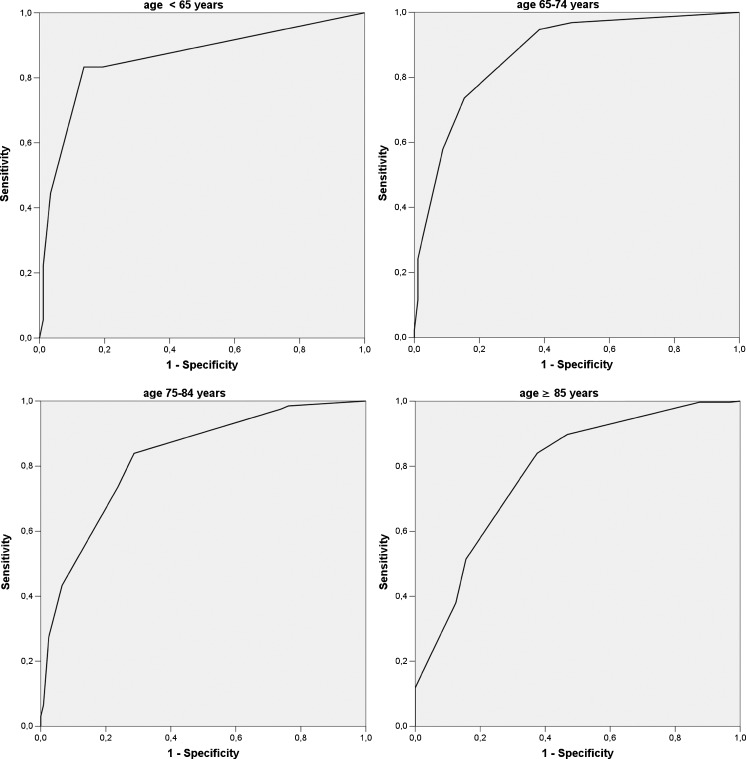
Patients with AD (n = 832, mean age 81.8 years) were compared with patients with subjective cognitive impairment (n = 333, mean age 71.8 years) in a large single-centre memory clinic. Mean of right and left MTA scores was determined with visual rating (Scheltens scale) using CT (0, no atrophy to 4, severe atrophy). Relationships between age and MTA scores were analysed with regression analysis. For various MTA cut-off scores, decade-specific sensitivity and specificity and area under the curve (AUC) values, computed with receiver operator characteristic curves, were determined.
MTA strongly increased with age in both groups to a similar degree. Optimal MTA cut-off values for the age ranges <65, 65-74, 75-84 and ≥85 were: ≥1.0, ≥1.5, ≥ 2.0 and ≥2.0. Corresponding values of sensitivity and specificity were 83.3% and 86.4%; 73.7% and 84.6%; 73.7% and 76.2%; and 84.0% and 62.5%.
From this large unique memory clinic cohort we suggest decade-specific MTA cut-off scores for clinical use. After age 85 years, however, the practical usefulness of the MTA cut-off is limited.
• We suggest decade-specific MTA cut-off scores for AD. • MTA cut-off after the age of 85 years has limited use. • CT is feasible and accurate for visual MTA rating.
提供特定年龄的内侧颞叶萎缩(MTA)截断分数,用于常规临床实践,作为阿尔茨海默病(AD)的标志物。
在一家大型单中心记忆诊所中,将AD患者(n = 832,平均年龄81.8岁)与主观认知障碍患者(n = 333,平均年龄71.8岁)进行比较。使用CT通过视觉评分(Scheltens量表)确定左右MTA分数的平均值(0,无萎缩至4,严重萎缩)。通过回归分析分析年龄与MTA分数之间的关系。对于各种MTA截断分数,使用受试者操作特征曲线计算特定十年的敏感性、特异性和曲线下面积(AUC)值。
两组中MTA均随年龄显著增加,且程度相似。年龄范围<65岁、65 - 74岁、75 - 84岁和≥85岁的最佳MTA截断值分别为:≥1.0、≥1.5、≥2.0和≥2.0。相应的敏感性和特异性值分别为83.3%和86.4%;73.7%和84.6%;73.7%和76.2%;以及84.0%和62.5%。
从这个大型独特的记忆诊所队列中,我们建议临床使用特定十年的MTA截断分数。然而,85岁以后,MTA截断值的实际用途有限。
• 我们建议针对AD使用特定十年的MTA截断分数。• 85岁以后MTA截断值的用途有限。• CT用于视觉MTA评分是可行且准确的。