Tomasetti Carmine, Iasevoli Felice, Buonaguro Elisabetta Filomena, De Berardis Domenico, Fornaro Michele, Fiengo Annastasia Lucia Carmela, Martinotti Giovanni, Orsolini Laura, Valchera Alessandro, Di Giannantonio Massimo, de Bartolomeis Andrea
NHS, Department of Mental Health ASL Teramo, Psychiatric Service of Diagnosis and Treatment, Hospital "Maria SS dello Splendore", 641021 Giulianova, Italy.
Laboratory of Molecular and Translational Psychiatry, Department of Neuroscience, Reproductive and Odontostomatogical Sciences, University of Naples "Federico II", 80131 Napoli, Italy.
Int J Mol Sci. 2017 Jan 12;18(1):135. doi: 10.3390/ijms18010135.
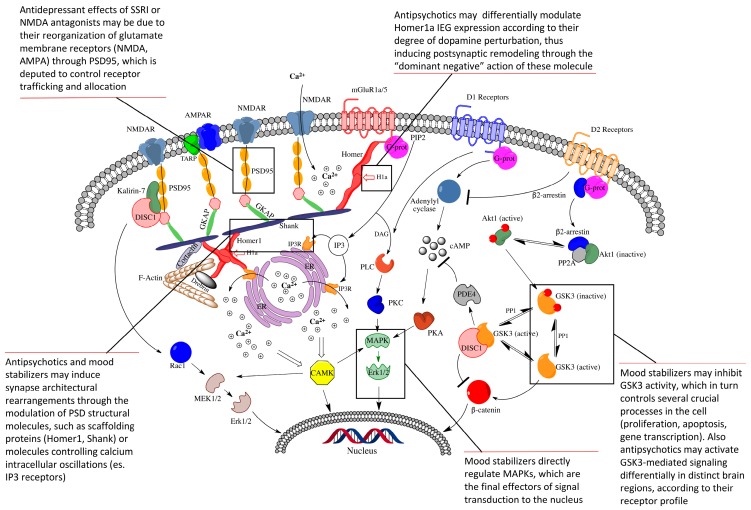
Dopamine-glutamate interplay dysfunctions have been suggested as pathophysiological key determinants of major psychotic disorders, above all schizophrenia and mood disorders. For the most part, synaptic interactions between dopamine and glutamate signaling pathways take part in the postsynaptic density, a specialized ultrastructure localized under the membrane of glutamatergic excitatory synapses. Multiple proteins, with the role of adaptors, regulators, effectors, and scaffolds compose the postsynaptic density network. They form structural and functional crossroads where multiple signals, starting at membrane receptors, are received, elaborated, integrated, and routed to appropriate nuclear targets. Moreover, transductional pathways belonging to different receptors may be functionally interconnected through postsynaptic density molecules. Several studies have demonstrated that psychopharmacologic drugs may differentially affect the expression and function of postsynaptic genes and proteins, depending upon the peculiar receptor profile of each compound. Thus, through postsynaptic network modulation, these drugs may induce dopamine-glutamate synaptic remodeling, which is at the basis of their long-term physiologic effects. In this review, we will discuss the role of postsynaptic proteins in dopamine-glutamate signals integration, as well as the peculiar impact of different psychotropic drugs used in clinical practice on postsynaptic remodeling, thereby trying to point out the possible future molecular targets of "synapse-based" psychiatric therapeutic strategies.
多巴胺 - 谷氨酸相互作用功能障碍被认为是主要精神障碍(尤其是精神分裂症和心境障碍)病理生理的关键决定因素。在很大程度上,多巴胺和谷氨酸信号通路之间的突触相互作用发生在突触后致密区,这是一种位于谷氨酸能兴奋性突触膜下的特殊超微结构。多种具有衔接蛋白、调节蛋白、效应蛋白和支架作用的蛋白质构成了突触后致密区网络。它们形成了结构和功能的交叉点,在这个交叉点上,从膜受体起始的多种信号被接收、加工、整合,并被传递到合适的核靶点。此外,属于不同受体的转导通路可能通过突触后致密区分子在功能上相互连接。多项研究表明,精神药理学药物可能会根据每种化合物独特的受体谱,对突触后基因和蛋白质的表达及功能产生不同影响。因此,通过突触后网络调节,这些药物可能诱导多巴胺 - 谷氨酸突触重塑,这是它们长期生理效应的基础。在本综述中,我们将讨论突触后蛋白在多巴胺 - 谷氨酸信号整合中的作用,以及临床实践中使用的不同精神药物对突触后重塑的独特影响,从而试图指出“基于突触”的精神治疗策略未来可能的分子靶点。