Schumpf Lea F, Theill Nathan, Scheiner David A, Fink Daniel, Riese Florian, Betschart Cornelia
Department of Gynecology, University Hospital Zurich, Frauenklinikstrasse 10, 8091, Zurich, Switzerland.
University Research Priority Program "Dynamics of Healthy Aging", University of Zurich, Zurich, Switzerland.
BMC Geriatr. 2017 Jan 13;17(1):17. doi: 10.1186/s12877-017-0414-7.
Specific knowledge of urinary incontinence (UI) and its interrelation with physical and cognitive health is essential to working towards prevention of UI and to improving quality of treatment and care. The purpose of this study was to determine the association between UI and the activities of daily living (ADL) hierarchy scale, the cognitive performance scale (CPS) and comorbid conditions.
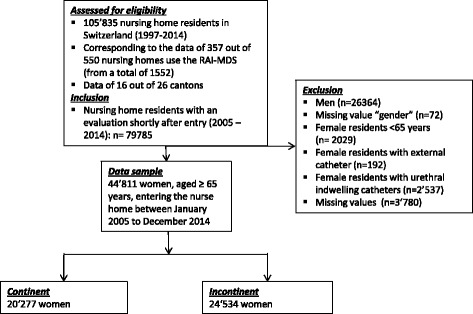
The cross-sectional retrospective analysis of 357 nursing homes in Switzerland was based on data of the Minimum Data Set of the Resident Assessment Instrument 2.0 (RAI-MDS). The analysis examined the effect of ADL hierarchy scale, CPS, joint motion and comorbidities on UI. Women ≥65 years were included (n = 44'811; January 2005 to September 2014) at the time of admission to a nursing home. Statistical analysis was done by means of descriptive statistics and logistic regression analysis.
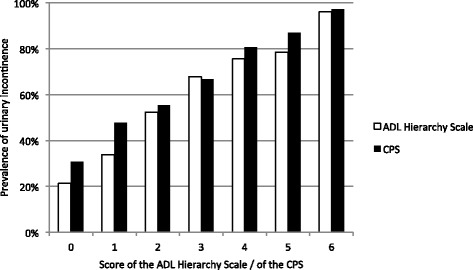
The prevalence of UI was 54.7%, the mean ADL hierarchy scale (± SD) 2.42 ± 3.26 (range = 0-6), the mean CPS 1.95 ± 1.67 (range = 0-6). There was a gradual increase in the odds ratio (OR) for UI depending on the ADL hierarchy scale, from the hierarchy scales of "supervised" to "total dependence" of 1.43 - 30.25. For CPS, the OR for UI from "borderline intact" to "very severe impairment" was 1.35 - 5.99. Considering the interaction between ADL and CPS, all ADL hierarchies remained significantly associated with UI, however for CPS this was the case only in the lower hierarchies. Of the 11 examined comorbid conditions, only diabetes mellitus (OR 1.19), dementia (OR 1.01) and arthrosis/arthritis (OR 1.53) were significantly associated with UI.
The study indicated that impairment in ADL performance is strongly associated with UI, more than CPS performance and comorbidities. Physical more than cognitive training in order to improve or at least stabilize ADL performance could be a way to prevent or reduce the process of developing UI.
了解尿失禁(UI)的具体知识及其与身体和认知健康的相互关系,对于预防尿失禁以及提高治疗和护理质量至关重要。本研究的目的是确定尿失禁与日常生活活动(ADL)分级量表、认知表现量表(CPS)及合并症之间的关联。
基于居民评估工具2.0(RAI-MDS)的最小数据集,对瑞士357家养老院进行横断面回顾性分析。该分析考察了ADL分级量表、CPS、关节活动度和合并症对尿失禁的影响。纳入≥65岁入住养老院时的女性(n = 44811;2005年1月至2014年9月)。采用描述性统计和逻辑回归分析进行统计分析。
尿失禁患病率为54.7%,ADL分级量表平均(±标准差)为2.42±3.26(范围=0 - 6),CPS平均为1.95±1.67(范围=0 - 6)。根据ADL分级量表,尿失禁的比值比(OR)呈逐渐上升趋势,从“受监督”到“完全依赖”的分级量表,OR为1.43 - 30.25。对于CPS,从“临界完好”到“非常严重受损”尿失禁的OR为1.35 - 5.99。考虑到ADL和CPS之间的相互作用,所有ADL分级与尿失禁仍显著相关,但对于CPS,仅在较低分级中如此。在11种检查的合并症中,只有糖尿病(OR 1.19)、痴呆(OR 1.01)和关节病/关节炎(OR 1.53)与尿失禁显著相关。
该研究表明,ADL功能障碍与尿失禁密切相关,比CPS功能障碍和合并症更为密切。通过身体训练而非认知训练来改善或至少稳定ADL功能,可能是预防或减少尿失禁发生过程的一种方法。