Wobser Hella, Gunesch Agnetha, Klebl Frank
Department of Internal Medicine and Gastroenterology, University Hospital of Regensburg, Regensburg, 93042, Germany.
Present address: Praxiszentrum Alte Mälzerei, Regensburg, Germany.
BMC Gastroenterol. 2017 Jan 13;17(1):10. doi: 10.1186/s12876-017-0570-4.
Patients with biliary obstruction are at high risk to develop septic complications after endoscopic retrograde cholangiography (ERC). We evaluated the benefits of local application of antimicrobial agents into ERC contrast media in preventing post-ERC infectious complications in a high-risk study population.
Patients undergoing ERC at our tertiary referral center were retrospectively included. Addition of vancomycin, gentamicin and fluconazol into ERC contrast media was evaluated in a case-control design. Outcomes comprised infectious complications within 3 days after ERC.
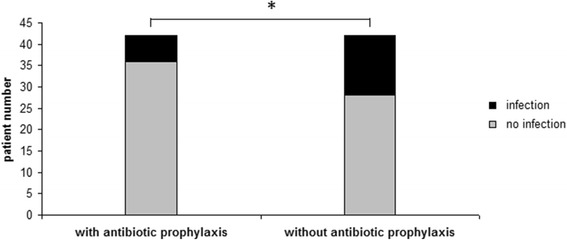
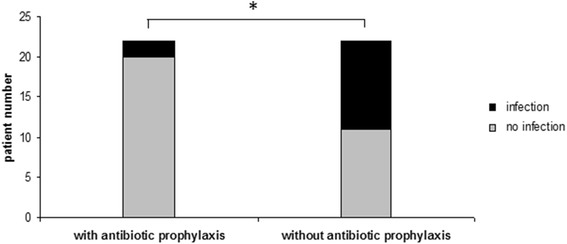
In total, 84 ERC cases were analyzed. Primarily indications for ERC were sclerosing cholangitis (75%) and malignant stenosis (9.5%). Microbial testing of collected bile fluid in the treatment group was positive in 91.4%. Detected organisms were sensitive to the administered antimicrobials in 93%. The use of antimicrobials in contrast media was associated with a significant decrease in post-ERC infectious complications compared to non-use (14.3% vs. 33.3%; odds ratio [OR]: 0.33, 95% confidence interval [CI]: 0.114-0.978). After adjusting for the variables acute cholangitis prior to ERC and incomplete biliary drainage, the beneficial effect of intraductal antibiotic prophylaxis was even more evident (OR = 0.153; 95% CI: 0.039-0.598, p = 0.007). Patients profiting most obviously from intraductal antimicrobials were those with secondary sclerosing cholangitis.
Local application of a combination of antibiotic and antimycotic agents to ERC contrast media efficiently reduced post-ERC infectious events in patients with biliary obstruction. This is the first study that evaluates ERC-related infectious complications in patients with secondary sclerosing cholangitis. Our first clinical results should now be prospectively evaluated in a larger patient cohort to improve the safety of ERC, especially in patients with secondary sclerosing cholangitis.
胆道梗阻患者在接受内镜逆行胆管造影术(ERC)后发生感染性并发症的风险很高。我们在一个高危研究人群中评估了在ERC造影剂中局部应用抗菌药物对预防ERC术后感染性并发症的益处。
回顾性纳入在我们三级转诊中心接受ERC的患者。采用病例对照设计评估在ERC造影剂中添加万古霉素、庆大霉素和氟康唑的效果。观察指标包括ERC术后3天内的感染性并发症。
共分析了84例ERC病例。ERC的主要适应证为硬化性胆管炎(75%)和恶性狭窄(9.5%)。治疗组收集的胆汁样本微生物检测阳性率为91.4%。检测到的微生物对所用抗菌药物的敏感率为93%。与未使用抗菌药物相比,在造影剂中使用抗菌药物与ERC术后感染性并发症显著减少相关(14.3%对33.3%;优势比[OR]:0.33,95%置信区间[CI]:0.114 - 0.978)。在对ERC术前急性胆管炎和胆管引流不完全等变量进行校正后,导管内抗生素预防的有益效果更为明显(OR = 0.153;95% CI:0.039 - 0.598,p = 0.007)。从导管内抗菌药物中获益最明显的患者是继发性硬化性胆管炎患者。
在ERC造影剂中局部应用抗生素和抗真菌药物联合可有效减少胆道梗阻患者ERC术后的感染事件。这是第一项评估继发性硬化性胆管炎患者与ERC相关感染性并发症的研究。我们的初步临床结果现在应在前瞻性研究中纳入更大的患者队列进行评估,以提高ERC的安全性,尤其是在继发性硬化性胆管炎患者中。