Tian Xiaojie
Graduate School of Asian and African Area Studies, Kyoto University, 46 Shimoadachi-cho, Yoshida, Sakyo-ku, Kyoto, 606-8501, Japan.
J Ethnobiol Ethnomed. 2017 Jan 13;13(1):2. doi: 10.1186/s13002-016-0131-x.
Researchers considering children's traditional ecological knowledge (TEK) highlighted the importance of examining children's daily activities as empirical contexts for its acquisition. Many of them evaluated children's TEK acquisition linearly as gain or loss, and paid less attention to the adaptive nature of this knowledge system and the social relationships arising from its acquisition processes. This study approaches children's TEK acquisition considering these abovementioned aspects. I utilize pastoral Maasai girls' firewood collection as a case study, and analyze the personal, interpersonal and cultural institutional aspects of girls' Ethnobotanical knowledge (EK) acquisition within this chore.
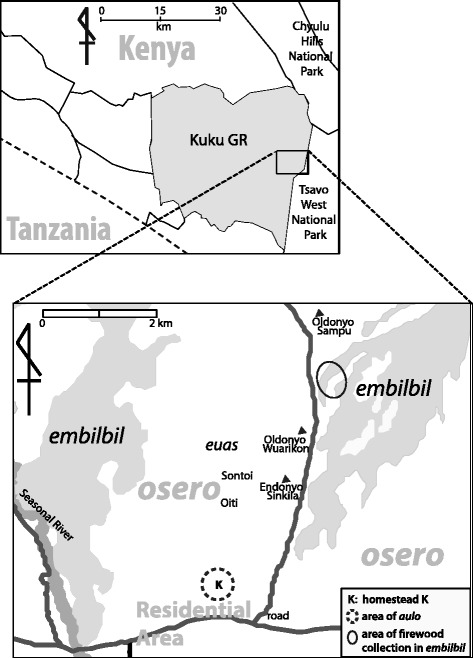
Participant observation and unstructured interviews were used for data collection. I joined 12 girls (6 to 15 years old) on day trips for firewood collection, and documented their participation and performance during this chore. I observed interactions among girls and between girls and women concerning this activity, and investigated girls' perceptions of local wood species via their descriptions. I also informally interviewed 15 women, between 20 and 80 years old on their evaluation of the wood species to be used as firewood.
Current diet change and gender-age roles in chore participation in Maasai society require females to continually participate in firewood collection. Within this social context, girls intensively participated in day trips of firewood collection during the long-term vacation in the dry season. They collected a sizable amount from 24 plant species, and generated EK through personal sensual experiences, such as fragrance, hardness, and heaviness of different wood species. They acquired local taxonomy and terminology of different wood species, and learned others preferences for wood species used as fuel through interpersonal communication. These personal and interpersonal aspects, together with current diet change and division of labor within gender-age roles in Maasai society, provide EK with multi-dimensional meanings in current subsistence strategies.
Results of this study show that girls acquired EK with multi-dimensional meanings through daily firewood collection, which cannot be only evaluated in a linear manner. Future studies focused on children's TEK acquisition should consider the personal, interpersonal, and cultural institutional aspects of this adaptive knowledge system and children's roles within it.
研究儿童传统生态知识(TEK)的人员强调,将儿童的日常活动作为获取该知识的经验背景进行考察具有重要意义。他们中的许多人将儿童TEK的获取以线性方式评估为增加或减少,较少关注这一知识体系的适应性本质以及获取过程中产生的社会关系。本研究从上述这些方面探讨儿童TEK的获取。我以马赛族牧牛女童拾柴为例进行研究,并分析女童在这项日常杂务中获取民族植物学知识(EK)的个人、人际和文化制度层面。
采用参与观察和非结构化访谈收集数据。我与12名女童(6至15岁)一同进行拾柴一日游,记录她们在这项日常杂务中的参与情况和表现。我观察了女童之间以及女童与成年女性之间关于此项活动的互动,并通过她们的描述来调查女童对当地木材种类的认知。我还对15名年龄在20至80岁之间的成年女性进行了非正式访谈,了解她们对用作柴火的木材种类的评价。
马赛社会当前的饮食变化以及日常杂务参与中的性别 - 年龄角色要求女性持续参与拾柴活动。在此社会背景下,女童在旱季的长假期间积极参与拾柴一日游。她们从24种植物中收集了大量柴火,并通过个人感官体验,如不同木材种类的气味、硬度和重量,获得了EK。她们掌握了不同木材种类的当地分类和术语,并通过人际交流了解了其他人对用作燃料的木材种类的偏好。这些个人和人际层面的因素,连同马赛社会当前的饮食变化以及性别 - 年龄角色中的劳动分工,为EK在当前生存策略中赋予了多维度的意义。
本研究结果表明,女童通过日常拾柴活动获得了具有多维度意义的EK,不能仅以线性方式进行评估。未来关注儿童TEK获取的研究应考虑这一适应性知识体系的个人、人际和文化制度层面以及儿童在其中的角色。