Crisà Elena, Cerrano Marco, Beggiato Eloise, Benevolo Giulia, Lanzarone Giuseppe, Manzini Paola Maria, Borchiellini Alessandra, Riera Ludovica, Boccadoro Mario, Ferrero Dario
Hematology Division, Università degli Studi di Torino, Via Genova 3, 10126, Turin, Italy.
S.C. Hematology, A.O. Città della Salute e della Scienza, Turin, Italy.
J Hematol Oncol. 2017 Jan 13;10(1):15. doi: 10.1186/s13045-017-0395-1.
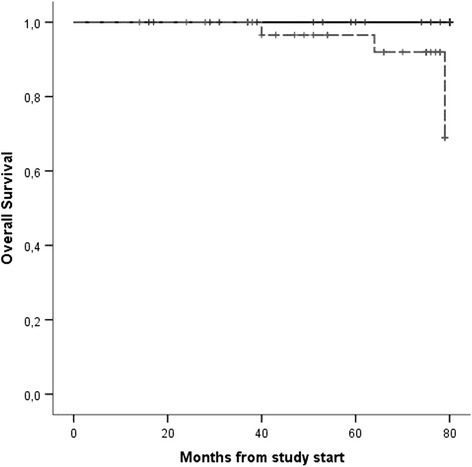
Pegylated interferon (peg-IFN) was proven by phase II trials to be effective in polycythemia vera (PV); however, it is not clear whether it could improve patient outcome compared to hydroxyurea (HU). Here, we present an observational study on 65 PV patients aged 65 years or younger, who received either peg-IFN (30) or HU (35) according to the physician choice. Median follow-up was 75 months. The two cohorts were comparable for patient and disease characteristics. Eighty-seven percent of the patients treated with peg-INF responded, with a CR rate of 70% as compared to 100 and 49% with HU, respectively. Discontinuation rate was similar in the two groups (20% in peg-IFN vs 17% in HU). JAK2 allele burden was monitored in peg-INF arm only, and a reduction was observed in 88% of the patients. No thrombotic events were observed during peg-IFN treatment compared to three on HU. Disease progression to myelofibrosis or acute myeloid leukemia occurred to a patient only in peg-INF, compared to three in HU. Overall, three second malignancies were observed during the study, two in patients who received HU only, and one in a patient largely treated HU who received also peg-IFN for 3 months. Overall survival was significantly better for peg-IFN patients compared to HU, p = 0.027. Our study, albeit limited by small patient and event number and lack of randomization, confirms the efficacy of peg-INF in PV and shows a significant survival advantage for peg-INF-treated patients. Waiting for confirming data from the ongoing phase III trials, our study can support peg-INF as a first-line treatment option for PV, at least for younger patients.
聚乙二醇化干扰素(peg-IFN)经II期试验证明对真性红细胞增多症(PV)有效;然而,与羟基脲(HU)相比,它是否能改善患者预后尚不清楚。在此,我们对65例65岁及以下的PV患者进行了一项观察性研究,这些患者根据医生的选择接受了peg-IFN(30例)或HU(35例)治疗。中位随访时间为75个月。两组患者和疾病特征具有可比性。接受peg-INF治疗的患者中有87%有反应,完全缓解率为70%,而接受HU治疗的患者分别为100%和49%。两组的停药率相似(peg-IFN组为20%,HU组为17%)。仅在peg-INF组监测了JAK2等位基因负荷,88%的患者观察到其降低。与HU组发生3例血栓事件相比,peg-IFN治疗期间未观察到血栓事件。疾病进展为骨髓纤维化或急性髓系白血病仅发生在接受peg-INF治疗的1例患者中,而HU组有3例。总体而言,研究期间观察到3例第二原发性恶性肿瘤,2例仅接受HU治疗的患者,1例主要接受HU治疗且还接受了3个月peg-IFN治疗的患者。与HU组相比,peg-IFN组患者的总生存期显著更好,p = 0.027。我们的研究尽管受患者和事件数量少以及缺乏随机化的限制,但证实了peg-INF在PV中的疗效,并显示出接受peg-INF治疗的患者有显著的生存优势。在等待正在进行的III期试验的确认数据期间,我们的研究可以支持将peg-INF作为PV的一线治疗选择,至少对于年轻患者是如此。