Paulson Eric S, Prah Douglas E, Schmainda Kathleen M
Department of Radiation Oncology, Medical College of Wisconsin, Milwaukee, Wisconsin.
Department of Radiology, Medical College of Wisconsin, Milwaukee, Wisconsin.
Tomography. 2016 Dec;2(4):295-307. doi: 10.18383/j.tom.2016.00217.
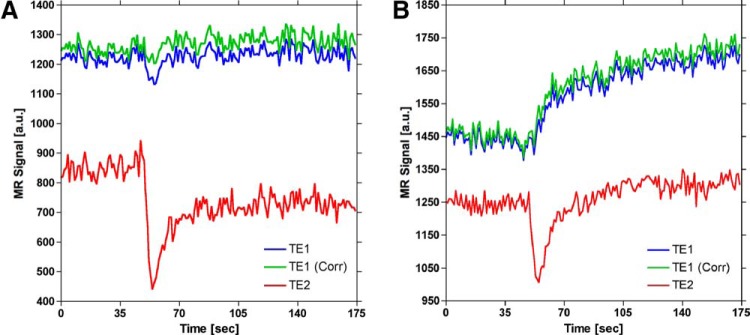
Dynamic contrast-enhanced (DCE) and dynamic susceptibility contrast (DSC) magnetic resonance imaging (MRI) are the perfusion imaging techniques most frequently used to probe the angiogenic character of brain neoplasms. With these methods, - and /*-weighted imaging sequences are used to image the distribution of gadolinium (Gd)-based contrast agents. However, it is well known that Gd exhibits combined , , and * shortening effects in tissue, and therefore, the results of both DCE- and DSC-MRI can be confounded by these opposing effects. In particular, residual susceptibility effects compete with shortening, which can confound DCE-MRI parameters, whereas dipolar and leakage and residual susceptibility effects can confound DSC-MRI parameters. We introduce here a novel perfusion imaging acquisition and postprocessing method termed Spiral Perfusion Imaging with Consecutive Echoes (SPICE) that can be used to simultaneously acquire DCE- and DSC-MRI data, which requires only a single dose of the Gd contrast agent, does not require the collection of a precontrast map for DCE-MRI processing, and eliminates the confounding contrast agent effects due to contrast extravasation. A detailed mathematical description of SPICE is provided here along with a demonstration of its utility in patients with high-grade glioma.
动态对比增强(DCE)和动态磁敏感对比(DSC)磁共振成像(MRI)是最常用于探究脑肿瘤血管生成特征的灌注成像技术。通过这些方法,使用T1加权成像序列来成像基于钆(Gd)的造影剂的分布。然而,众所周知,钆在组织中表现出综合的T1、T2和T2缩短效应,因此,DCE-MRI和DSC-MRI的结果都可能受到这些相反效应的混淆。特别是,残余磁敏感效应与T1缩短相互竞争,这可能会混淆DCE-MRI参数,而偶极T2和T2泄漏以及残余磁敏感效应可能会混淆DSC-MRI参数。我们在此介绍一种新的灌注成像采集和后处理方法,称为连续回波螺旋灌注成像(SPICE),它可用于同时采集DCE-MRI和DSC-MRI数据,只需要一剂Gd造影剂,不需要为DCE-MRI处理采集造影前的T1图,并且消除了由于造影剂外渗导致的混淆造影剂效应。本文提供了SPICE的详细数学描述,并展示了其在高级别胶质瘤患者中的效用。