Stephens Richard, Zile Amy
School of Psychology, Keele University, Keele, Staffordshire, ST5 5BG, United Kingdom.
J Psycholinguist Res. 2017 Aug;46(4):983-995. doi: 10.1007/s10936-016-9473-8.
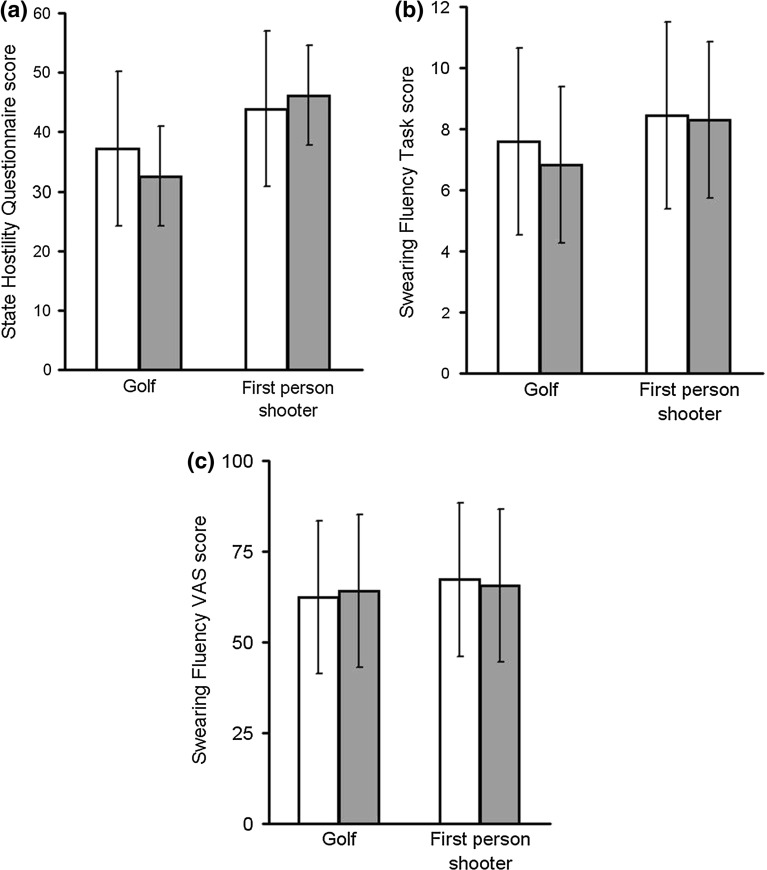
This study assessed the effect of experimentally manipulated emotional arousal on swearing fluency. We hypothesised that swear word generation would be increased with raised emotional arousal. The emotional arousal of 60 participants was manipulated by having them play a first-person shooter video game or, as a control, a golf video game, in a randomised order. A behavioural measure of swearing fluency based on the Controlled Oral Word Association Test was employed. Successful experimental manipulation was indicated by raised State Hostility Questionnaire scores after playing the shooter game. Swearing fluency was significantly greater after playing the shooter game compared with the golf game. Validity of the swearing fluency task was demonstrated via positive correlations with self-reported swearing fluency and daily swearing frequency. In certain instances swearing may represent a form of emotional expression. This finding will inform debates around the acceptability of using taboo language.
本研究评估了实验操纵的情绪唤起对咒骂流畅性的影响。我们假设,随着情绪唤起的增强,咒骂词的生成会增加。60名参与者的情绪唤起通过让他们按随机顺序玩第一人称射击视频游戏或作为对照的高尔夫视频游戏来进行操纵。采用了基于受控口语单词联想测验的咒骂流畅性行为测量方法。玩射击游戏后状态敌意问卷得分升高表明实验操纵成功。与高尔夫游戏相比,玩射击游戏后的咒骂流畅性显著更高。咒骂流畅性任务的有效性通过与自我报告的咒骂流畅性和日常咒骂频率的正相关得到了证明。在某些情况下,咒骂可能代表一种情绪表达形式。这一发现将为围绕使用禁忌语言可接受性的辩论提供参考。