Trejo-Tzab R, Caballero-Espada Liliana, Quintana P, Ávila-Ortega Alejandro, Medina-Esquivel R A
Facultad de Ingeniería Química, Universidad Autónoma de Yucatán, Mérida, Yucatán, 97203, México.
Depto. de Física Aplicada, CINVESTAV-Unidad Mérida, A.P. 73, Cordemex, 97310, Mérida, Yucatán, México.
Nanoscale Res Lett. 2017 Dec;12(1):32. doi: 10.1186/s11671-016-1821-y. Epub 2017 Jan 13.
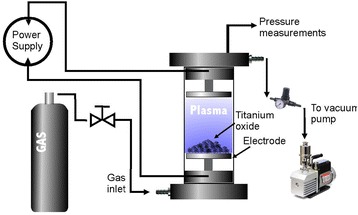
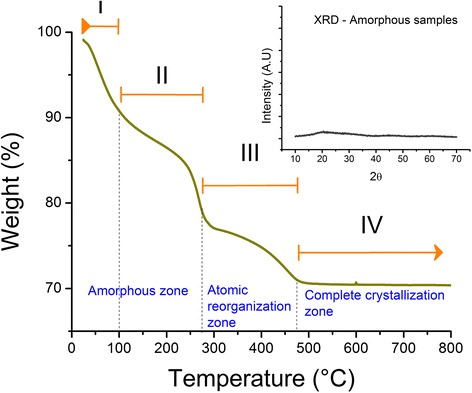
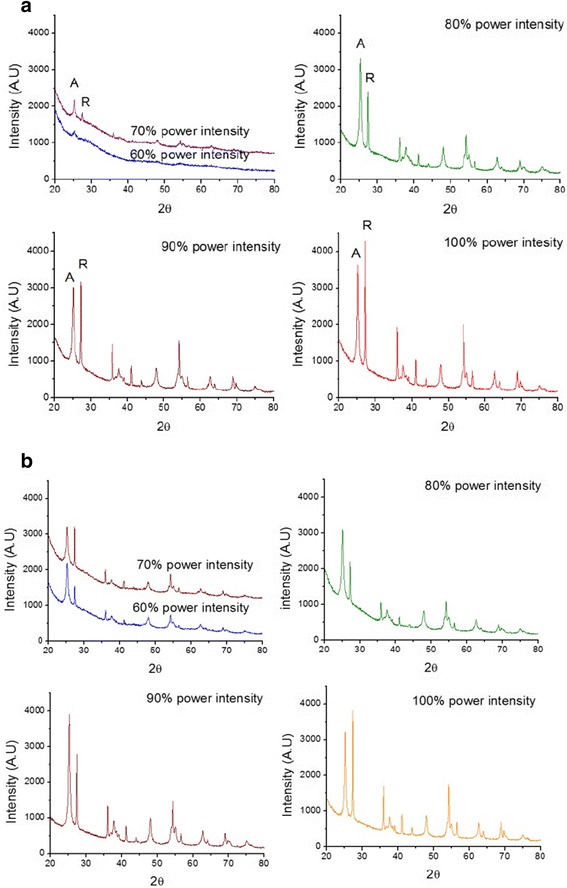
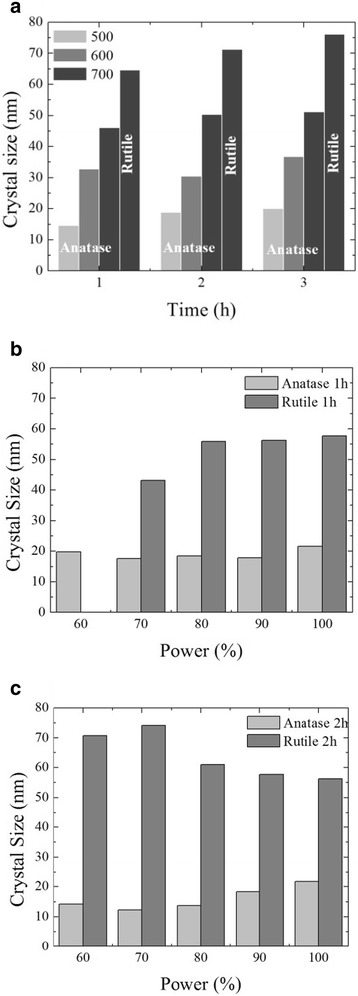
In this work, the development of a new crystallization technique is reported, using nitrogen plasma (AC) to obtain nanostructured anatase and rutile from amorphous titanium oxide (TiO). This methodology increases throughput and minimizes thermal effects. Nanostructured amorphous TiO was obtained by the sol-gel method and subsequently subjected to AC treatment, at a controlled pressure, applying different powers and treatment times in order to obtain phase changes. The obtained samples were characterized using X-ray diffraction (XRD), thermogravimetric analysis (TGA), and X-ray photoelectron spectroscopy (XPS). The results show the crystallization in parallel with anatase and rutile phases with a proportion that is directly related to the applied power in the plasma and the treatment time. This technique allows us to obtain smaller crystals in comparison with those of classic thermal methodologies. It is also demonstrated that the application of plasma represents a novel and innovative method to obtain phase polymorphic changes in titanium oxide without needing to apply prolonged heat treatments at high temperatures and can therefore be taken into consideration as a technique with low energy costs, in comparison with conventional heat treatments.
在这项工作中,报道了一种新的结晶技术的开发,该技术使用氮等离子体(交流电)从非晶态二氧化钛(TiO)中获得纳米结构的锐钛矿和金红石。这种方法提高了产量并将热效应降至最低。通过溶胶 - 凝胶法获得纳米结构的非晶态TiO,随后在可控压力下进行交流电处理,施加不同的功率和处理时间以实现相变。使用X射线衍射(XRD)、热重分析(TGA)和X射线光电子能谱(XPS)对所得样品进行表征。结果表明,锐钛矿相和金红石相同时结晶,其比例与等离子体中的施加功率和处理时间直接相关。与传统热方法相比,该技术使我们能够获得更小的晶体。还证明了等离子体的应用代表了一种新颖且创新的方法,可在无需高温长时间热处理的情况下实现二氧化钛的相多晶型变化,因此与传统热处理相比,可被视为一种低能耗技术。