Xiao Fei, Xu Wenping, Feng Ying, Fu Feng, Zhang Xiaomin, Zhang Yinfa, Wang Lizhong, Chen Xinzhong
Department of Anesthesia, Women's Hospital, School of Medicine, Zhejiang University, Hangzhou, China.
Department of Anesthesia, Jiaxing Maternity and Child Care Hospital, Jiaxing, Zhejiang, China.
BMC Anesthesiol. 2017 Jan 17;17(1):8. doi: 10.1186/s12871-017-0300-z.
Addition of intrathecal magnesium sulfate to local anesthetics has been reported to potentiate spinal anesthesia and prolong analgesia in parturients. The current study was to determine whether intrathecal magnesium sulfate would reduce the dose of hyperbaric bupivacaine in spinal anesthesia with bupivacaine and sufentanil for cesarean delivery.
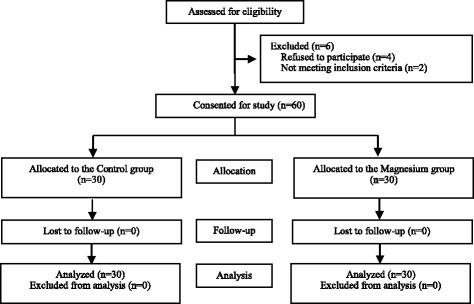
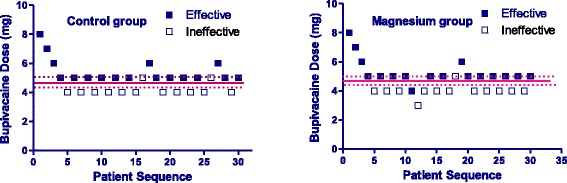
Sixty healthy parturients undergoing scheduled cesarean delivery were randomly assigned to receive spinal anesthesia with 0.5% hyperbaric bupivacaine and 5 μg sufentanil with either 0.9% sodium chloride (Control group) or 50% magnesium sulfate (50 mg) (Magnesium group). Effective anesthesia was defined as a bilateral T sensory block level achieved within 10 min of intrathecal drug administration and no additional epidural anesthetic was required during surgery. Characteristic of spinal anesthesia and the incidence of side effects were observed. The ED for both groups was calculated using the Dixon and Massey formula.
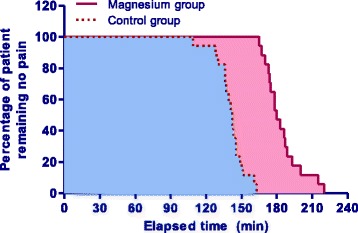
There was no significant difference in the ED of bupivacaine between the Magnesium group and the Control group (4.9 mg vs 4.7 mg) (P = 0.53). The duration of spinal anesthesia (183 min vs 148 min, P < 0.001) was longer, the consumption of fentanyl during the first 24 h postoperatively (343 μg vs 550 μg, P < 0.001) was lower in the Magnesium group than that in the Control group.
Intrathecal magnesium sulfate (50 mg) did not reduce the dose requirement of intrathecal bupivacaine, but can extend the duration of spinal anesthesia with no obvious additional side effects.
This study was registered with Chinese Clinical Trial Registry (ChiCTR) on 15 Jul. 2014 and was given a trial ID number ChiCTR-TRC- 14004954 .
据报道,在局部麻醉药中添加鞘内硫酸镁可增强分娩产妇的脊髓麻醉效果并延长镇痛时间。本研究旨在确定鞘内硫酸镁是否会减少布比卡因和舒芬太尼用于剖宫产脊髓麻醉时高压布比卡因的剂量。
60例计划行剖宫产的健康产妇被随机分为两组,分别接受0.5%高压布比卡因和5μg舒芬太尼加0.9%氯化钠溶液(对照组)或50%硫酸镁(50mg)(镁组)的脊髓麻醉。有效麻醉定义为鞘内给药后10分钟内达到双侧T感觉阻滞平面,且手术期间无需额外的硬膜外麻醉。观察脊髓麻醉的特点和副作用发生率。使用Dixon和Massey公式计算两组的半数有效剂量(ED)。
镁组和对照组布比卡因的半数有效剂量无显著差异(4.9mg对4.7mg)(P = 0.53)。镁组脊髓麻醉持续时间(183分钟对148分钟,P < 0.001)更长,术后24小时内芬太尼消耗量(343μg对550μg,P < 0.001)低于对照组。
鞘内注射50mg硫酸镁并未降低鞘内布比卡因的剂量需求,但可延长脊髓麻醉持续时间且无明显额外副作用。
本研究于2014年7月15日在中国临床试验注册中心(ChiCTR)注册,注册号为ChiCTR-TRC-14004954。