Xu Jun-Jie, Yu Yan-Qiu, Hu Qing-Hai, Yan Hong-Jing, Wang Zhe, Lu Lin, Zhuang Ming-Hua, Chen Xi, Fu Ji-Hua, Tang Wei-Ming, Geng Wen-Qing, Jiang Yong-Jun, Shang Hong
Key Laboratory of AIDS Immunology of National Health and Family Planning Commission, Department of Laboratory Medicine, The First Affiliated Hospital, China Medical University, Shenyang, China.
Collaborative Innovation Center for Diagnosis and Treatment of Infectious Diseases, Hangzhou, China.
Infect Dis Poverty. 2017 Jan 18;6(1):15. doi: 10.1186/s40249-016-0219-5.
Delayed or inappropriate treatment for sexually transmitted diseases (STDs) increases the risk of HIV acquisition and may cause other harmful outcomes. However, studies on STD treatment-seeking behaviour and correlated factors in men who have sex with men (MSM) are scarce. This information is crucial for the promotion of STD treatment-seeking behaviour and reduction of HIV transmission among Chinese MSM.
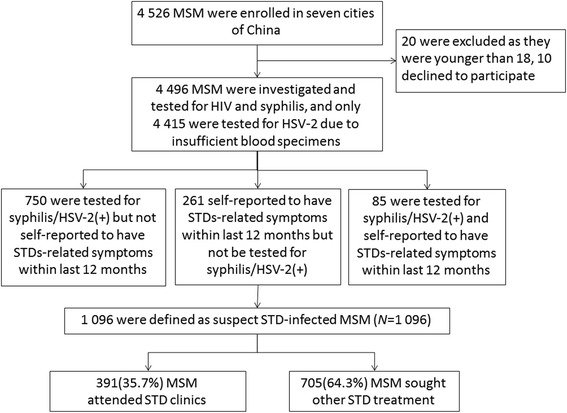
During 2012-2013, a multicentre cross-sectional study was conducted in 7 Chinese cities. Participants completed an interview-questionnaire and gave venous blood samples, which were then tested for antibodies to HIV, syphilis, and herpes simplex virus-2 (HSV-2). MSM who tested positive for syphilis/HSV-2 or had obvious STD-related symptoms within the last 12 months were defined as suspected STD-infected MSM.
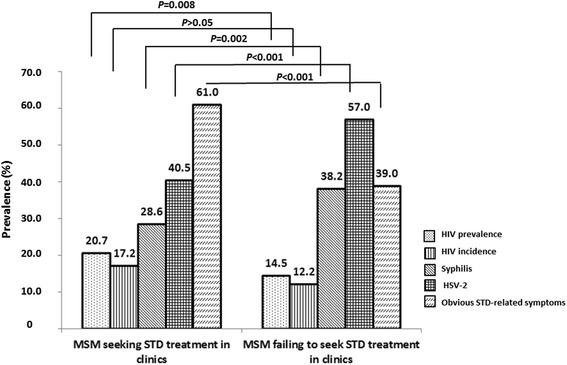
Of the 4 496 eligible MSM who completed this survey, 24.4% (1 096/4 496) were categorized as suspected STD-infected MSM. 35.7% (391/1 096) of these MSM with suspected STD infections sought STD treatment in clinics within the last 12 months. Among MSM who did not attend STD clinics for treatment, the prevalence of syphilis and HSV-2 was significantly higher; the HIV prevalence and incidence within this subpopulation reached as high as 14.5% and 12.2/100 person-years, respectively. Multivariate logistic regression analysis indicated that having 7-12 years of education (vs. ≤6 years; aOR, 2.5; 95%CI, 1.0-6.1), ≥13 years of education (vs. ≤6 years: aOR, 2.8; 95%CI, 1.2-7.0), monthly income >500 USD (vs. ≤500 USD: aOR, 1.5; 95%CI, 1.1-2.1), obvious STD-related symptoms within last 12 months (aOR, 5.3; 95%CI, 3.7-7.5), being HIV infected (aOR, 1.7; 95%CI, 1.1-2.6), currently syphilis infected (aOR, 0.6; 95%CI, 0.4-0.9) and HSV-2 infected (aOR, 0.6; 95%CI, 0.5-0.9) were independent correlates with seeking STD treatment in clinics among Chinese MSM.
The high prevalence of STD infection coupled with a low proportion of individuals who exhibit appropriate treatment-seeking behaviour create a high risk of a growing HIV epidemic among Chinese MSM. Models that prioritize better screening for and education about STDs should be urgently implemented, especially among low-income MSM.
性传播疾病(STD)的延迟治疗或不恰当治疗会增加感染艾滋病毒的风险,并可能导致其他有害后果。然而,关于男男性行为者(MSM)寻求性病治疗行为及其相关因素的研究较少。这些信息对于促进中国男男性行为者寻求性病治疗行为及减少艾滋病毒传播至关重要。
2012年至2013年期间,在中国7个城市开展了一项多中心横断面研究。参与者完成一份访谈问卷并提供静脉血样,随后检测血样中的艾滋病毒、梅毒和单纯疱疹病毒2型(HSV-2)抗体。梅毒/HSV-2检测呈阳性或在过去12个月内有明显性病相关症状的男男性行为者被定义为疑似感染性病的男男性行为者。
在完成这项调查的4496名符合条件的男男性行为者中,24.4%(1096/4496)被归类为疑似感染性病的男男性行为者。在这些疑似感染性病的男男性行为者中,35.7%(391/1096)在过去12个月内在诊所寻求过性病治疗。在未前往性病诊所治疗的男男性行为者中,梅毒和HSV-2的患病率显著更高;该亚人群中的艾滋病毒患病率和发病率分别高达14.5%和12.2/100人年。多因素逻辑回归分析表明,受教育7 - 12年(对比≤6年;调整后比值比[aOR],2.5;95%置信区间[CI],1.0 - 6.1)、受教育≥13年(对比≤6年:aOR,2.8;95%CI,1.2 - 7.0)、月收入>500美元(对比≤500美元:aOR,1.5;95%CI,1.1 - 2.1)、过去12个月内有明显性病相关症状(aOR,5.3;95%CI,3.7 - 7.5)、感染艾滋病毒(aOR,1.7;95%CI,1.1 - 2.6)、目前感染梅毒(aOR,0.6;95%CI,0.4 - 0.9)和感染HSV-2(aOR,0.6;95%CI,0.5 - 0.9)是中国男男性行为者在诊所寻求性病治疗的独立相关因素。
性病感染的高患病率以及表现出恰当治疗寻求行为的个体比例较低,使得中国男男性行为者中艾滋病毒流行风险不断增加。应紧急实施优先加强性病筛查和教育的模式,尤其是在低收入男男性行为者中。