Suda Goki, Ogawa Koji, Kimura Megumi, Nakai Masato, Sho Takuya, Morikawa Kenichi, Sakamoto Naoya
Department of Gastroenterology and Hepatology, Graduate School of Medicine, Hokkaido University, Hokkaido, Japan.
J Clin Transl Hepatol. 2016 Dec 28;4(4):320-327. doi: 10.14218/JCTH.2016.00032. Epub 2016 Dec 26.
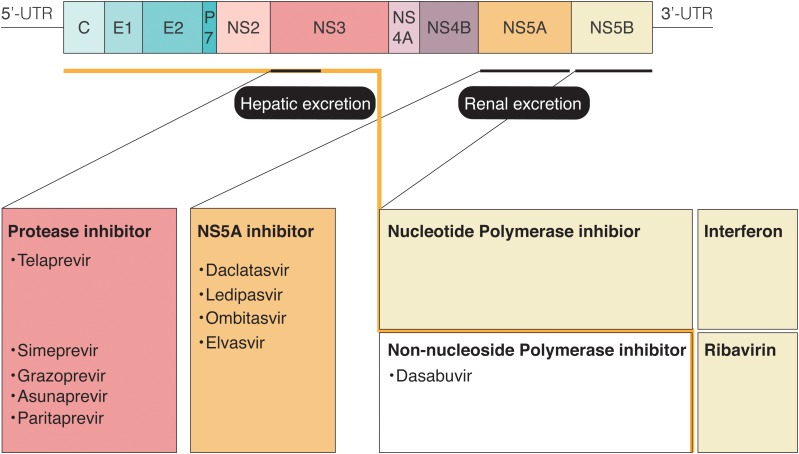
Prevalence of hepatitis C virus (HCV) infection is high in patients with end-stage renal dysfunction, including patients undergoing hemodialysis (HD). The HCV infection itself can cause glomerulonephritis and puts individuals at increased risk of developing end-stage renal disease; fortunately, successful HCV eradication sometimes restore HCV-related renal dysfunction. Moreover, the prognosis of dialysis patients infected with HCV is significantly worse and the renal allograft survival in HCV-infected patients is also worse than in dialysis patients without HCV infection. If life prognosis is favorable, therefore, anti-HCV therapy is strongly recommended for HCV-infected patients with severe renal dysfunction. The standard therapy for HCV-infected patients with severe renal dysfunction has historically been interferon-based therapy. However, this therapy remains ineffective in achieving high, sustained viral response rates and the rate of adverse events and treatment discontinuation due to treatment-induced adverse events continues to be high in patients with severe renal dysfunction. Safe and effective anti-HCV therapies are urgently needed, and crucial, for patients with severe renal dysfunction. Recently, direct-acting antivirals (DAAs) that specifically target viral proteins have been developed, and these targets include the NS3, NS5A, and NS5B of HCV. Clinical trials have revealed high efficacy and safety of the DAA-based therapies, but patients with severe renal dysfunction were not included in the majority of these trials. However, several recent reports have shown high efficacy and safety for some regimens of DAA combination therapy for HCV-infected patients with severe renal dysfunction. In this review, we discuss novel treatments for HCV-infected patients with severe renal dysfunction and the pharmacokinetics of these drugs.
丙型肝炎病毒(HCV)感染在终末期肾功能不全患者中很常见,包括接受血液透析(HD)的患者。HCV感染本身可导致肾小球肾炎,并使个体患终末期肾病的风险增加;幸运的是,成功根除HCV有时可恢复与HCV相关的肾功能不全。此外,感染HCV的透析患者的预后明显更差,且HCV感染患者的肾移植存活率也低于未感染HCV的透析患者。因此,如果生命预后良好,强烈建议对患有严重肾功能不全的HCV感染患者进行抗HCV治疗。对于患有严重肾功能不全的HCV感染患者,标准治疗方法一直是以干扰素为基础的治疗。然而,这种治疗在实现高持续病毒应答率方面仍然无效,并且在严重肾功能不全的患者中,由于治疗引起的不良事件导致的不良事件发生率和治疗中断率仍然很高。对于严重肾功能不全的患者,迫切需要安全有效的抗HCV治疗方法,这至关重要。最近,已经开发出了特异性靶向病毒蛋白的直接作用抗病毒药物(DAA),这些靶点包括HCV的NS3、NS5A和NS5B。临床试验已经揭示了基于DAA的治疗方法具有高疗效和安全性,但大多数这些试验中未纳入严重肾功能不全的患者。然而,最近的几份报告显示,某些DAA联合治疗方案对患有严重肾功能不全的HCV感染患者具有高疗效和安全性。在这篇综述中,我们讨论了针对患有严重肾功能不全的HCV感染患者的新治疗方法以及这些药物的药代动力学。