Bojesen Stig E, Timpson Nicholas, Relton Caroline, Davey Smith George, Nordestgaard Børge G
Department of Clinical Biochemistry, Herlev and Gentofte Hospital, Copenhagen University Hospital, Herlev, Denmark.
Faculty of Health and Medical Sciences, University of Copenhagen, Copenhagen, Denmark.
Thorax. 2017 Jul;72(7):646-653. doi: 10.1136/thoraxjnl-2016-208789. Epub 2017 Jan 18.
Self-reported smoking underestimates disease risk. Smoking affects DNA methylation, in particular the cg05575921 site in the aryl hydrocarbon receptor repressor ) gene. We tested the hypothesis that cg05575921 hypomethylation is associated with risk of smoking-related morbidity and mortality.
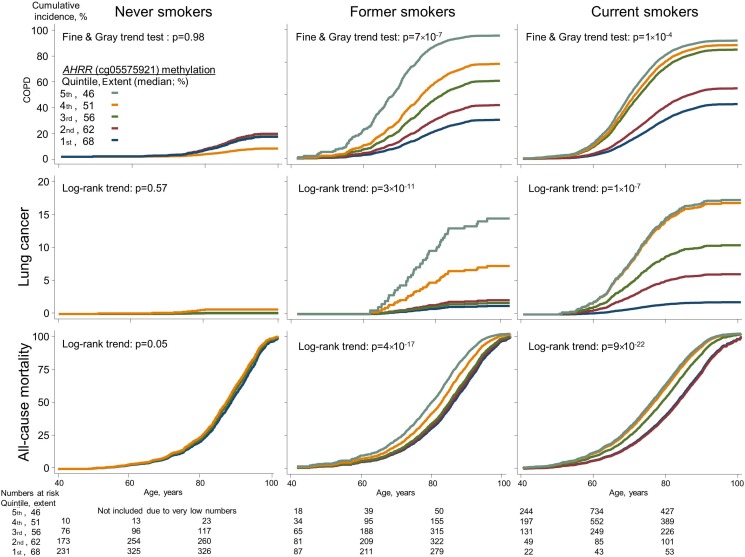
From the Copenhagen City Heart Study representing the Danish general population, we studied 9234 individuals. Using bisulphite treated leucocyte DNA, (cg05575921) methylation was measured. Rs1051730 () genotype was used to evaluate smoking heaviness. Participants were followed for up to 22 years for exacerbations of COPD, event of lung cancer and all-cause mortality. Six-year lung cancer risk was calculated according to the Prostate, Lung, Colorectal and Ovarian Cancer Screening Trial (PLCO).
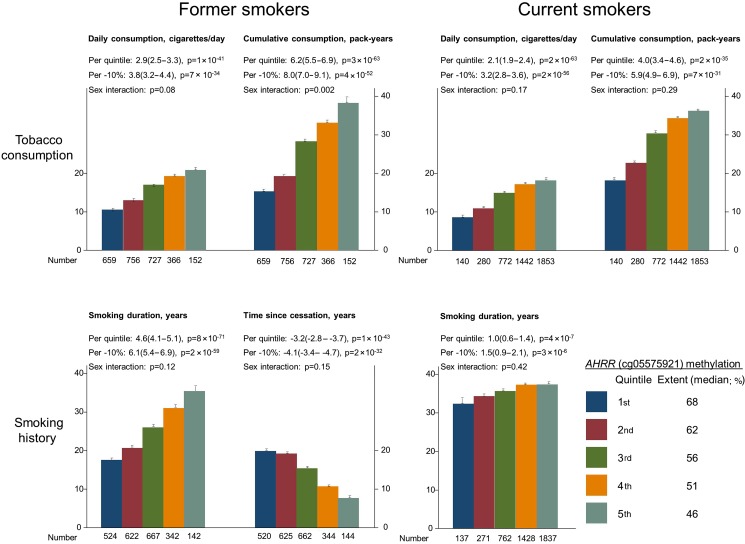
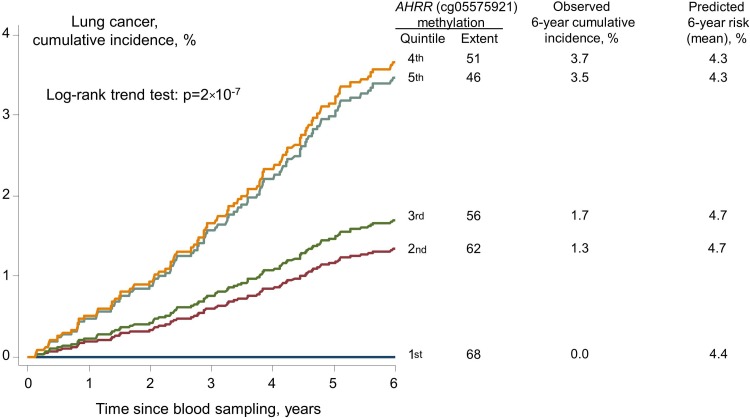
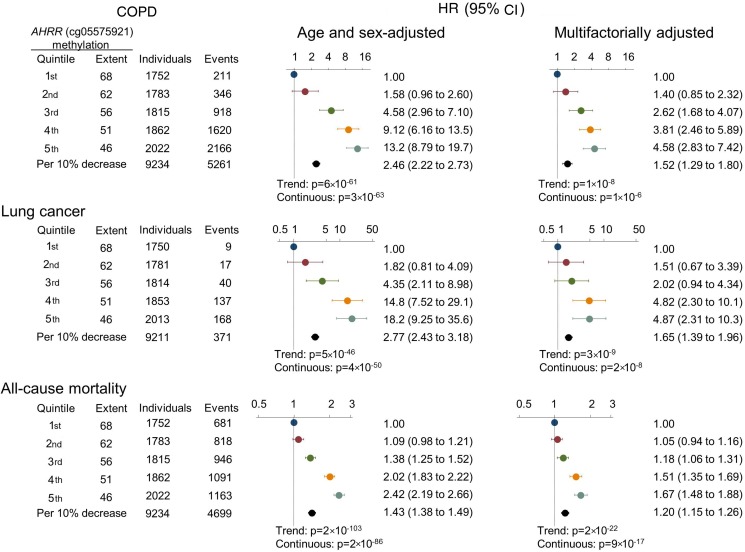
(cg05575921) hypomethylation was associated with former and current smoking status, high daily and cumulative smoking, short time since smoking cessation (all p values <7×10), and the smoking-related genotype (-0.48% per T-allele, p=0.002). The multifactorially adjusted HRs for the lowest versus highest methylation quintiles were 4.58 (95% CI 2.83 to 7.42) for COPD exacerbations, 4.87 (2.31 to 10.3) for lung cancer and 1.67 (1.48 to 1.88) for all-cause mortality. Finally, among 2576 high-risk smokers eligible for lung cancer screening by CT, observed cumulative incidences of lung cancer after 6 years for individuals in the lowest and highest methylation quintiles were 3.7% and 0.0% (p=2×10), whereas predicted PLCO 6-year risks were similar (4.3% and 4.4%, p=0.77).
(cg05575921) hypomethylation, a marker of smoking behaviour, provides potentially clinical relevant predictions of future smoking-related morbidity and mortality.
自我报告的吸烟情况会低估疾病风险。吸烟会影响DNA甲基化,尤其是芳烃受体阻遏物(AHRR)基因中的cg05575921位点。我们检验了cg05575921低甲基化与吸烟相关发病和死亡风险相关的假设。
从代表丹麦普通人群的哥本哈根城市心脏研究中,我们研究了9234名个体。使用亚硫酸氢盐处理的白细胞DNA测量(cg05575921)甲基化。Rs1051730(AHRR)基因型用于评估吸烟量。对参与者进行长达22年的随访,观察慢性阻塞性肺疾病(COPD)加重、肺癌事件和全因死亡率。根据前列腺、肺癌、结直肠癌和卵巢癌筛查试验(PLCO)计算6年肺癌风险。
(cg05575921)低甲基化与既往和当前吸烟状态、每日高吸烟量和累积吸烟量、戒烟后短时间相关(所有p值<7×10),以及与吸烟相关的AHRR基因型相关(每T等位基因-0.48%,p = 0.002)。对于COPD加重,最低与最高甲基化五分位数的多因素调整风险比(HR)为4.58(95%置信区间[CI]2.83至7.42),肺癌为4.87(2.31至10.3),全因死亡率为1.67(1.48至1.88)。最后,在2576名符合CT肺癌筛查条件的高危吸烟者中,最低和最高甲基化五分位数个体6年后观察到的肺癌累积发病率分别为3.7%和0.0%(p = 2×10),而预测的PLCO 6年风险相似(4.3%和4.4%,p = 0.77)。
(cg05575921)低甲基化作为吸烟行为的一个标志物,可为未来吸烟相关的发病和死亡提供潜在的临床相关预测。