Kasturirangan Srinath, Rainey G Jonah, Xu Linda, Wang Xinwei, Portnoff Alyse, Chen Tracy, Fazenbaker Christine, Zhong Helen, Bee Jared, Zeng Zhutian, Jenne Craig, Wu Herren, Gao Changshou
From the Departments of Antibody Discovery and Protein Engineering.
Oncology, and.
J Biol Chem. 2017 Mar 10;292(10):4361-4370. doi: 10.1074/jbc.M116.770628. Epub 2017 Jan 18.
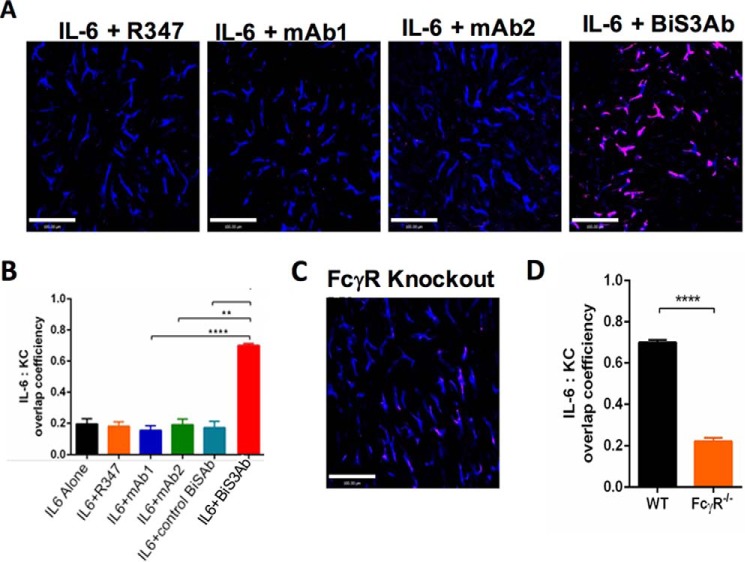
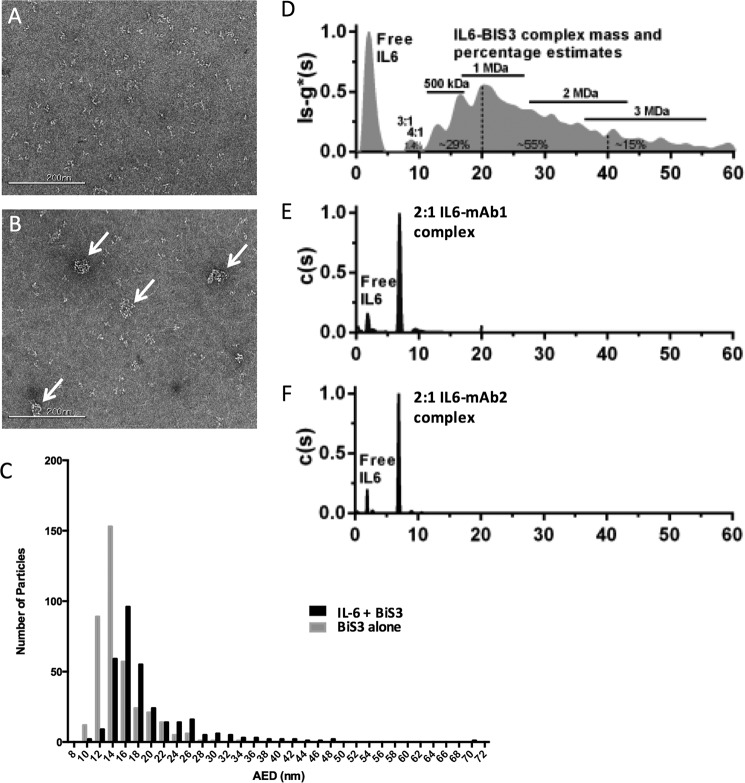
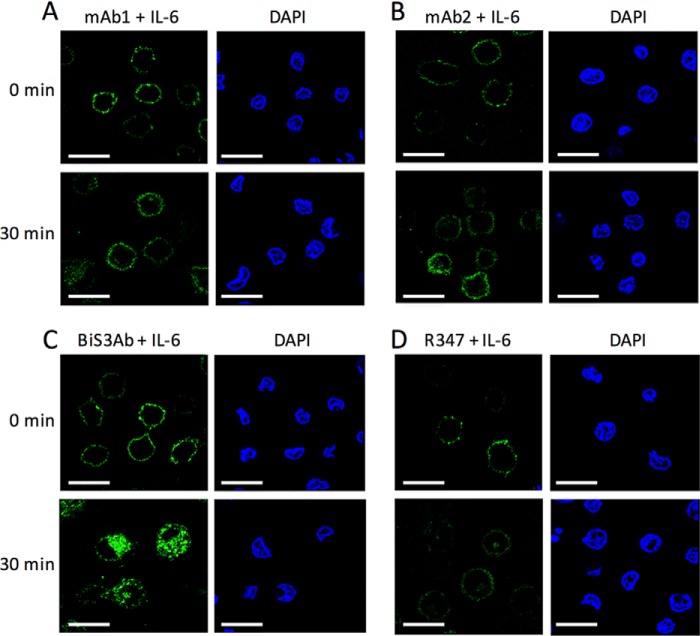
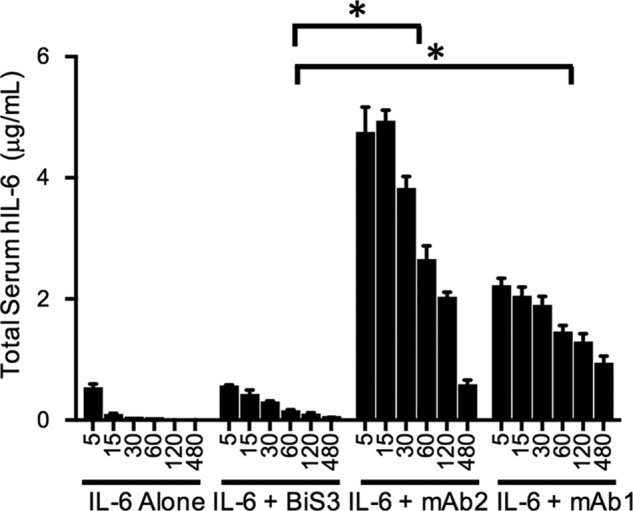
Soluble ligands have commonly been targeted by antibody therapeutics for cancers and other diseases. Although monoclonal antibodies targeting such ligands can block their interactions with their cognate receptors, they can also significantly increase the half-life of their ligands by FcRn-mediated antibody recycling, thereby evading ligand renal clearance and requiring increasingly high antibody doses to neutralize the increasing pool of target. To overcome this issue, we generated a bispecific/biparatopic antibody (BiSAb) that targets two different epitopes on IL-6 to block IL-6-mediated signaling. The BiSAb formed large immune complexes with IL-6 that can bind Fcγ receptors on phagocytic cells and are rapidly internalized. In addition, rapid clearance of the BiSAb·IL-6 complex was observed in mice while the parental antibodies prolonged the serum half-life of IL-6. Intravital imaging of the liver in mice confirmed that the rapid clearance of these large immune complexes was associated with Fcγ receptor-dependent binding to Kupffer cells in the liver. The approach described here provides a general strategy for therapeutic antibodies with the ability to not only neutralize but also actively drive clearance of their soluble antigens.
可溶性配体通常是癌症和其他疾病抗体疗法的作用靶点。尽管靶向此类配体的单克隆抗体可阻断其与同源受体的相互作用,但它们也可通过FcRn介导的抗体再循环显著延长其配体的半衰期,从而逃避配体的肾脏清除,并且需要越来越高的抗体剂量来中和不断增加的靶标池。为克服这一问题,我们制备了一种双特异性/双表位抗体(BiSAb),该抗体靶向IL-6上的两个不同表位以阻断IL-6介导的信号传导。BiSAb与IL-6形成大的免疫复合物,该复合物可结合吞噬细胞上的Fcγ受体并迅速被内化。此外,在小鼠中观察到BiSAb·IL-6复合物的快速清除,而亲本抗体则延长了IL-6的血清半衰期。对小鼠肝脏进行的活体成像证实,这些大免疫复合物的快速清除与Fcγ受体依赖性结合肝脏中的库普弗细胞有关。本文所述方法为治疗性抗体提供了一种通用策略,该抗体不仅具有中和能力,还具有主动促使其可溶性抗原清除的能力。