Ling Lin, Gu Shaohua, Cheng Yan
Department of Cardiology, The First Affiliated Hospital of Soochow University, Suzhou, Jiangsu 215006, P.R. China.
Department of Nephrology, The Third People's Hospital of Kunshan, Kunshan, Jiangsu 215300, P.R. China.
Mol Med Rep. 2017 Feb;15(2):567-572. doi: 10.3892/mmr.2016.6098. Epub 2016 Dec 30.
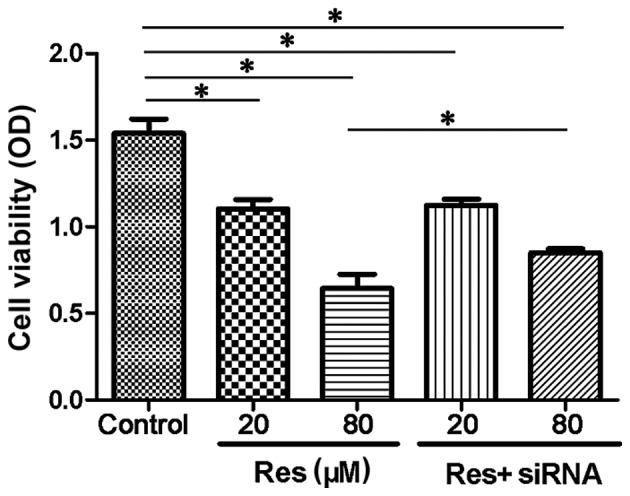
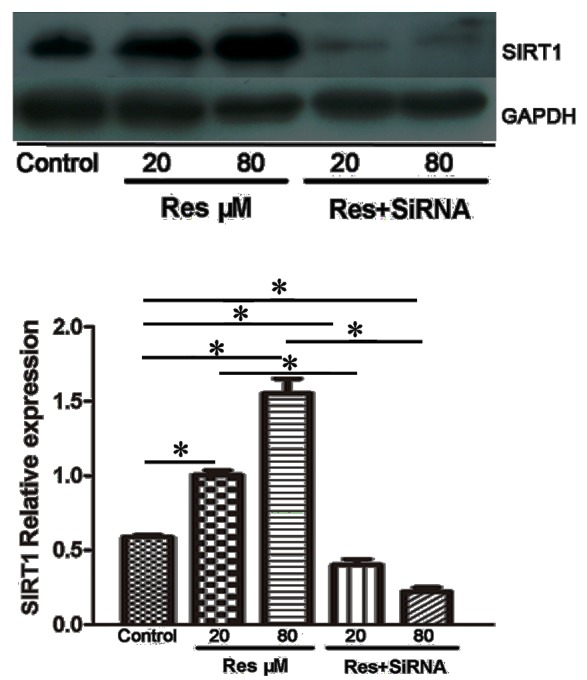
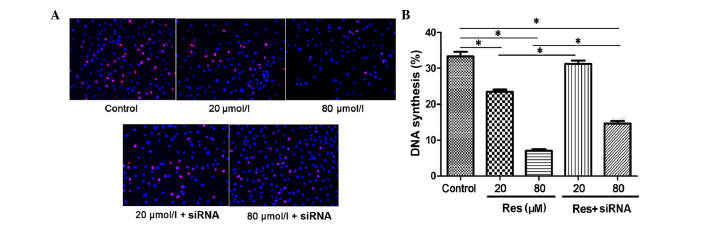
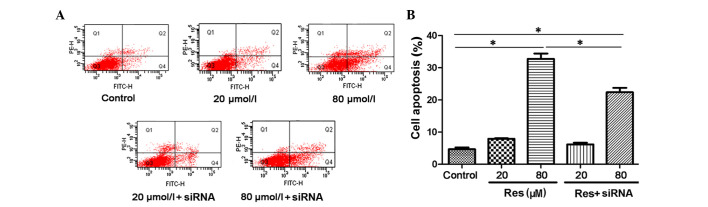
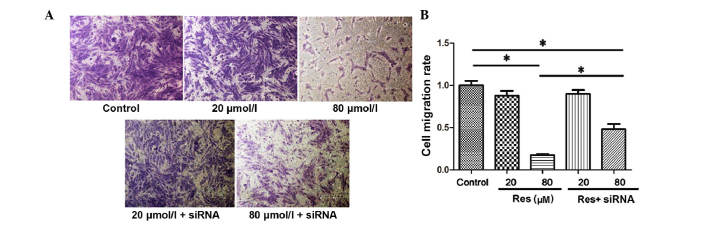
Atherosclerosis is one of the most important causes of cardiovascular disease and studies have showed that adventitial fibroblasts, which are considered to be the most common cell type of the vascular adventitia, are involved in the development of early atherosclerotic plaques. Resveratrol is a plant polyphenolic compound confirmed to have anti‑atherosclerotic and cardioprotective effects. The aim of the present study was to investigate the effects of resveratrol on adventitial fibroblasts in vitro and to clarify the underlying mechanism. Adventitial fibroblasts were isolated from the thoracic aorta of 8‑week‑old SPF Sprague‑Dawley rats. Following pre‑treatment with different concentrations of resveratrol, cell viability, DNA synthesis ability, cell apoptosis and cell migration ability were assessed in vitro. Through transfection with small interfering (si)RNA targeting sirtuin 1 (SIRT1), the role of the SIRT1 pathway in these processes was evaluated. Western blot analysis was used to assess the protein expression of SIRT1. It was demonstrated that resveratrol inhibited the cell viability, DNA synthesis and migratory ability of the adventitial fibroblasts, and induced cell apoptosis in a concentration‑dependent manner in vitro. These effects were partly through the SIRT1 pathways. siRNA targeting SIRT1 successfully reversed the antiproliferative, antimigratory and pro‑apoptotic effects of resveratrol on adventitial fibroblasts. In conclusion, the data showed that resveratrol inhibited cell viability, DNA synthesis and cell migration, and induced cell apoptosis in the rat adventitial fibroblasts in vitro through the SIRT1 signaling pathway. As the activation and migration of adventitial fibroblasts contributes to the early development of atherosclerosis, this may be a mechanism underlying the anti‑atherosclerotic effect of resveratrol.
动脉粥样硬化是心血管疾病最重要的病因之一,研究表明,外膜成纤维细胞被认为是血管外膜最常见的细胞类型,参与早期动脉粥样硬化斑块的形成。白藜芦醇是一种植物多酚化合物,已证实具有抗动脉粥样硬化和心脏保护作用。本研究的目的是探讨白藜芦醇对体外培养的外膜成纤维细胞的影响,并阐明其潜在机制。从8周龄SPF级Sprague-Dawley大鼠的胸主动脉中分离外膜成纤维细胞。用不同浓度的白藜芦醇预处理后,体外评估细胞活力、DNA合成能力、细胞凋亡和细胞迁移能力。通过转染靶向沉默调节蛋白1(SIRT1)的小干扰(si)RNA,评估SIRT1通路在这些过程中的作用。采用蛋白质印迹分析评估SIRT1的蛋白表达。结果表明,白藜芦醇在体外以浓度依赖的方式抑制外膜成纤维细胞的活力、DNA合成和迁移能力,并诱导细胞凋亡。这些作用部分是通过SIRT1通路实现的。靶向SIRT1的siRNA成功逆转了白藜芦醇对外膜成纤维细胞的抗增殖、抗迁移和促凋亡作用。总之,数据表明白藜芦醇在体外通过SIRT1信号通路抑制大鼠外膜成纤维细胞的活力、DNA合成和细胞迁移,并诱导细胞凋亡。由于外膜成纤维细胞的激活和迁移有助于动脉粥样硬化的早期发展,这可能是白藜芦醇抗动脉粥样硬化作用的潜在机制。