Platre Matthieu Pierre, Jaillais Yvon
a Laboratoire Reproduction et Développement des Plantes , Univ Lyon, ENS de Lyon, Université Claude Bernard Lyon 1, CNRS, INRA , Lyon , France.
Plant Signal Behav. 2017 Feb;12(2):e1282022. doi: 10.1080/15592324.2017.1282022.
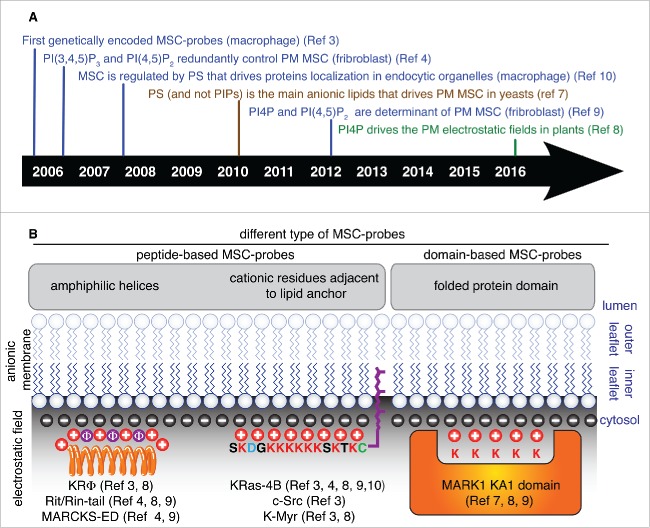
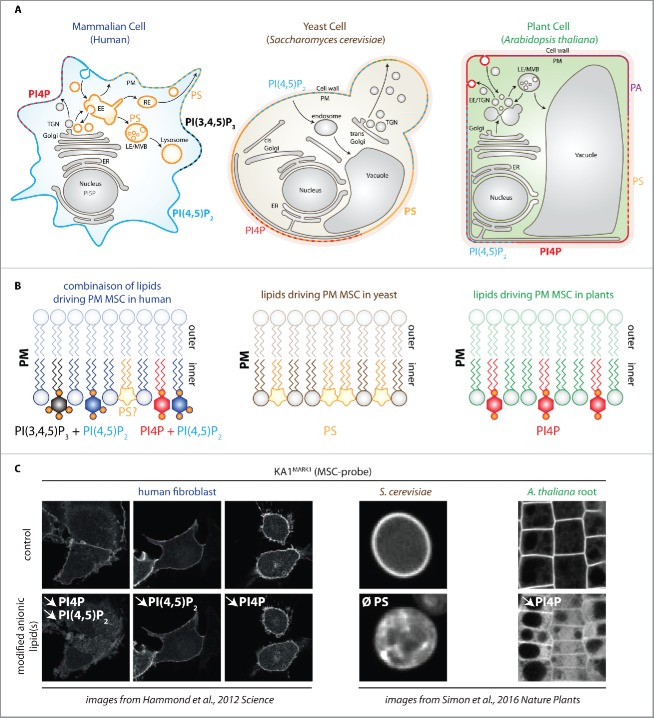
A wide range of signaling processes occurs at the cell surface through the reversible association of proteins from the cytosol to the plasma membrane. Some low abundant lipids are enriched at the membrane of specific compartments and thereby contribute to the identity of cell organelles by acting as biochemical landmarks. Lipids also influence membrane biophysical properties, which emerge as an important feature in specifying cellular territories. Such parameters are crucial for signal transduction and include lipid packing, membrane curvature and electrostatics. In particular, membrane electrostatics specifies the identity of the plasma membrane inner leaflet. Membrane surface charges are carried by anionic phospholipids, however the exact nature of the lipid(s) that powers the plasma membrane electrostatic field varies among eukaryotes and has been hotly debated during the last decade. Herein, we discuss the role of anionic lipids in setting up plasma membrane electrostatics and we compare similarities and differences that were found in different eukaryotic cells.
多种信号传导过程通过胞质溶胶中的蛋白质与质膜的可逆结合在细胞表面发生。一些低丰度脂质在特定区室的膜上富集,从而通过作为生化标记物来有助于细胞器的识别。脂质还影响膜的生物物理性质,这在确定细胞区域时成为一个重要特征。这些参数对于信号转导至关重要,包括脂质堆积、膜曲率和静电作用。特别是,膜静电作用确定了质膜内小叶的特征。膜表面电荷由阴离子磷脂携带,然而,驱动质膜静电场的脂质的确切性质在真核生物中各不相同,并且在过去十年中一直是激烈争论的话题。在此,我们讨论阴离子脂质在建立质膜静电作用中的作用,并比较在不同真核细胞中发现的异同。