Alfaqawi F, Lip P L, Elsherbiny S, Chavan R, Mitra A, Mushtaq B
Department of Ophthalmology, Birmingham and Midland Eye Centre, City Hospital, Birmingham, West Midlands, UK.
Eye (Lond). 2017 Apr;31(4):650-656. doi: 10.1038/eye.2016.301. Epub 2017 Jan 20.
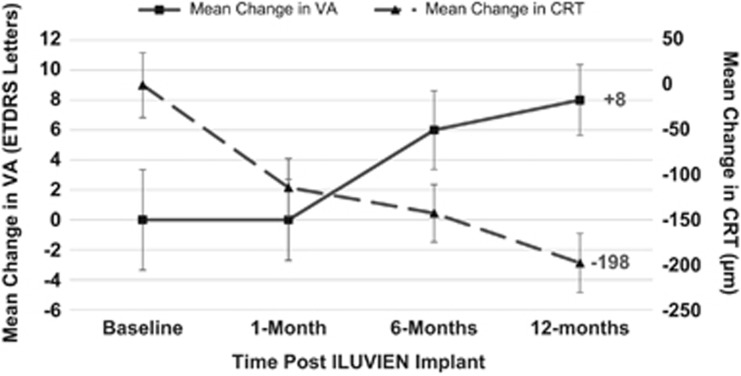
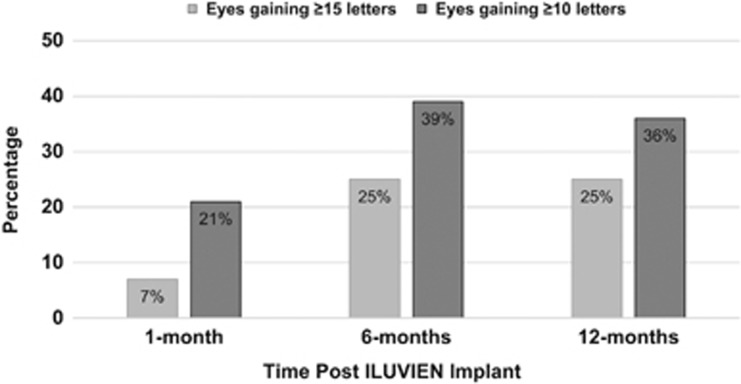
PurposeTo report the 12-months visual and anatomical outcomes of chronic diabetic macular oedema (DMO) treated with ILUVIEN in a real-world clinical practice in a single tertiary referral centre.MethodRetrospective data collection and analysis of consecutive 28 eyes of 23 diabetic patients received ILUVIEN implant for refractory DMO. Standard assessment included visual acuity (VA), central retinal thickness (CRT), slit-lamp biomicroscopy, and Goldmann tonometry for intraocular pressure (IOP) at 1, 6, and 12 months.ResultsBaseline mean VA was 47 (SD 18) letters improved to 55 (SD 17) letters (P=0.004) at 12 months. VA was improved in 16 eyes (57%), stabilised in 9 eyes (32%), and decreased in 3 eyes (11%). Seven eyes (25%) gained ≥15 letters, and 10 eyes (36%) gained >10 letters from baseline. The percentage of eyes achieved driving vision (≥70 Early Treatment Diabetic Retinopathy Study letters) was doubled from baseline 18 to 36% at 6 months and 32% at 12 months. Mean CRT decreased by 198 μm from baseline 494 μm (SD 191) to 296 μm (SD 121) at 12 months (P<0.001). Two eyes received additional anti-vascular endothelial growth factor injections after 10 months.
Raised IOP in three eyes (11%) controlled with IOP-lowering drops, vitreous haemorrhage in one eye and one endophthalmitis (1 year vision improved to 6/24).ConclusionOur real-world results show that the visual and the anatomical improvements achieved by a single ILUVIEN implant injection were maintained up to 12 months with minimal adjunctive therapy. IOP monitoring remains essential in ILUVIEN patients, although our study shows a relatively low risk of IOP elevation post ILUVIEN injection, even in existing controlled ocular hypertension. Our results demonstrate that ILUVIEN is an effective long-term option in treating chronic refractory DMO.
目的
报告在一家三级转诊中心的实际临床实践中,使用ILUVIEN治疗慢性糖尿病性黄斑水肿(DMO)的12个月视觉和解剖学结果。
方法
回顾性收集并分析23例糖尿病患者连续28只接受ILUVIEN植入治疗难治性DMO的眼睛的数据。标准评估包括在1、6和12个月时的视力(VA)、中心视网膜厚度(CRT)、裂隙灯显微镜检查和Goldmann眼压计测量眼压(IOP)。
结果
基线平均视力为47(标准差18)字母,在12个月时提高到55(标准差17)字母(P = 0.004)。16只眼(57%)视力提高,9只眼(32%)稳定,3只眼(11%)下降。7只眼(25%)从基线提高了≥15个字母,10只眼(36%)从基线提高了>10个字母。达到驾驶视力(≥70早期治疗糖尿病性视网膜病变研究字母)的眼百分比从基线的18%在6个月时翻倍至36%,在12个月时为32%。平均CRT在12个月时从基线的494μm(标准差191)降至296μm(标准差121),下降了198μm(P < 0.001)。两只眼在10个月后接受了额外的抗血管内皮生长因子注射。
3只眼(11%)眼压升高,通过降眼压滴眼液控制,1只眼玻璃体积血,1只眼发生眼内炎(1年后视力提高到6/24)。
结论
我们的实际结果表明,单次ILUVIEN植入注射所实现的视觉和解剖学改善在长达12个月的时间里得以维持,辅助治疗极少。眼压监测在ILUVIEN治疗的患者中仍然至关重要,尽管我们的研究表明ILUVIEN注射后眼压升高的风险相对较低,即使在现有的控制良好的高眼压患者中也是如此。我们的结果表明,ILUVIEN是治疗慢性难治性DMO的一种有效的长期选择。