Duarte Cristiana, Matos Marcela, Stubbs R James, Gale Corinne, Morris Liam, Gouveia Jose Pinto, Gilbert Paul
Cognitive and Behavioural Centre for Research and Intervention, University of Coimbra, Rua do Colégio Novo, Apartado, Coimbra, Portugal.
College of Life and Natural Sciences, University of Derby, Derby, United Kingdom.
PLoS One. 2017 Jan 20;12(1):e0167571. doi: 10.1371/journal.pone.0167571. eCollection 2017.
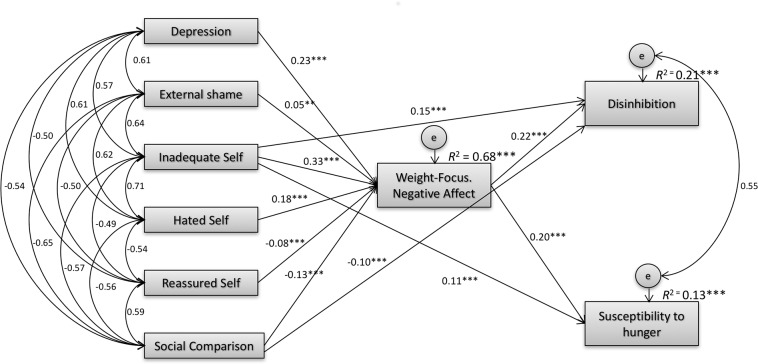
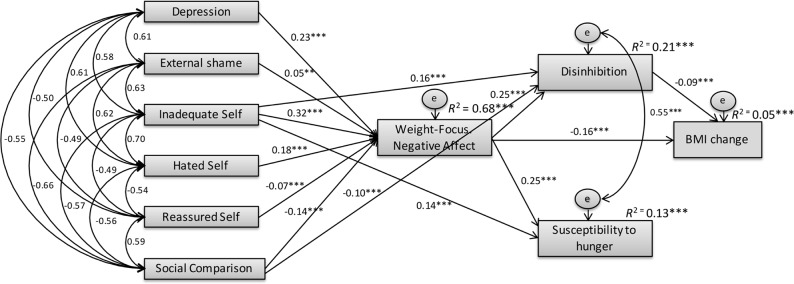
Recent research has suggested that obesity is a stigmatised condition. Concerns with personal inferiority (social rank), shame and self-criticism may impact on weight management behaviours. The current study examined associations between social comparison (shame, self-criticism), negative affect and eating behaviours in women attending a community based weight management programme focused on behaviour change. 2,236 participants of the programme completed an online survey using measures of shame, self-criticism, social comparison, and weight-related affect, which were adapted to specifically address eating behaviour, weight and body shape perceptions. Correlation analyses showed that shame, self-criticism and social comparison were associated with negative affect. All of these variables were related to eating regulation and weight control (p < 0.001). Path analysis revealed that the association of shame, hated-self, and low self-reassurance on disinhibition and susceptibility to hunger was fully mediated by weight-related negative affect, even when controlling for the effect of depressive symptoms (p < 0.050 to p < 0.010). In addition, feelings of inadequacy and unfavourable social comparisons were associated with higher disinhibition and susceptibility to hunger, partially mediated through weight-related negative affect (p = 0.001). These variables were negatively associated with extent of weight loss during programme attendance prior to the survey, while self-reassurance and positive social comparisons were positively associated with the extent of weight loss prior to the survey (p < .050). Shame, self-criticism, and perceptions of inferiority may play a significant role in self-regulation of eating behaviour in overweight people trying to manage their weight.
近期研究表明,肥胖是一种受污名化的状况。对个人自卑感(社会地位)、羞耻感和自我批评的担忧可能会影响体重管理行为。本研究调查了参加以行为改变为重点的社区体重管理项目的女性中,社会比较(羞耻感、自我批评)、消极情绪与饮食行为之间的关联。该项目的2236名参与者完成了一项在线调查,使用了羞耻感、自我批评、社会比较以及与体重相关情绪的测量方法,这些测量方法经过调整以专门针对饮食行为、体重和体型认知。相关性分析表明,羞耻感、自我批评和社会比较与消极情绪相关。所有这些变量都与饮食调节和体重控制有关(p < 0.001)。路径分析显示,羞耻感、自我厌恶和低自我肯定对去抑制和饥饿易感性的关联完全由与体重相关的消极情绪介导,即使在控制抑郁症状的影响时也是如此(p < 0.050至p < 0.010)。此外,不足感和不利的社会比较与更高的去抑制和饥饿易感性相关,部分通过与体重相关的消极情绪介导(p = 0.001)。这些变量与调查前参加项目期间的体重减轻程度呈负相关,而自我肯定和积极的社会比较与调查前的体重减轻程度呈正相关(p < 0.050)。羞耻感、自我批评和自卑感可能在试图控制体重的超重人群的饮食行为自我调节中起重要作用。