Górka-Kostrubiec Beata, Szczepaniak-Wnuk Iga
Institute of Geophysics, Polish Academy of Sciences, Ks. Janusza 64, 01-452 Warsaw, Poland.
Air Qual Atmos Health. 2017;10(1):105-116. doi: 10.1007/s11869-016-0412-5. Epub 2016 Jun 9.
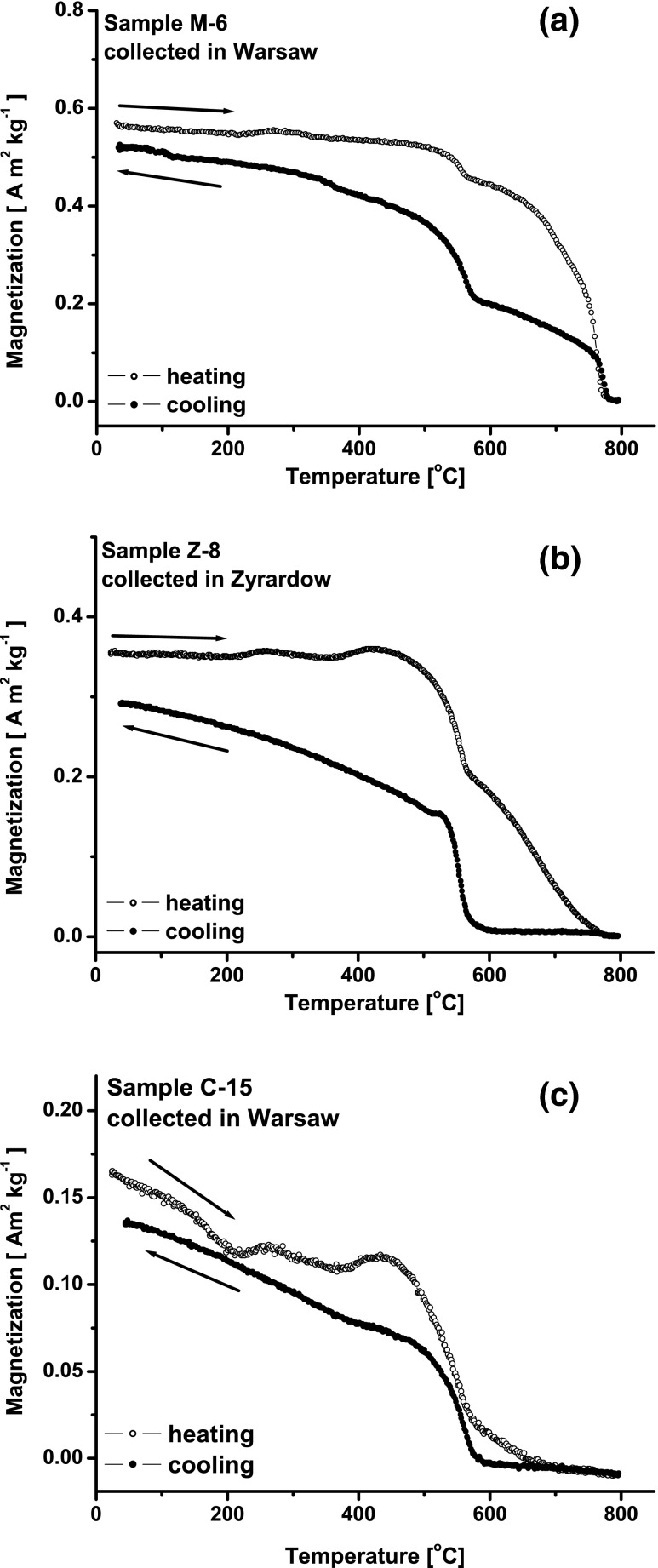
Magnetite in mixture with metallic iron in indoor dust samples was examined using several magnetic analyses, thermomagnetic curves of the magnetic susceptibility and the induced magnetization vs. temperature, hysteresis loops, and first-order reversal curves. The study of the magnetic properties was supplemented by the analysis of chemical elements and electron microscopic observation. The metallic iron in the mixture affects the values of hysteresis parameters, decreasing coercivity () and increasing saturation magnetization (), and it is responsible for the magnetic enhancement of magnetic susceptibility. The thermomagnetic curves show several distinct features: the first Curie temperature of magnetite, the second one (∼764 °C) of iron, and the rapid decrease on the heating curves (between 600 and 750 °C) caused by the oxidation of iron to magnetite. Two magnetochemical processes appear during the thermal treatment of indoor dust: the oxidation of iron to magnetite and the neo-formation of magnetite as a result of chemical transformation of non-magnetic minerals. The shift of the hysteresis parameter ratios from the multi-domain (MD) region towards the single-domain (SD) region on the Day-Dunlop plot is controlled by the oxidation of iron in the thermally induced process and the grain size of the new formed magnetite. The magnetic properties of indoor dust are a potential indicator of indoor air pollution. Elemental iron plays an important role in the development of inflammation in humans via oxidative stress, so that the presence of metallic Fe in indoor dust can affect human health.
利用多种磁分析方法,即磁化率和感应磁化强度与温度的热磁曲线、磁滞回线以及一阶反转曲线,对室内灰尘样品中与金属铁混合的磁铁矿进行了检测。通过化学元素分析和电子显微镜观察对磁性特性研究进行了补充。混合物中的金属铁会影响磁滞参数值,降低矫顽力()并增加饱和磁化强度(),并且它是导致磁化率磁增强的原因。热磁曲线呈现出几个明显特征:磁铁矿的第一居里温度、铁的第二居里温度(约764°C)以及铁氧化成磁铁矿导致加热曲线(600至750°C之间)上的快速下降。在室内灰尘热处理过程中出现了两个磁化学过程:铁氧化成磁铁矿以及非磁性矿物化学转化导致磁铁矿的新形成。在Day-Dunlop图上,磁滞参数比从多畴(MD)区域向单畴(SD)区域的转变受热诱导过程中铁的氧化以及新形成磁铁矿的晶粒尺寸控制。室内灰尘的磁性特性是室内空气污染的一个潜在指标。元素铁通过氧化应激在人类炎症发展中起重要作用,因此室内灰尘中金属铁的存在会影响人类健康。