Hosgood Sarah A, Saeb-Parsy Kourosh, Wilson Colin, Callaghan Christopher, Collett Dave, Nicholson Michael L
Department of Surgery, University of Cambridge, Addenbrooke's Hospital, Cambridge, UK.
Freeman Hospital, Newcastle upon Tyne, UK.
BMJ Open. 2017 Jan 23;7(1):e012237. doi: 10.1136/bmjopen-2016-012237.
Ex vivo normothermic perfusion (EVNP) is a novel technique that reconditions the kidney and restores renal function prior to transplantation. Phase I data from a series of EVNP in extended criteria donor kidneys have established the safety and feasibility of the technique in clinical practice.
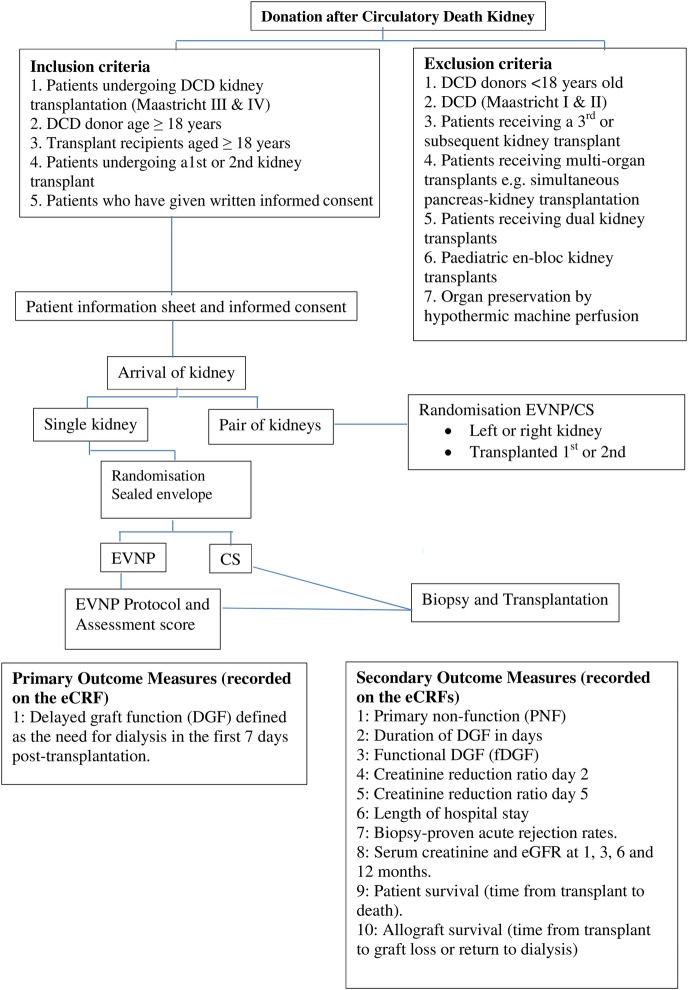
This is a UK-based phase II multicentre randomised controlled trial to assess the efficacy of EVNP compared with the conventional static cold storage technique in donation after circulatory death (DCD) kidney transplantation. 400 patients receiving a kidney from a DCD donor (categories III and IV, controlled) will be recruited into the study. On arrival at the transplant centre, kidneys will be randomised to receive either EVNP (n=200) or remain in static cold storage (n=200). Kidneys undergoing EVNP will be perfused with an oxygenated packed red cell solution at near body temperature for 60 min prior to transplantation. The primary outcome measure will be determined by rates of delayed graft function (DGF) defined as the need for dialysis in the first week post-transplant. Secondary outcome measures include incidences of primary non-function, the duration of DGF, functional DGF defined as <10% fall in serum creatinine for 3 consecutive days in the first week post-transplant, creatinine reduction ratio days 2 and 5, length of hospital stay, rates of biopsy-proven acute rejection, serum creatinine and estimated glomerular filtration rate at 1, 3, 6 and 12 months post-transplant and patient and allograft survival. The EVNP assessment score will be recorded and the level of fibrosis and inflammation will also be measured using tissue, blood and urine samples. Ethics and dissemination. The study has been approved by the National Health Service (NHS) Health Research Authority Research Ethics Committee. The results are expected to be published in 2020.
ISRCTN15821205; Pre-results.
体外常温灌注(EVNP)是一种新型技术,可在移植前对肾脏进行修复并恢复肾功能。一系列针对扩大标准供体肾脏的EVNP的I期数据已证实该技术在临床实践中的安全性和可行性。
这是一项基于英国的II期多中心随机对照试验,旨在评估与传统静态冷藏技术相比,EVNP在循环死亡后捐赠(DCD)肾移植中的疗效。将招募400名接受DCD供体(III类和IV类,受控)肾脏的患者进入研究。到达移植中心后,肾脏将被随机分配接受EVNP(n = 200)或继续进行静态冷藏(n = 200)。接受EVNP的肾脏将在移植前用接近体温的含氧红细胞悬液灌注60分钟。主要结局指标将由移植后第一周内需要透析定义的移植肾功能延迟(DGF)发生率来确定。次要结局指标包括原发性无功能的发生率、DGF的持续时间、功能性DGF(定义为移植后第一周内血清肌酐连续3天下降<10%)、第2天和第5天的肌酐降低率、住院时间、活检证实的急性排斥反应发生率、移植后1、3、6和12个月时的血清肌酐和估计肾小球滤过率以及患者和移植物存活率。将记录EVNP评估评分,并使用组织、血液和尿液样本测量纤维化和炎症水平。伦理与传播。该研究已获得英国国家医疗服务体系(NHS)健康研究管理局研究伦理委员会的批准。预计结果将于2020年发表。
ISRCTN15821205;预结果。