Devine Aisling P, McDonald Robbie A, Quaife Tristan, Maclean Ilya M D
Department of Biosciences, Wallace Building, Swansea University, Singleton Park, Swansea, SA2 8PP, UK.
Environment and Sustainability Institute, University of Exeter, Cornwall Campus, Penryn, TR10 9EZ, UK.
Oecologia. 2017 Apr;183(4):939-951. doi: 10.1007/s00442-017-3807-6. Epub 2017 Jan 23.
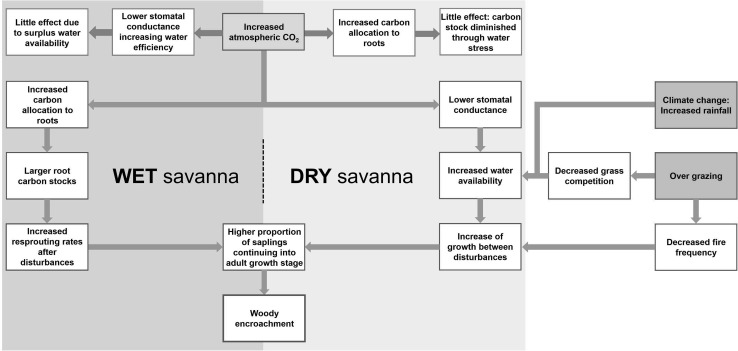
Savanna ecosystems are an integral part of the African landscape and sustain the livelihoods of millions of people. Woody encroachment in savannas is a widespread phenomenon but its causes are widely debated. We review the extensive literature on woody encroachment to help improve understanding of the possible causes and to highlight where and how future scientific efforts to fully understand these causes should be focused. Rainfall is the most important determinant of maximum woody cover across Africa, but fire and herbivory interact to reduce woody cover below the maximum at many locations. We postulate that woody encroachment is most likely driven by CO enrichment and propose a two-system conceptual framework, whereby mechanisms of woody encroachment differ depending on whether the savanna is a wet or dry system. In dry savannas, the increased water-use efficiency in plants relaxes precipitation-driven constraints and increases woody growth. In wet savannas, the increase of carbon allocation to tree roots results in faster recovery rates after disturbance and a greater likelihood of reaching sexual maturity. Our proposed framework can be tested using a mixture of experimental and earth observational techniques. At a local level, changes in precipitation, burning regimes or herbivory could be driving woody encroachment, but are unlikely to be the explanation of this continent-wide phenomenon.
稀树草原生态系统是非洲地貌的一个组成部分,维持着数百万人的生计。稀树草原的木本植物入侵是一种普遍现象,但其成因存在广泛争议。我们回顾了关于木本植物入侵的大量文献,以帮助增进对可能成因的理解,并突出未来为全面理解这些成因应重点开展科学研究的地点和方式。降雨是整个非洲木本植物最大覆盖范围的最重要决定因素,但火灾和食草作用相互影响,在许多地方将木本植物覆盖范围降低至最大值以下。我们推测木本植物入侵最有可能是由二氧化碳浓度升高驱动的,并提出了一个双系统概念框架,据此木本植物入侵的机制因稀树草原是湿润系统还是干旱系统而有所不同。在干旱稀树草原,植物水分利用效率的提高缓解了降水驱动的限制,增加了木本植物的生长。在湿润稀树草原,分配给树木根系的碳增加导致干扰后恢复速度加快,达到性成熟的可能性更大。我们提出的框架可以通过结合实验和地球观测技术进行检验。在局部层面,降水、燃烧模式或食草作用的变化可能正在推动木本植物入侵,但不太可能是这一全洲范围现象的解释。