Drew R S, Rice B, Rüütel K, Delpech V, Attawell K A, Hales D K, Velasco C, Amato-Gauci A J, Pharris A, Tavoschi L, Noori T
Independent Consultant, Stowmarket, UK.
HIV Measurement and Surveillance Methodology Consortium, London School of Hygiene and Tropical Medicine, London, UK.
HIV Med. 2017 Aug;18(7):490-499. doi: 10.1111/hiv.12480. Epub 2017 Jan 24.
The European Centre for Disease Prevention and Control (ECDC) supports countries to monitor progress in their response to the HIV epidemic. In line with these monitoring responsibilities, we assess how, and to what extent, the continuum of care is being measured across countries.
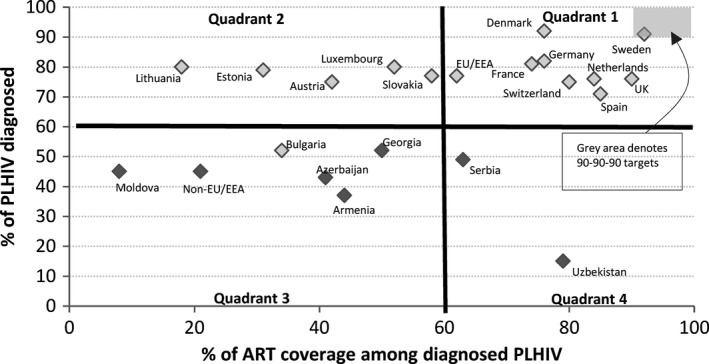
The ECDC sent out questionnaires to 55 countries in Europe and Central Asia in 2014. Nominated country representatives were questioned on how they defined and measured six elements of the continuum. We present our results using three previously described frameworks [breakpoints; Joint United Nations Programme on HIV/AIDS (UNAIDS) 90-90-90 targets; diagnosis and treatment quadrant].
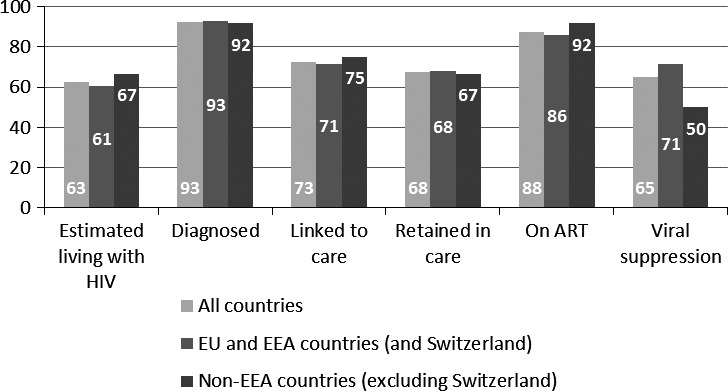
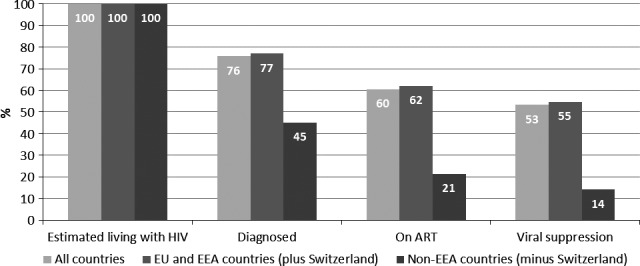
Forty countries provided data for at least one element of the continuum. Countries reported most frequently on the number of people diagnosed with HIV infection (37; 93%), and on the number in receipt of antiretroviral therapy (ART) (35; 88%). There was little consensus across countries in their approach to defining linkage to, and retention in, care. The most common breakpoint (>19% reduction between two adjacent elements) related to the estimated number of people living with HIV who were diagnosed (18 of 23; 78%).
We present continuum data from multiple countries that provide both a snapshot of care provision and a baseline against which changes over time in care provision across Europe and Central Asia may be measured. To better inform HIV testing and treatment programmes, standard data collection approaches and definitions across the HIV continuum of care are needed. If countries wish to ensure an unbroken HIV continuum of care, people living with HIV need to be diagnosed promptly, and ART needs to be offered to all those diagnosed.
欧洲疾病预防与控制中心(ECDC)支持各国监测其应对艾滋病毒疫情的进展情况。根据这些监测职责,我们评估各国在多大程度上以及如何对连续护理进行衡量。
2014年,ECDC向欧洲和中亚的55个国家发送了调查问卷。指定的国家代表被问及他们如何定义和衡量连续护理的六个要素。我们使用之前描述的三个框架(断点;联合国艾滋病规划署(UNAIDS)90-90-90目标;诊断和治疗象限)来呈现我们的结果。
40个国家提供了至少一个连续护理要素的数据。各国报告最多的是艾滋病毒感染诊断人数(37个国家;93%)以及接受抗逆转录病毒治疗(ART)的人数(35个国家;88%)。各国在定义与护理的联系及护理留存方面的方法几乎没有达成共识。最常见的断点(两个相邻要素之间减少>19%)与已诊断的艾滋病毒感染者估计人数有关(23个国家中的18个;78%)。
我们展示了多个国家的连续护理数据,这些数据既提供了护理提供情况的快照,也提供了一个基线,据此可以衡量欧洲和中亚地区护理提供情况随时间的变化。为了更好地为艾滋病毒检测和治疗计划提供信息,需要在艾滋病毒连续护理过程中采用标准的数据收集方法和定义。如果各国希望确保艾滋病毒连续护理不间断,就需要及时诊断艾滋病毒感染者,并为所有确诊者提供抗逆转录病毒治疗。