New York University School of Medicine, New York, New York.
University of Pittsburgh, Pittsburgh, Pennsylvania.
Arthritis Rheumatol. 2017 Jun;69(6):1176-1186. doi: 10.1002/art.40053. Epub 2017 May 3.
In rheumatoid arthritis (RA), autoreactive B cells are pathogenic drivers and sources of anti-citrullinated protein antibodies (ACPAs) that are a diagnostic biomarker and predictor of worse long-term prognosis. Yet, the immunobiologic significance of persistent ACPA production at the cellular level is poorly understood. This study was undertaken to investigate the representation of ACPA-expressing switched-memory B cells in RA.
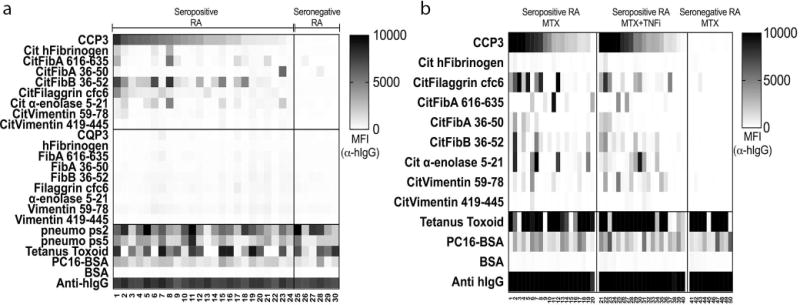
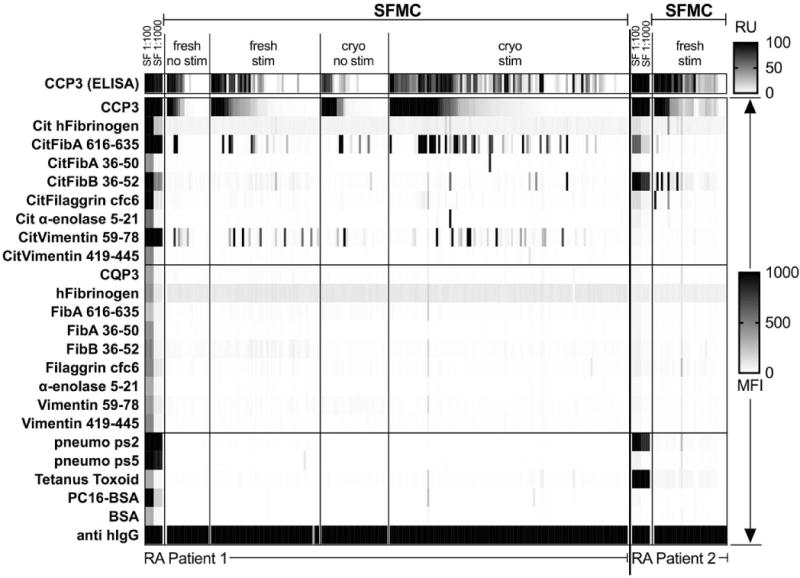
In a cross-sectional study of RA patients, we investigated the presence of continued defects in immune homeostasis as a function of disease activity. Using an enzyme-linked immunosorbent assay (ELISA) and a sensitive multiplex bead-based immunoassay, we characterized fine binding antibody specificities in sera, synovial fluid (SF), and B cell culture supernatants. In this manner, we determined the frequency and epitope reactivity patterns of ACPAs produced by SF B cells and switched-memory blood B cells and compared the latter to serum ACPA levels and disease activity scores.
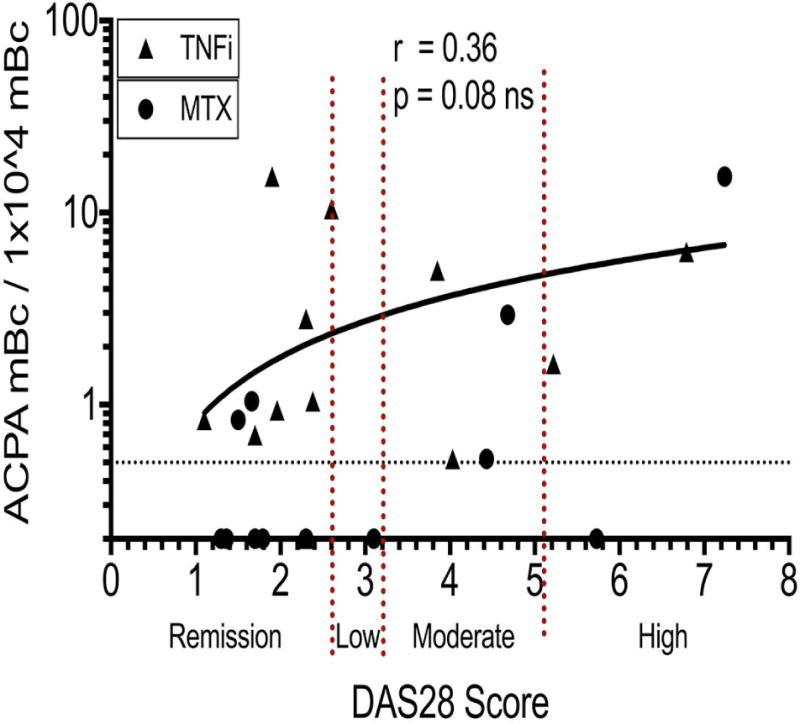
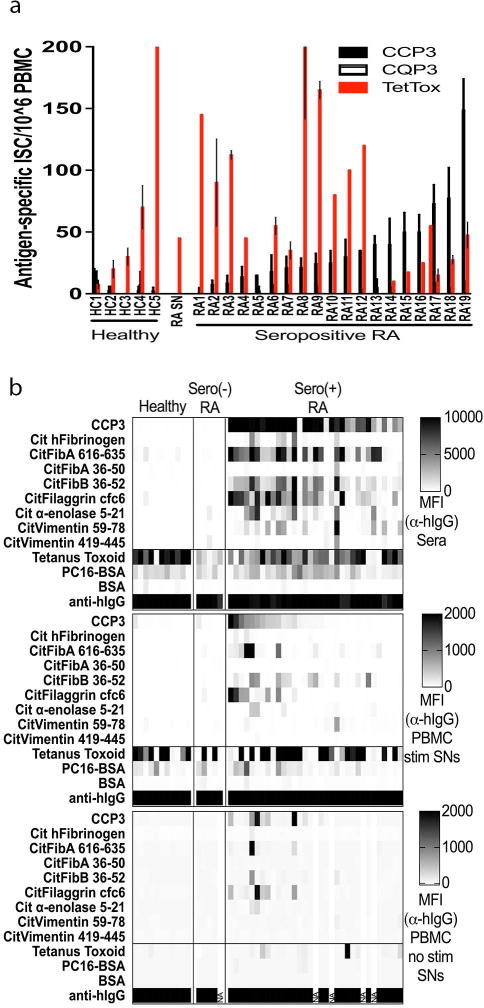
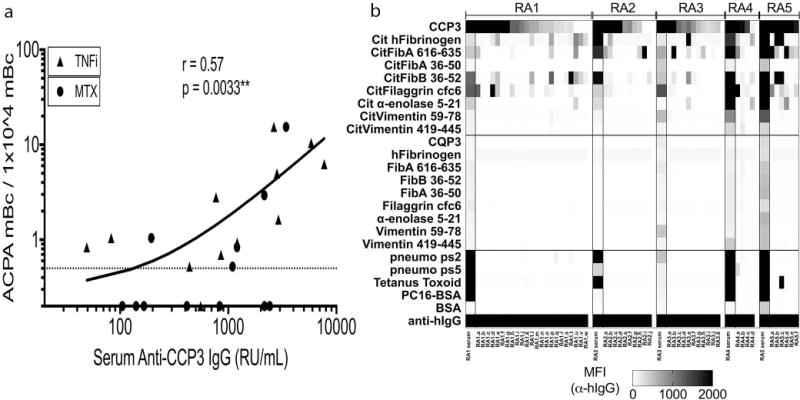
Cultured B cells from SF were shown to spontaneously secrete ACPAs, while constitutive IgG autoantibody production by peripheral blood mononuclear cells (PBMCs) was substantially less frequent. After in vitro stimulation, PBMCs secreted IgG ACPA that was overwhelmingly from switched-memory B cells, across all patient groups treated with methotrexate and/or a tumor necrosis factor inhibitor. Intriguingly, the frequencies of ACPA-expressing switched-memory B cells significantly correlated with serum IgG anti-cyclic citrullinated peptide 3 (r = 0.57, P = 0.003). Moreover, treatment-induced clinical remission had little or no effect on the circulating burden of switched-memory ACPA-expressing B cells, in part explaining the continued dysregulation of humoral immunity.
Our findings rationalize why therapeutic cessation most often results in disease reactivation and clinical flare. Hence, a clinical disease activity score is not a reliable indicator of the resolution of pathologic recirculating B cell autoimmunity.
在类风湿关节炎(RA)中,自身反应性 B 细胞是致病性驱动因素和抗瓜氨酸蛋白抗体(ACPA)的来源,ACPA 是一种诊断生物标志物和预后不良的预测因子。然而,在细胞水平上持续产生 ACPA 的免疫生物学意义仍知之甚少。本研究旨在探讨 RA 中表达 ACPA 的转换记忆 B 细胞的代表性。
在 RA 患者的横断面研究中,我们研究了疾病活动度作为功能的免疫稳态持续缺陷的存在。我们使用酶联免疫吸附试验(ELISA)和敏感的多重珠基免疫分析,对血清、滑液(SF)和 B 细胞培养上清液中的精细结合抗体特异性进行了表征。通过这种方式,我们确定了 SF B 细胞和转换记忆血液 B 细胞产生的 ACPA 的频率和表位反应模式,并将后者与血清 ACPA 水平和疾病活动评分进行了比较。
显示 SF 培养的 B 细胞可自发分泌 ACPA,而外周血单核细胞(PBMC)组成性 IgG 自身抗体产生的频率则明显较低。在体外刺激后,PBMC 分泌的 IgG ACPA 主要来自所有接受甲氨蝶呤和/或肿瘤坏死因子抑制剂治疗的患者群体中的转换记忆 B 细胞。有趣的是,表达 ACPA 的转换记忆 B 细胞的频率与血清 IgG 抗环瓜氨酸肽 3(r=0.57,P=0.003)显著相关。此外,治疗诱导的临床缓解对循环中转换记忆 ACPA 表达 B 细胞的负担几乎没有影响,这在一定程度上解释了体液免疫的持续失调。
我们的发现合理化了为什么治疗停止通常会导致疾病复发和临床发作。因此,临床疾病活动评分并不是病理循环 B 细胞自身免疫缓解的可靠指标。