Li Tong, Wang Ping, Wang Stephani C, Wang Yu-Feng
School of Basic Medical Sciences, Harbin Medical University , Harbin , China.
Department of Internal Medicine, Albany Medical Center , Albany, NY , USA.
Front Immunol. 2017 Jan 10;7:693. doi: 10.3389/fimmu.2016.00693. eCollection 2016.
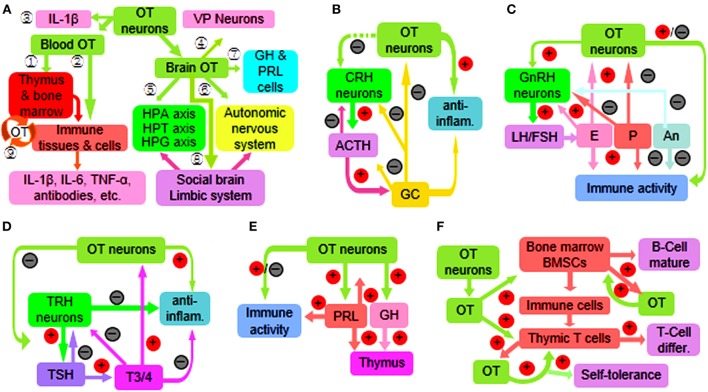
The hypothalamic neuroendocrine system is mainly composed of the neural structures regulating hormone secretion from the pituitary gland and has been considered as the higher regulatory center of the immune system. Recently, the hypothalamo-neurohypophysial system (HNS) emerged as an important component of neuroendocrine-immune network, wherein the oxytocin (OT)-secreting system (OSS) plays an essential role. The OSS, consisting of OT neurons in the supraoptic nucleus, paraventricular nucleus, their several accessory nuclei and associated structures, can integrate neural, endocrine, metabolic, and immune information and plays a pivotal role in the development and functions of the immune system. The OSS can promote the development of thymus and bone marrow, perform immune surveillance, strengthen immune defense, and maintain immune homeostasis. Correspondingly, OT can inhibit inflammation, exert antibiotic-like effect, promote wound healing and regeneration, and suppress stress-associated immune disorders. In this process, the OSS can release OT to act on immune system directly by activating OT receptors or through modulating activities of other hypothalamic-pituitary-immune axes and autonomic nervous system indirectly. However, our understandings of the role of the OSS in neuroendocrine regulation of immune system are largely incomplete, particularly its relationship with other hypothalamic-pituitary-immune axes and the vasopressin-secreting system that coexists with the OSS in the HNS. In addition, it remains unclear about the relationship between the OSS and peripherally produced OT in immune regulation, particularly intrathymic OT that is known to elicit central immunological self-tolerance of T-cells to hypophysial hormones. In this work, we provide a brief review of current knowledge of the features of OSS regulation of the immune system and of potential approaches that mediate OSS coordination of the activities of entire neuroendocrine-immune network.
下丘脑神经内分泌系统主要由调节垂体激素分泌的神经结构组成,一直被视为免疫系统的高级调节中心。最近,下丘脑 - 神经垂体系统(HNS)成为神经内分泌 - 免疫网络的重要组成部分,其中催产素(OT)分泌系统(OSS)发挥着至关重要的作用。OSS由视上核、室旁核中的OT神经元及其几个附属核以及相关结构组成,能够整合神经、内分泌、代谢和免疫信息,并在免疫系统的发育和功能中发挥关键作用。OSS可以促进胸腺和骨髓的发育,进行免疫监视,增强免疫防御,并维持免疫稳态。相应地,OT可以抑制炎症,发挥类抗生素作用,促进伤口愈合和再生,并抑制与应激相关的免疫紊乱。在这个过程中,OSS可以通过激活OT受体直接释放OT作用于免疫系统,或者通过间接调节其他下丘脑 - 垂体 - 免疫轴和自主神经系统的活动来实现。然而,我们对OSS在免疫系统神经内分泌调节中的作用的理解在很大程度上并不完整,特别是它与其他下丘脑 - 垂体 - 免疫轴以及与OSS在HNS中共存的加压素分泌系统的关系。此外,OSS与免疫调节中外周产生的OT之间的关系仍不清楚,特别是胸腺内OT,已知它能引发T细胞对垂体激素的中枢免疫自我耐受。在这项工作中,我们简要综述了当前关于OSS调节免疫系统的特征以及介导OSS协调整个神经内分泌 - 免疫网络活动的潜在途径的知识。