Thierry Eloïse, Deprez Eric, Delelis Olivier
Laboratoire de Biologie et Pharmacologie Appliquée, CNRS UMR8113, Ecole Normale Supérieure de Cachan, Université Paris-Saclay Cachan, France.
Front Microbiol. 2017 Jan 11;7:2165. doi: 10.3389/fmicb.2016.02165. eCollection 2016.
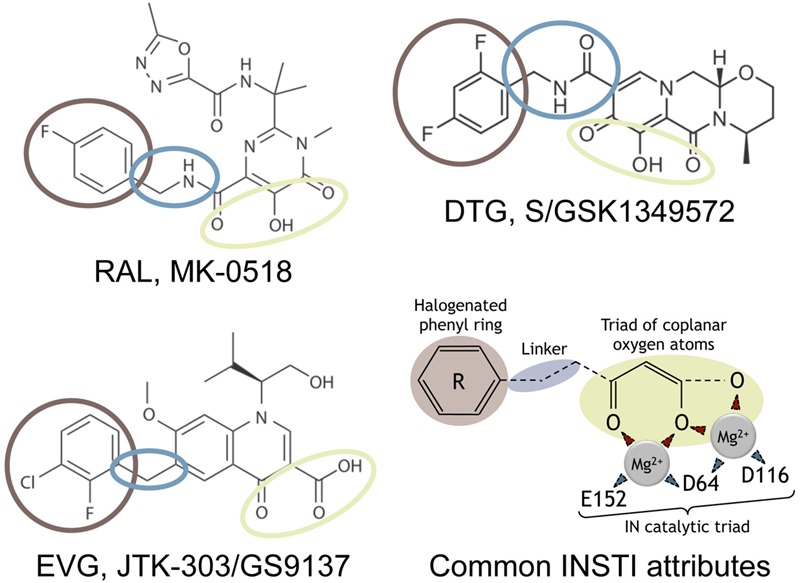
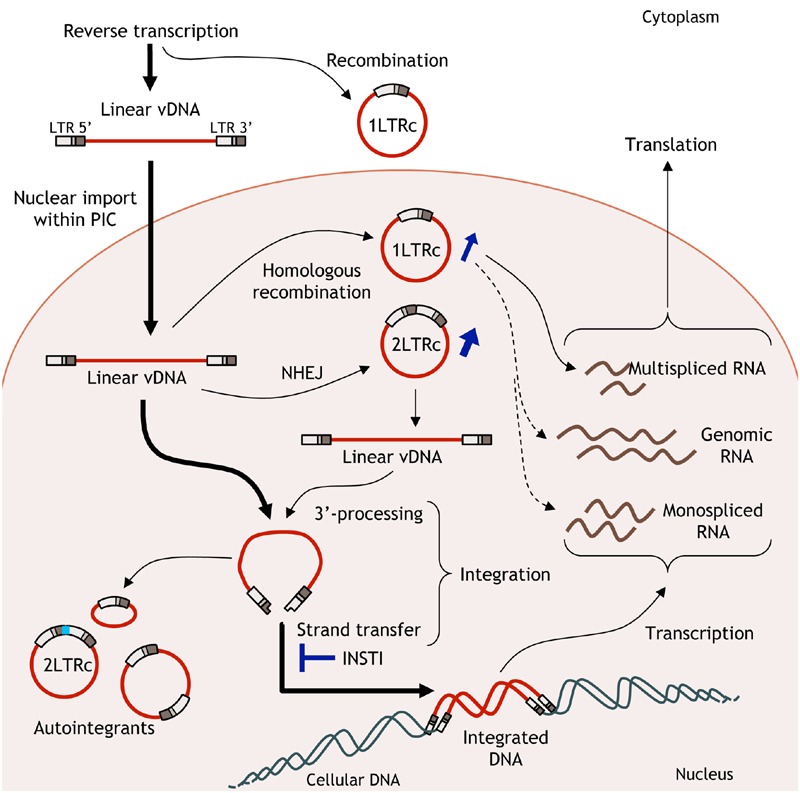
Integrase strand-transfer inhibitors (INSTIs), such as raltegravir (RAL), elvitegravir, or dolutegravir (DTG), are efficient antiretroviral agents used in HIV treatment in order to inhibit retroviral integration. By contrast to RAL treatments leading to well-identified mutation resistance pathways at the integrase level, recent clinical studies report several cases of patients failing DTG treatment without clearly identified resistance mutation in the integrase gene raising questions for the mechanism behind the resistance. These compounds, by impairing the integration of HIV-1 viral DNA into the host DNA, lead to an accumulation of unintegrated circular viral DNA forms. This viral DNA could be at the origin of the INSTI resistance by two different ways. The first one, sustained by a recent report, involves 2-long terminal repeat circles integration and the second one involves expression of accumulated unintegrated viral DNA leading to a basal production of viral particles maintaining the viral information.
整合酶链转移抑制剂(INSTIs),如拉替拉韦(RAL)、埃替格韦或多替拉韦(DTG),是用于治疗HIV的有效抗逆转录病毒药物,以抑制逆转录病毒整合。与导致整合酶水平明确的耐药突变途径的RAL治疗不同,最近的临床研究报告了几例患者在接受DTG治疗时失败,而整合酶基因中未明确鉴定出耐药突变,这引发了对耐药机制的质疑。这些化合物通过损害HIV-1病毒DNA整合到宿主DNA中,导致未整合的环状病毒DNA形式积累。这种病毒DNA可能通过两种不同方式成为INSTI耐药的根源。第一种方式,由最近的一份报告支持,涉及2-长末端重复序列环的整合,第二种方式涉及积累的未整合病毒DNA的表达,导致维持病毒信息的病毒颗粒基础产生。