Ogbomo Henry, Mody Christopher H
The Calvin, Phoebe and Joan Snyder Institute for Chronic Diseases, University of Calgary, Calgary, AB, Canada; Department of Microbiology, Immunology and Infectious Diseases, University of Calgary, Calgary, AB, Canada; Department of Physiology and Pharmacology, University of Calgary, Calgary, AB, Canada.
The Calvin, Phoebe and Joan Snyder Institute for Chronic Diseases, University of Calgary, Calgary, AB, Canada; Department of Microbiology, Immunology and Infectious Diseases, University of Calgary, Calgary, AB, Canada; Department of Internal Medicine, University of Calgary, Calgary, AB, Canada.
Front Immunol. 2017 Jan 11;7:692. doi: 10.3389/fimmu.2016.00692. eCollection 2016.
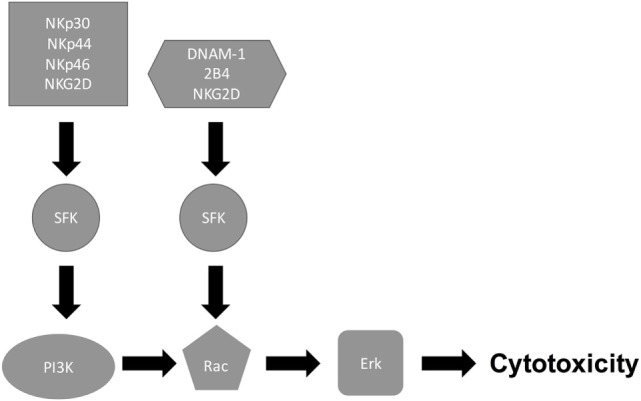
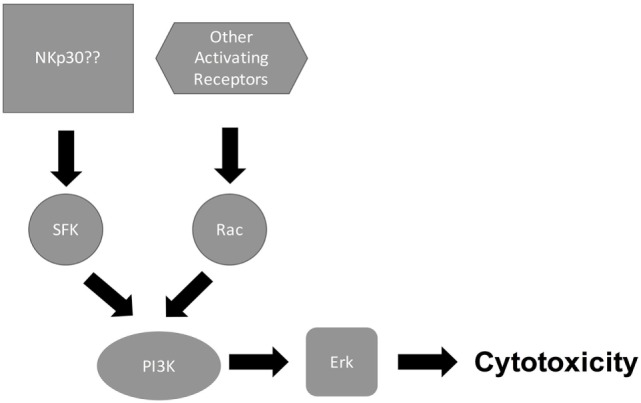
Natural killer (NK) cells kill or inhibit the growth of a number of fungi including , and . Although many fungi are not dangerous, invasive fungal pathogens, such as , cause life-threatening disease in individuals with impaired cell-mediated immunity. While there are similarities to cell-mediated killing of tumor cells, there are also important differences. Similar to tumor killing, NK cells directly kill fungi in a receptor-mediated and cytotoxic granule-dependent manner. Unlike tumor cell killing where multiple NK cell-activating receptors cooperate and signal events that mediate cytotoxicity, only the NKp30 receptor has been described to mediate signaling events that trigger the NK cell to mobilize its cytolytic payload to the site of interaction with and , subsequently leading to granule exocytosis and fungal killing. More recently, the NKp46 receptor was reported to bind adhesins Epa1, 6, and 7 and directly mediate fungal clearance. A number of unanswered questions remain. For example, is only one NK cell-activating receptor sufficient for signaling leading to fungal killing? Are the signaling pathways activated by fungi similar to those activated by tumor cells during NK cell killing? How do the cytolytic granules traffic to the site of interaction with fungi, and how does this process compare with tumor killing? Recent insights into receptor use, intracellular signaling and cytolytic granule trafficking during NK cell-mediated fungal killing will be compared to tumor killing, and the implications for therapeutic approaches will be discussed.
自然杀伤(NK)细胞可杀死或抑制包括[具体真菌名称1]、[具体真菌名称2]等多种真菌的生长。尽管许多真菌并无危害,但侵袭性真菌病原体,如[具体真菌名称3],会在细胞介导免疫受损的个体中引发危及生命的疾病。虽然NK细胞介导的真菌杀伤与肿瘤细胞杀伤存在相似之处,但也有重要差异。与肿瘤杀伤类似,NK细胞以受体介导和细胞毒性颗粒依赖的方式直接杀死真菌。与肿瘤细胞杀伤不同,肿瘤细胞杀伤时多个NK细胞激活受体协同作用并介导细胞毒性信号事件,而对于真菌杀伤,仅描述了NKp30受体介导触发NK细胞将其溶细胞物质转运至与[具体真菌名称1]和[具体真菌名称2]相互作用位点的信号事件,随后导致颗粒胞吐和真菌杀伤。最近,有报道称NKp46受体可结合[具体真菌名称3]的黏附素Epa1、6和7并直接介导真菌清除。仍有许多未解决的问题。例如,仅一个NK细胞激活受体对于引发真菌杀伤的信号传导是否足够?真菌激活的信号通路与NK细胞杀伤肿瘤细胞时激活的信号通路是否相似?溶细胞颗粒如何转运至与真菌相互作用的位点,以及该过程与肿瘤杀伤相比如何?本文将比较NK细胞介导真菌杀伤过程中受体使用、细胞内信号传导和溶细胞颗粒转运方面的最新见解与肿瘤杀伤情况,并讨论其对治疗方法的影响。