Matthiessen Peter, Ankley Gerald T, Biever Ronald C, Bjerregaard Poul, Borgert Christopher, Brugger Kristin, Blankinship Amy, Chambers Janice, Coady Katherine K, Constantine Lisa, Dang Zhichao, Denslow Nancy D, Dreier David A, Dungey Steve, Gray L Earl, Gross Melanie, Guiney Patrick D, Hecker Markus, Holbech Henrik, Iguchi Taisen, Kadlec Sarah, Karouna-Renier Natalie K, Katsiadaki Ioanna, Kawashima Yukio, Kloas Werner, Krueger Henry, Kumar Anu, Lagadic Laurent, Leopold Annegaaike, Levine Steven L, Maack Gerd, Marty Sue, Meador James, Mihaich Ellen, Odum Jenny, Ortego Lisa, Parrott Joanne, Pickford Daniel, Roberts Mike, Schaefers Christoph, Schwarz Tamar, Solomon Keith, Verslycke Tim, Weltje Lennart, Wheeler James R, Williams Mike, Wolf Jeffrey C, Yamazaki Kunihiko
Independent Consultant, Dolfan Barn, Beulah, Llanwrtyd Wells, Powys, United Kingdom.
US Environmental Protection Agency, Duluth, Minnesota.
Integr Environ Assess Manag. 2017 Mar;13(2):267-279. doi: 10.1002/ieam.1885. Epub 2017 Jan 27.
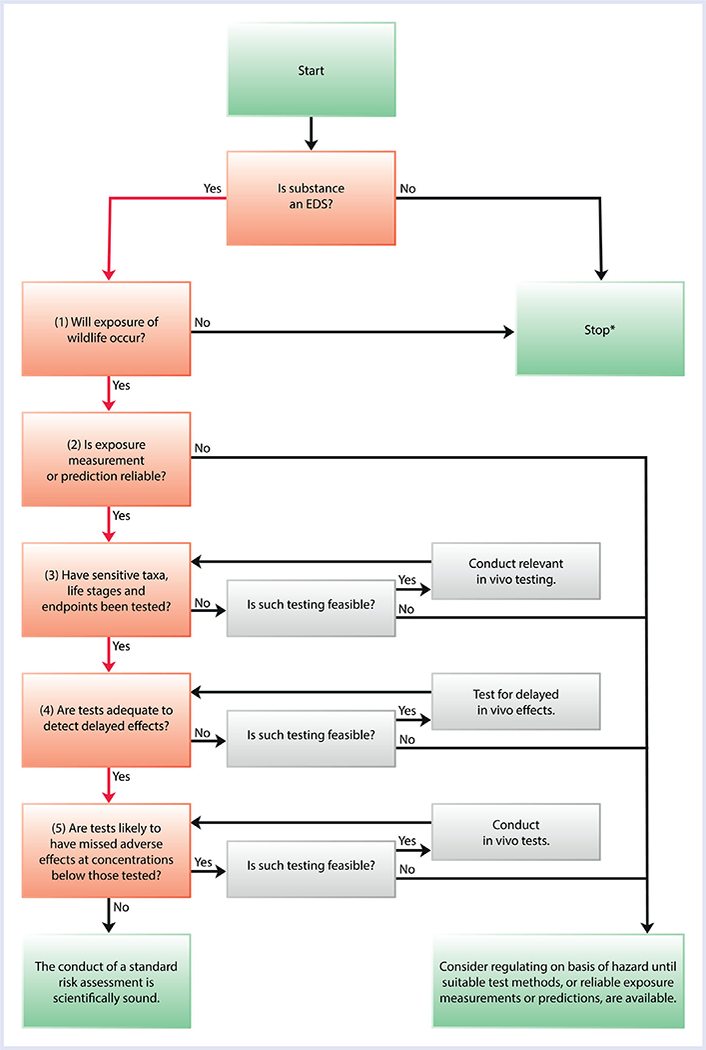
A SETAC Pellston Workshop "Environmental Hazard and Risk Assessment Approaches for Endocrine-Active Substances (EHRA)" was held in February 2016 in Pensacola, Florida, USA. The primary objective of the workshop was to provide advice, based on current scientific understanding, to regulators and policy makers; the aim being to make considered, informed decisions on whether to select an ecotoxicological hazard- or a risk-based approach for regulating a given endocrine-disrupting substance (EDS) under review. The workshop additionally considered recent developments in the identification of EDS. Case studies were undertaken on 6 endocrine-active substances (EAS-not necessarily proven EDS, but substances known to interact directly with the endocrine system) that are representative of a range of perturbations of the endocrine system and considered to be data rich in relevant information at multiple biological levels of organization for 1 or more ecologically relevant taxa. The substances selected were 17α-ethinylestradiol, perchlorate, propiconazole, 17β-trenbolone, tributyltin, and vinclozolin. The 6 case studies were not comprehensive safety evaluations but provided foundations for clarifying key issues and procedures that should be considered when assessing the ecotoxicological hazards and risks of EAS and EDS. The workshop also highlighted areas of scientific uncertainty, and made specific recommendations for research and methods-development to resolve some of the identified issues. The present paper provides broad guidance for scientists in regulatory authorities, industry, and academia on issues likely to arise during the ecotoxicological hazard and risk assessment of EAS and EDS. The primary conclusion of this paper, and of the SETAC Pellston Workshop on which it is based, is that if data on environmental exposure, effects on sensitive species and life-stages, delayed effects, and effects at low concentrations are robust, initiating environmental risk assessment of EDS is scientifically sound and sufficiently reliable and protective of the environment. In the absence of such data, assessment on the basis of hazard is scientifically justified until such time as relevant new information is available. Integr Environ Assess Manag 2017;13:267-279. © 2017 The Authors. Integrated Environmental Assessment and Management published by Wiley Periodicals, Inc. on behalf of Society of Environmental Toxicology & Chemistry (SETAC).
2016年2月,美国佛罗里达州彭萨科拉举办了一场SETAC佩尔斯顿研讨会,主题为“内分泌活性物质的环境危害与风险评估方法(EHRA)”。该研讨会的主要目标是,基于当前的科学认识,为监管机构和政策制定者提供建议;目的是就是否选择生态毒理学危害或基于风险的方法来监管正在审查的特定内分泌干扰物质(EDS)做出审慎、明智的决策。该研讨会还审议了EDS识别方面的最新进展。针对6种内分泌活性物质(EAS,不一定是已证实的EDS,但已知可直接与内分泌系统相互作用的物质)开展了案例研究,这些物质代表了内分泌系统的一系列扰动情况,并且被认为在多个生物组织层面上针对1种或多种生态相关分类群拥有丰富的相关信息数据。所选物质包括17α-乙炔雌二醇、高氯酸盐、丙环唑、17β-群勃龙、三丁基锡和乙烯菌核利。这6个案例研究并非全面的安全性评估,而是为阐明在评估EAS和EDS的生态毒理学危害及风险时应考虑的关键问题和程序奠定了基础。该研讨会还强调了科学上的不确定性领域,并就研究和方法开发提出了具体建议,以解决一些已识别出的问题。本文为监管机构、行业和学术界的科学家们在EAS和EDS的生态毒理学危害及风险评估过程中可能出现的问题提供了广泛指导。本文以及作为其基础的SETAC佩尔斯顿研讨会的主要结论是,如果关于环境暴露、对敏感物种和生命阶段的影响、延迟效应以及低浓度效应的数据可靠,则启动EDS的环境风险评估在科学上是合理的,并且对环境保护具有足够的可靠性和保护作用。在缺乏此类数据的情况下,在获得相关新信息之前,基于危害进行评估在科学上是合理的。《综合环境评估与管理》2017年;13:267 - 279。© 2017作者。《综合环境评估与管理》由威利期刊公司代表环境毒理学与化学学会(SETAC)出版。