Hagen Stephen J, Son Minjun
Author to whom any correspondence should be addressed.
Phys Biol. 2017 Jan 27;14(1):015001. doi: 10.1088/1478-3975/aa546c.
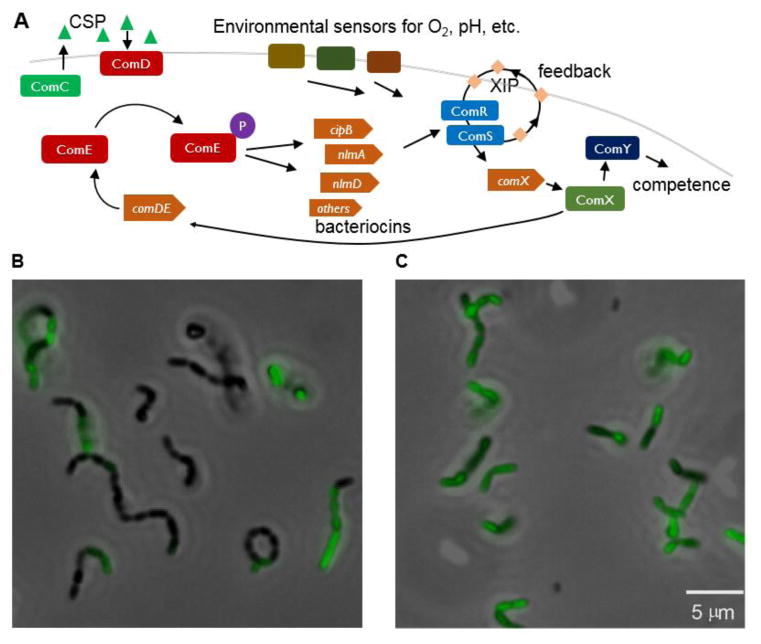
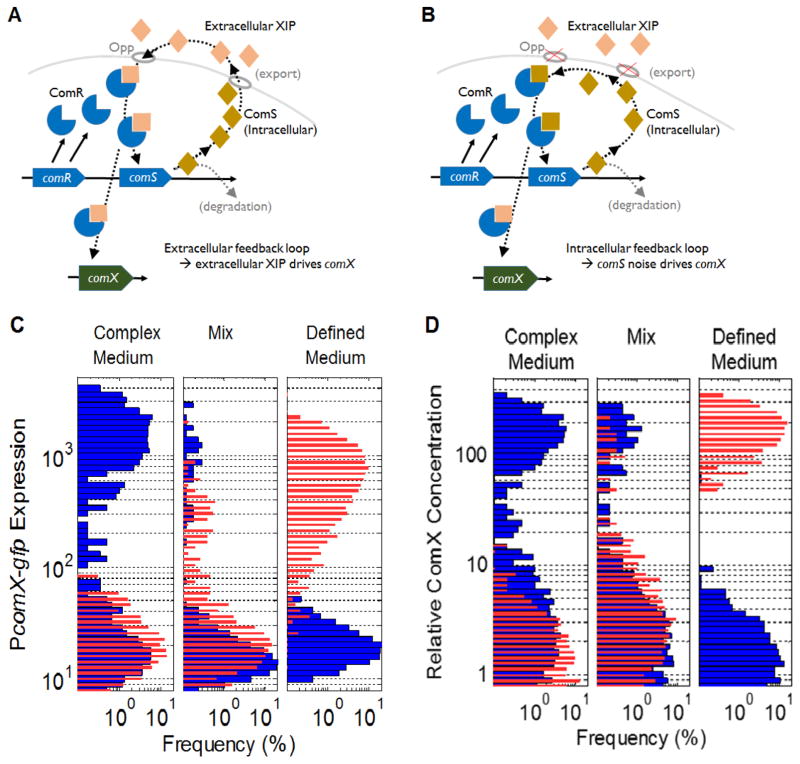
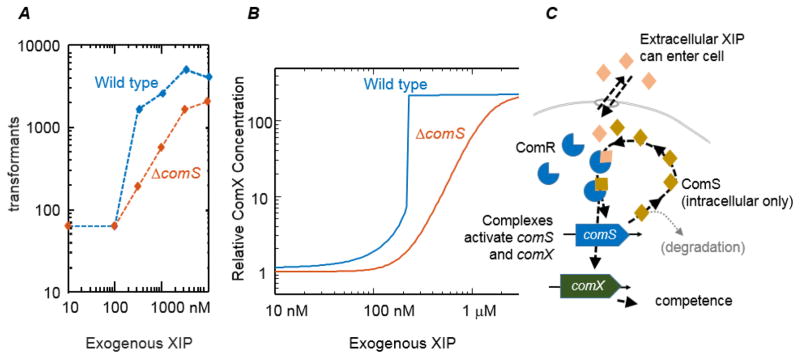
Bacterial pathogens rely on chemical signaling and environmental cues to regulate disease-causing behavior in complex microenvironments. The human pathogen Streptococcus mutans employs a particularly complex signaling and sensing scheme to regulate genetic competence and other virulence behaviors in the oral biofilms it inhabits. Individual S. mutans cells make the decision to enter the competent state by integrating chemical and physical cues received from their microenvironment along with endogenously produced peptide signals. Studies at the single-cell level, using microfluidics to control the extracellular environment, provide physical insight into how the cells process these inputs to generate complex and often heterogeneous outputs. Fine changes in environmental stimuli can dramatically alter the behavior of the competence circuit. Small shifts in pH can switch the quorum sensing response on or off, while peptide-rich media appear to switch the output from a unimodal to a bimodal behavior. Therefore, depending on environmental cues, the quorum sensing circuitry can either synchronize virulence across the population, or initiate and amplify heterogeneity in that behavior. Much of this complex behavior can be understood within the framework of a quorum sensing system that can operate both as an intercellular signaling mechanism and intracellularly as a noisy bimodal switch.
细菌病原体依靠化学信号和环境线索来调节在复杂微环境中的致病行为。人类病原体变形链球菌采用一种特别复杂的信号传导和感应机制,来调节其在所处口腔生物膜中的遗传感受态及其他毒力行为。单个变形链球菌细胞通过整合从其微环境接收的化学和物理线索以及内源性产生的肽信号,来决定进入感受态。利用微流控技术控制细胞外环境进行的单细胞水平研究,为细胞如何处理这些输入以产生复杂且往往异质的输出提供了物理层面的见解。环境刺激的细微变化可显著改变感受态回路的行为。pH值的微小变化可开启或关闭群体感应反应,而富含肽的培养基似乎会将输出从单峰行为转变为双峰行为。因此,根据环境线索,群体感应电路既可以使群体中的毒力同步,也可以引发并放大该行为中的异质性。这种复杂行为的大部分可以在群体感应系统的框架内得到理解,该系统既可以作为一种细胞间信号传导机制,也可以在细胞内作为一种有噪声的双峰开关发挥作用。