Borrow Persephone, Moody M Anthony
Nuffield Department of Clinical Medicine, University of Oxford, Oxford, UK.
Duke University Human Vaccine Institute and Departments of Pediatrics and Immunology, Duke University School of Medicine, Durham, NC, USA.
Immunol Rev. 2017 Jan;275(1):62-78. doi: 10.1111/imr.12504.
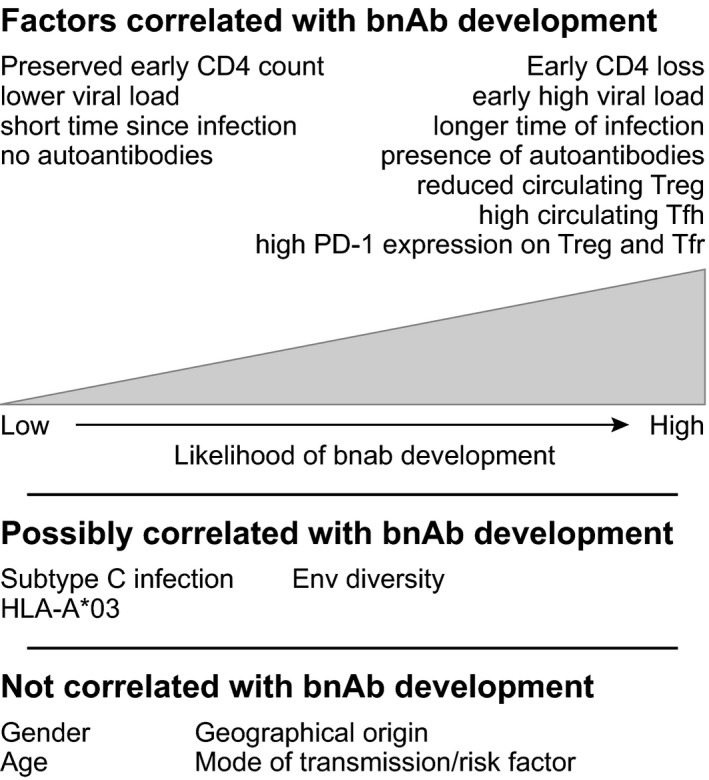
Induction of broadly neutralizing antibodies (bnAbs) capable of inhibiting infection with diverse variants of human immunodeficiency virus type 1 (HIV-1) is a key, as-yet-unachieved goal of prophylactic HIV-1 vaccine strategies. However, some HIV-infected individuals develop bnAbs after approximately 2-4 years of infection, enabling analysis of features of these antibodies and the immunological environment that enables their induction. Distinct subsets of CD4 T cells play opposing roles in the regulation of humoral responses: T follicular helper (Tfh) cells support germinal center formation and provide help for affinity maturation and the development of memory B cells and plasma cells, while regulatory CD4 (Treg) cells including T follicular regulatory (Tfr) cells inhibit the germinal center reaction to limit autoantibody production. BnAbs exhibit high somatic mutation frequencies, long third heavy-chain complementarity determining regions, and/or autoreactivity, suggesting that bnAb generation is likely to be highly dependent on the activity of CD4 Tfh cells, and may be constrained by host tolerance controls. This review discusses what is known about the immunological environment during HIV-1 infection, in particular alterations in CD4 Tfh, Treg, and Tfr populations and autoantibody generation, and how this is related to bnAb development, and considers the implications for HIV-1 vaccine design.
诱导能够抑制多种人类免疫缺陷病毒1型(HIV-1)变体感染的广泛中和抗体(bnAbs)是预防性HIV-1疫苗策略的一个关键但尚未实现的目标。然而,一些HIV感染者在感染约2至4年后会产生bnAbs,这使得人们能够分析这些抗体的特征以及促成其诱导产生的免疫环境。不同亚群的CD4 T细胞在体液免疫反应的调节中发挥着相反的作用:滤泡辅助性T(Tfh)细胞支持生发中心的形成,并为亲和力成熟以及记忆B细胞和浆细胞的发育提供帮助,而包括滤泡调节性T(Tfr)细胞在内的调节性CD4(Treg)细胞则抑制生发中心反应以限制自身抗体的产生。bnAbs表现出高体细胞突变频率、长的重链互补决定区和/或自身反应性,这表明bnAb的产生可能高度依赖于CD4 Tfh细胞的活性,并且可能受到宿主耐受性控制的限制。本综述讨论了关于HIV-1感染期间免疫环境的已知信息,特别是CD4 Tfh、Treg和Tfr细胞群的变化以及自身抗体的产生,以及这与bnAb的发展有何关系,并考虑了其对HIV-1疫苗设计的影响。