Farrar Michelle A, Lee Ming-Jen, Howells James, Andrews Peter I, Lin Cindy S-Y
Department of Neurology, Sydney Children's Hospital and School of Women's and Children's Health, University of New South Wales, Sydney, Australia.
Department of Neurology and Medical Genetics, National Taiwan University Hospital, Taipei, Taiwan.
Pain. 2017 May;158(5):900-911. doi: 10.1097/j.pain.0000000000000856.
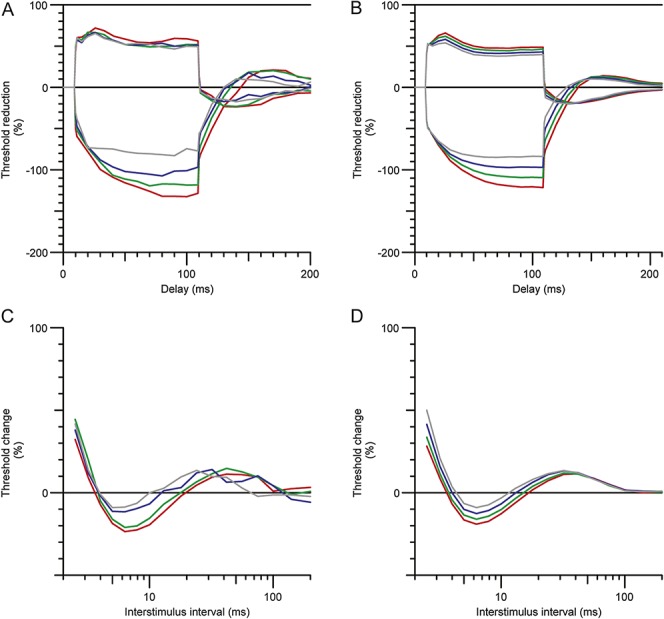
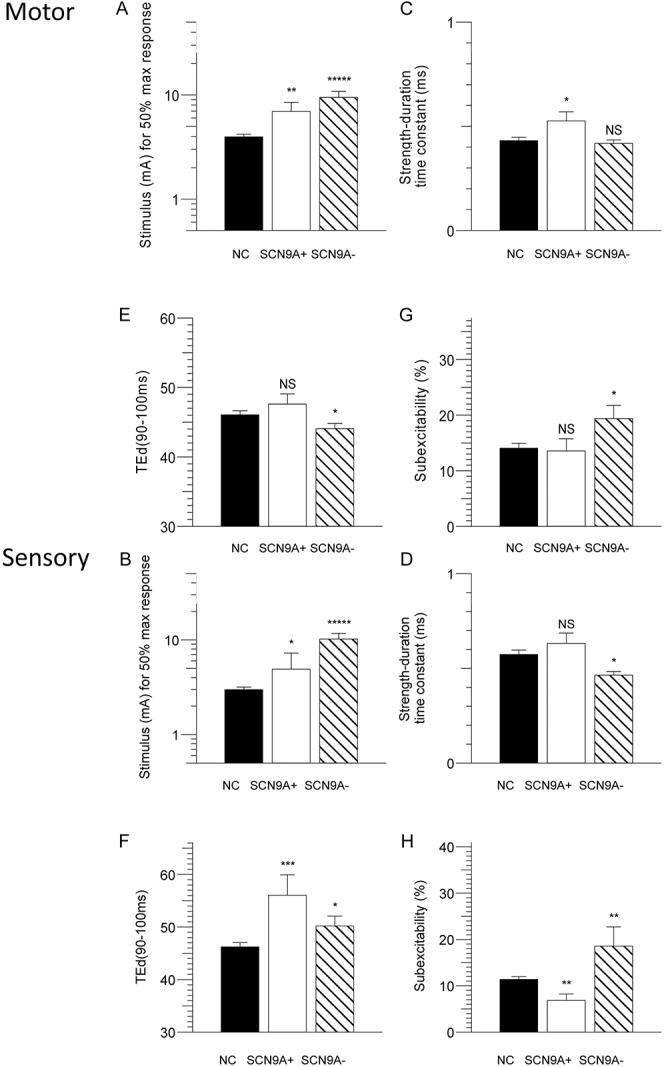
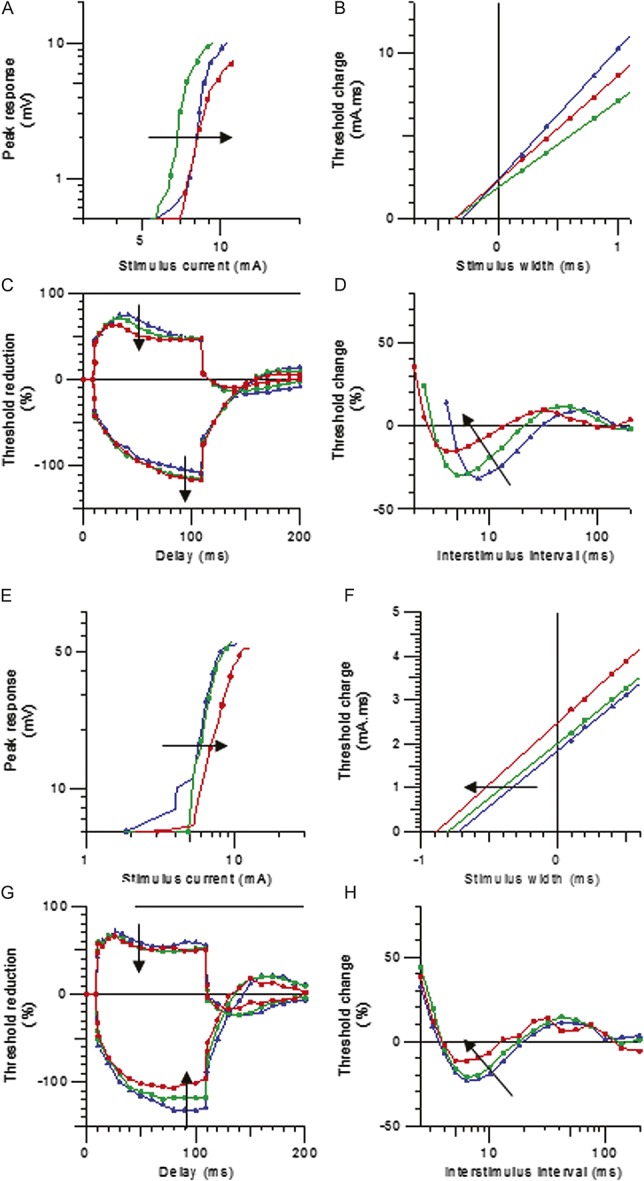
Erythromelalgia (EM) is a rare neurovascular disorder characterized by intermittent severe burning pain, erythema, and warmth in the extremities on heat stimuli. To investigate the underlying pathophysiology, peripheral axonal excitability studies were performed and changes with heating and therapy explored. Multiple excitability indices (stimulus-response curve, strength-duration time constant (SDTC), threshold electrotonus, and recovery cycle) were investigated in 23 (9 EMSCN9A+ and 14 EMSCN9A-) genetically characterized patients with EM stimulating median motor and sensory axons at the wrist. At rest, patients with EM showed a higher threshold and rheobase (P < 0.001) compared with controls. Threshold electrotonus and current-voltage relationships demonstrated greater changes of thresholds in both depolarizing and hyperpolarizing preconditioning electrotonus in both EM cohorts compared with controls in sensory axons (P < 0.005). When average temperature was raised from 31.5°C to 36.3°C in EMSCN9A+ patients, excitability changes showed depolarization, specifically SDTC significantly increased, in contrast to the effects of temperature previously established in healthy subjects (P < 0.05). With treatment, 4 EMSCN9A+ patients (4/9) reported improvement with mexiletine, associated with reduction in SDTC in motor and sensory axons. This is the first study of primary EM using threshold tracking techniques to demonstrate alterations in peripheral axonal membrane function. Taken together, these changes may be attributed to systemic neurovascular abnormalities in EM, with chronic postischaemic resting membrane potential hyperpolarization due to Na/K pump overactivity. With heating, a trigger of acute symptoms, axonal depolarization developed, corresponding to acute axonal ischaemia. This study has provided novel insights into EM pathophysiology.
红斑性肢痛症(EM)是一种罕见的神经血管疾病,其特征为在热刺激下四肢间歇性出现严重灼痛、红斑和发热。为了研究其潜在的病理生理学机制,我们进行了外周轴突兴奋性研究,并探讨了加热和治疗过程中的变化。我们对23例(9例EMSCN9A阳性和14例EMSCN9A阴性)经基因特征化的EM患者进行了多项兴奋性指标(刺激 - 反应曲线、强度 - 时间常数(SDTC)、阈下电紧张和恢复周期)的研究,在腕部刺激正中运动和感觉轴突。静息时,与对照组相比,EM患者表现出更高的阈值和基强度(P < 0.001)。阈下电紧张和电流 - 电压关系表明,与对照组相比,两个EM队列的感觉轴突在去极化和超极化预处理电紧张中阈值变化更大(P < 0.005)。当EMSCN9A阳性患者的平均温度从31.5°C升高到36.3°C时,兴奋性变化表现为去极化,特别是SDTC显著增加,这与之前在健康受试者中确定的温度效应相反(P < 0.05)。治疗后,4例EMSCN9A阳性患者(4/9)报告美西律治疗有效,同时运动和感觉轴突的SDTC降低。这是首次使用阈值跟踪技术对原发性EM进行的研究,以证明外周轴突膜功能的改变。综上所述,这些变化可能归因于EM中的全身性神经血管异常,由于钠/钾泵过度活动导致慢性缺血后静息膜电位超极化。加热作为急性症状的触发因素,会导致轴突去极化,这与急性轴突缺血相对应。本研究为EM的病理生理学提供了新的见解。