Howarth Clare, Sutherland Brad, Choi Hyun B, Martin Chris, Lind Barbara Lykke, Khennouf Lila, LeDue Jeffrey M, Pakan Janelle M P, Ko Rebecca W Y, Ellis-Davies Graham, Lauritzen Martin, Sibson Nicola R, Buchan Alastair M, MacVicar Brian A
Djavad Mowafaghian Centre for Brain Health, University of British Columbia, Vancouver, British Columbia V6T 1Z3, Canada.
Cancer Research United Kingdom and Medical Research Council Oxford Institute for Radiation Oncology, Department of Oncology, University of Oxford, Oxford, OX3 7DQ, United Kingdom.
J Neurosci. 2017 Mar 1;37(9):2403-2414. doi: 10.1523/JNEUROSCI.0005-16.2016. Epub 2017 Jan 30.
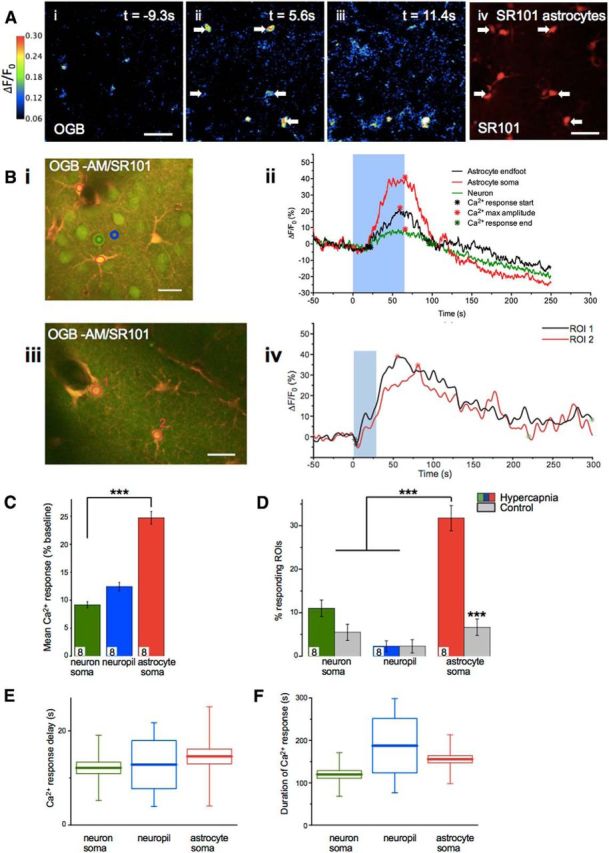
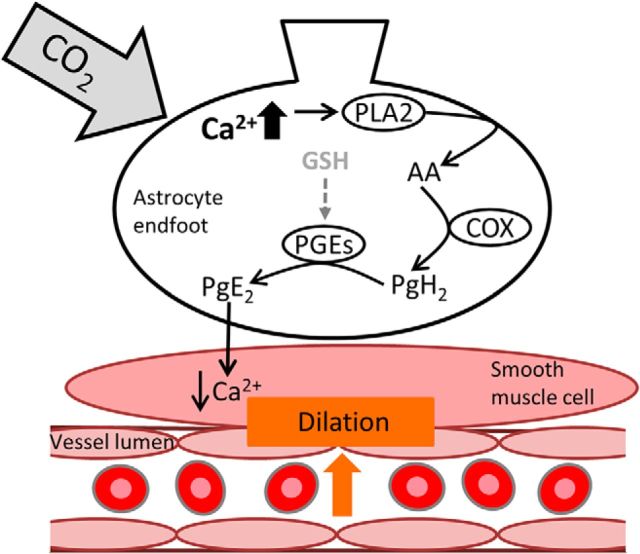
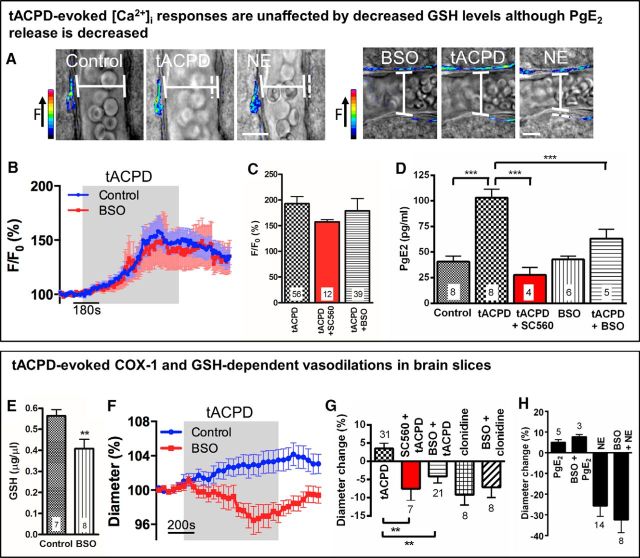
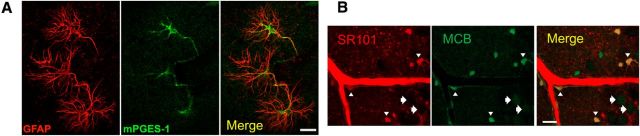
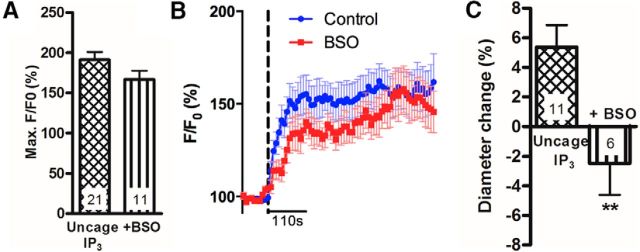
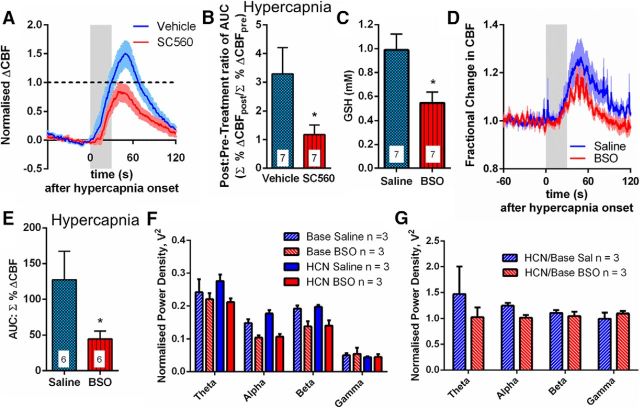
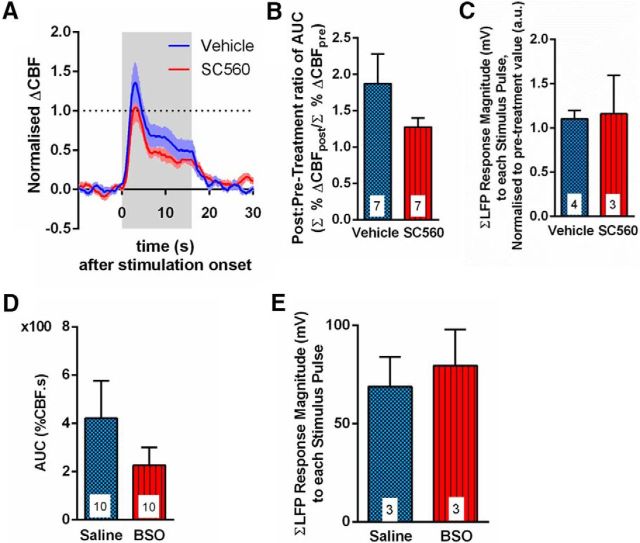
Cerebral blood flow (CBF) is controlled by arterial blood pressure, arterial CO, arterial O, and brain activity and is largely constant in the awake state. Although small changes in arterial CO are particularly potent to change CBF (1 mmHg variation in arterial CO changes CBF by 3%-4%), the coupling mechanism is incompletely understood. We tested the hypothesis that astrocytic prostaglandin E (PgE) plays a key role for cerebrovascular CO reactivity, and that preserved synthesis of glutathione is essential for the full development of this response. We combined two-photon imaging microscopy in brain slices with work in rats and C57BL/6J mice to examine the hemodynamic responses to CO and somatosensory stimulation before and after inhibition of astrocytic glutathione and PgE synthesis. We demonstrate that hypercapnia (increased CO) evokes an increase in astrocyte [Ca] and stimulates COX-1 activity. The enzyme downstream of COX-1 that synthesizes PgE (microsomal prostaglandin E synthase-1) depends critically for its vasodilator activity on the level of glutathione in the brain. We show that, when glutathione levels are reduced, astrocyte calcium-evoked release of PgE is decreased and vasodilation triggered by increased astrocyte [Ca] and by hypercapnia is inhibited. Astrocyte synthetic pathways, dependent on glutathione, are involved in cerebrovascular reactivity to CO Reductions in glutathione levels in aging, stroke, or schizophrenia could lead to dysfunctional regulation of CBF and subsequent neuronal damage. Neuronal activity leads to the generation of CO, which has previously been shown to evoke cerebral blood flow (CBF) increases via the release of the vasodilator PgE We demonstrate that hypercapnia (increased CO) evokes increases in astrocyte calcium signaling, which in turn stimulates COX-1 activity and generates downstream PgE production. We demonstrate that astrocyte calcium-evoked production of the vasodilator PgE is critically dependent on brain levels of the antioxidant glutathione. These data suggest a novel role for astrocytes in the regulation of CO-evoked CBF responses. Furthermore, these results suggest that depleted glutathione levels, which occur in aging and stroke, will give rise to dysfunctional CBF regulation and may result in subsequent neuronal damage.
脑血流量(CBF)受动脉血压、动脉血二氧化碳分压(CO₂)、动脉血氧分压(O₂)和脑活动的控制,在清醒状态下基本保持恒定。尽管动脉血二氧化碳分压的微小变化对改变脑血流量特别有效(动脉血二氧化碳分压每变化1 mmHg,脑血流量变化3%-4%),但其耦合机制尚未完全明确。我们检验了以下假设:星形胶质细胞前列腺素E(PgE)在脑血管对二氧化碳的反应性中起关键作用,并且谷胱甘肽的合成得以保留对于这种反应的充分发展至关重要。我们将脑片双光子成像显微镜技术与大鼠和C57BL/6J小鼠实验相结合,以研究在抑制星形胶质细胞谷胱甘肽和PgE合成前后对二氧化碳和体感刺激的血流动力学反应。我们证明高碳酸血症(二氧化碳增加)会引起星形胶质细胞内钙离子浓度([Ca²⁺])升高,并刺激环氧化酶-1(COX-1)活性。COX-1下游合成PgE的酶(微粒体前列腺素E合酶-1)的血管舒张活性严重依赖于脑内谷胱甘肽水平。我们发现,当谷胱甘肽水平降低时,星形胶质细胞因钙离子升高而释放的PgE减少,由星形胶质细胞[Ca²⁺]升高和高碳酸血症引发的血管舒张受到抑制。依赖于谷胱甘肽的星形胶质细胞合成途径参与了脑血管对二氧化碳的反应性。衰老、中风或精神分裂症中谷胱甘肽水平降低可能导致脑血流量调节功能失调及随后的神经元损伤。神经元活动会导致二氧化碳生成,此前已证明二氧化碳通过释放血管舒张剂PgE引起脑血流量(CBF)增加。我们证明高碳酸血症(二氧化碳增加)会引起星形胶质细胞钙信号增加,进而刺激COX-1活性并产生下游PgE产物。我们证明星形胶质细胞因钙离子升高而产生的血管舒张剂PgE严重依赖于脑内抗氧化剂谷胱甘肽水平。这些数据表明星形胶质细胞在调节二氧化碳诱发的脑血流量反应中具有新作用。此外,这些结果表明衰老和中风中出现的谷胱甘肽水平降低会导致脑血流量调节功能失调,并可能导致随后的神经元损伤。