Ademolue T W, Amodu O K, Awandare G A
West African Centre for Cell Biology of Infectious Pathogens, Department of Biochemistry, Cell and Molecular Biology, College of Basic and Applied Sciences, University of Ghana, Legon, Ghana.
Institute of Child Health, University of Ibadan, Nigeria.
Clin Exp Immunol. 2017 May;188(2):283-292. doi: 10.1111/cei.12936. Epub 2017 Feb 28.
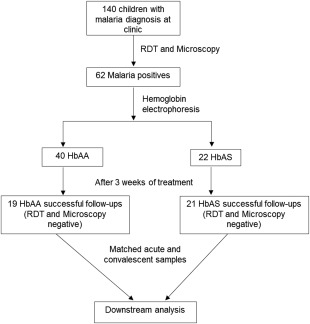
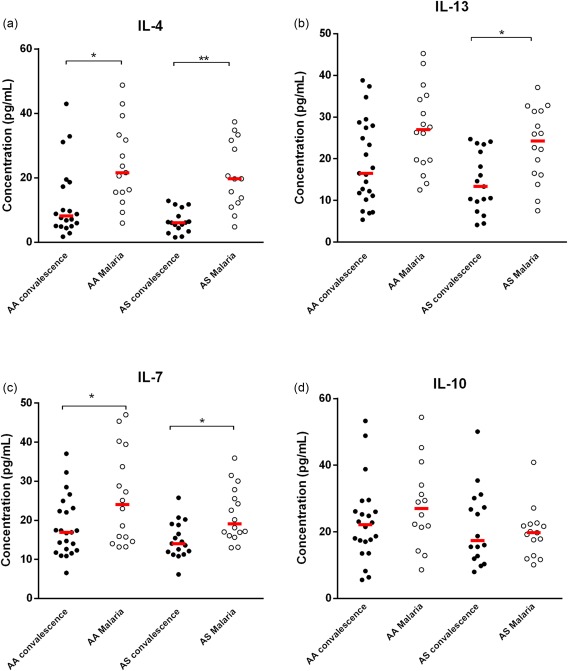
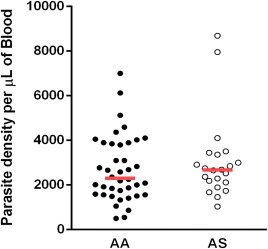
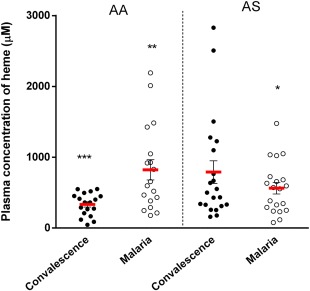
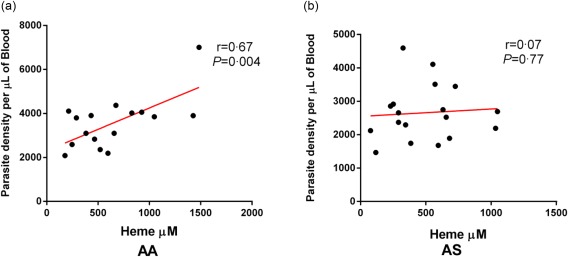
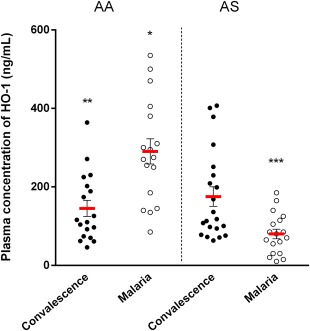
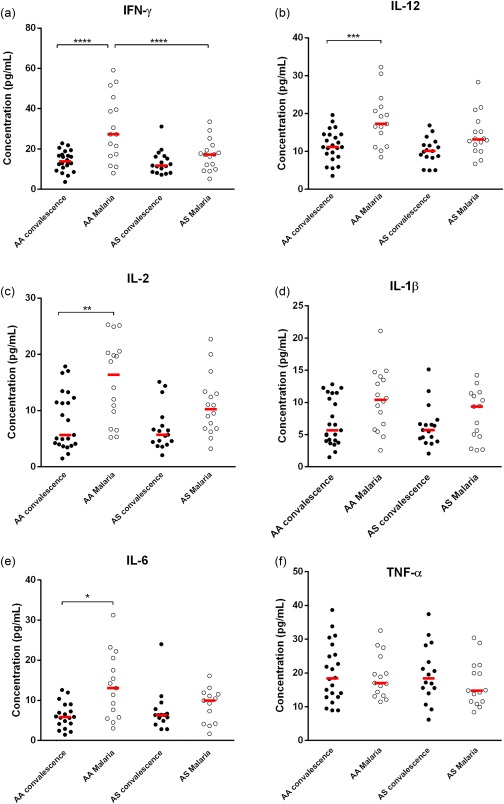
The controlled induction of haemoxygenase-1 (HO-1), an enzyme that catabolizes haem, has been shown to reduce haem, preventing pathologies associated with haem toxicity. The hemoglobin genotype HbAS confers reduced susceptibility to severe complications of malaria by a mechanism that is not well understood. Using a longitudinal approach, we investigated the effect of baseline concentrations of HO-1 on the accumulation of haem during acute Plasmodium falciparum malaria in HbAS and HbAA genotypes. Plasma concentrations of haem, HO-1 and cytokines were quantified in venous blood obtained from children (9 months-5 years of age) during malaria infection, and at convalescence (baseline levels). Parasitaemia was determined during malaria infection. In patients with the HbAA genotype, there was a significant elevation in the plasma concentration of haem (P = 0.002), and a consequent increased induction of HO-1 (P < 0.001) during falciparum malaria compared with levels at convalescence. Contrary to HbAA, plasma concentration of haem did not change in the HbAS genotypical group (P = 0·110), and the induction of HO-1 was reduced during malaria compared with levels at convalescence (P = 0·006). Higher plasma levels of haem were observed in HbAS compared with HbAA at convalescence (P = 0·010), but this difference did not affect the levels of HO-1 within each genotype (P = 0·450). Relatively milder proinflammatory responses were observed in HbAS children during malaria infection compared to HbAA children. Our findings suggest that a mechanism of reduced susceptibility to severe malaria pathologies by the HbAS genotype may involve the control of haem, leading to controlled levels of HO-1 and milder proinflammatory responses during acute malaria.
血红素加氧酶-1(HO-1)是一种分解血红素的酶,对其进行可控诱导已被证明可减少血红素,预防与血红素毒性相关的病变。血红蛋白基因型HbAS通过一种尚未完全了解的机制降低了对疟疾严重并发症的易感性。我们采用纵向研究方法,调查了HO-1基线浓度对HbAS和HbAA基因型急性恶性疟原虫疟疾期间血红素积累的影响。在疟疾感染期间以及恢复期(基线水平),对从儿童(9个月至5岁)采集的静脉血中的血红素、HO-1和细胞因子的血浆浓度进行了定量分析。在疟疾感染期间测定了疟原虫血症。与恢复期水平相比,HbAA基因型患者在恶性疟期间血浆血红素浓度显著升高(P = 0.002),随后HO-1的诱导增加(P < 0.001)。与HbAA相反,HbAS基因型组的血浆血红素浓度没有变化(P = 0.110),并且与恢复期水平相比,疟疾期间HO-1的诱导减少(P = 0.006)。在恢复期,HbAS患者的血浆血红素水平高于HbAA患者(P = 0.010),但这种差异并不影响每种基因型内的HO-1水平(P = 0.450)。与HbAA儿童相比,HbAS儿童在疟疾感染期间观察到相对较轻的促炎反应。我们的研究结果表明,HbAS基因型降低对严重疟疾病变易感性的机制可能涉及对血红素的控制,从而在急性疟疾期间导致HO-1水平得到控制以及促炎反应较轻。