Tomberg Joshua, Fedarovich Alena, Vincent Leah R, Jerse Ann E, Unemo Magnus, Davies Christopher, Nicholas Robert A
Department of Pharmacology, University of North Carolina at Chapel Hill , Chapel Hill, North Carolina 27599-7365, United States.
Department of Biochemistry and Molecular Biology, Medical University of South Carolina , Charleston, South Carolina 29425, United States.
Biochemistry. 2017 Feb 28;56(8):1140-1150. doi: 10.1021/acs.biochem.6b01030. Epub 2017 Feb 16.
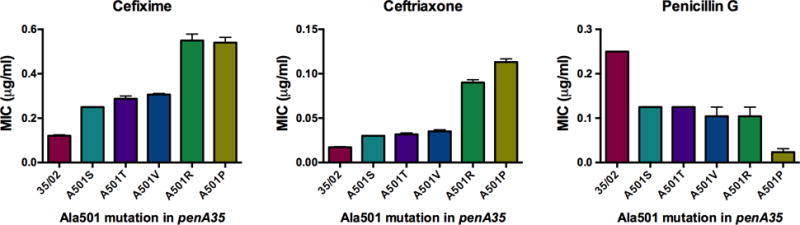
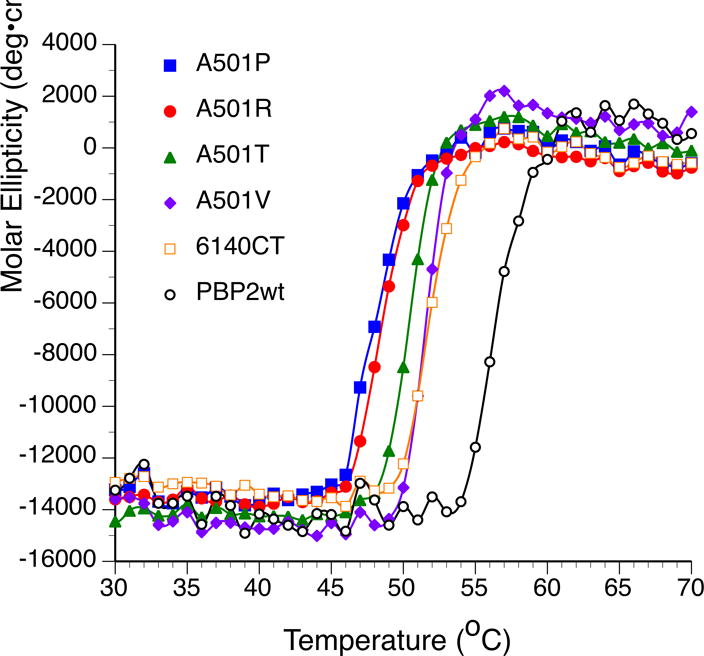
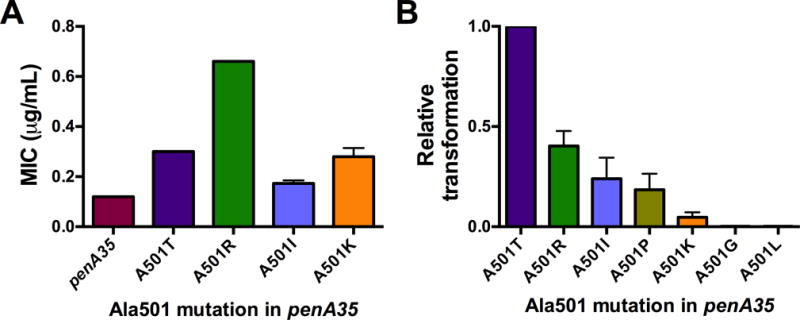
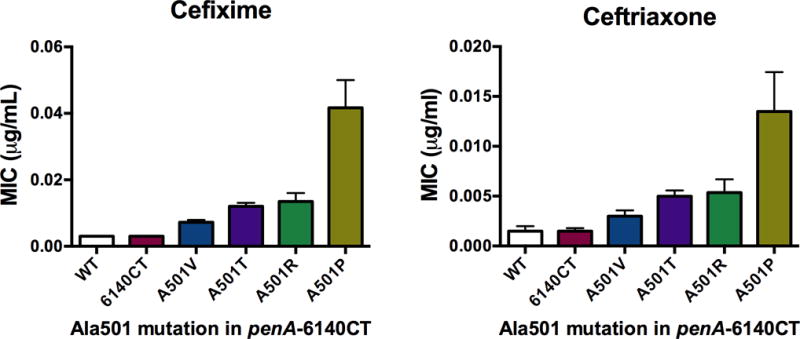
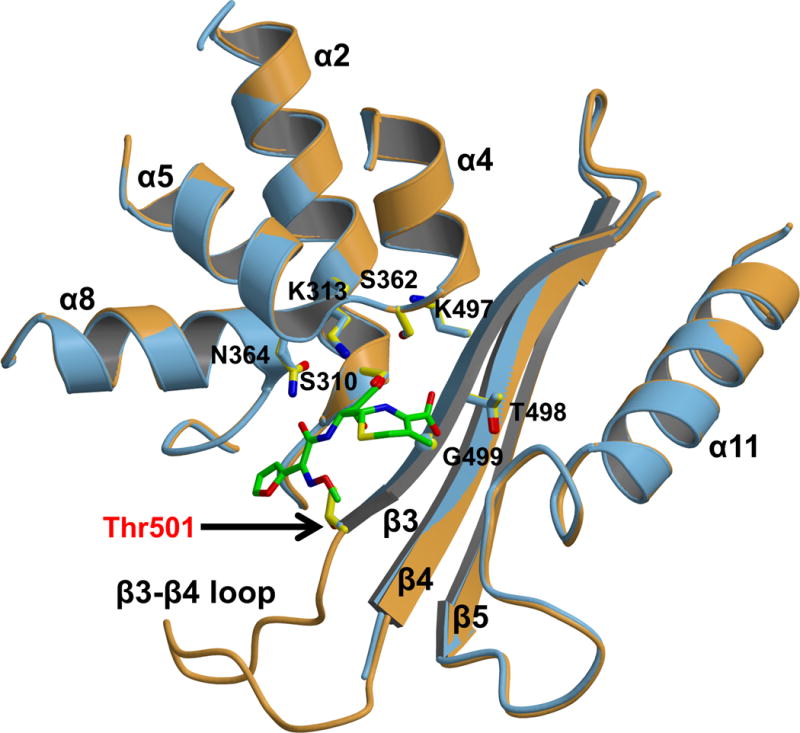
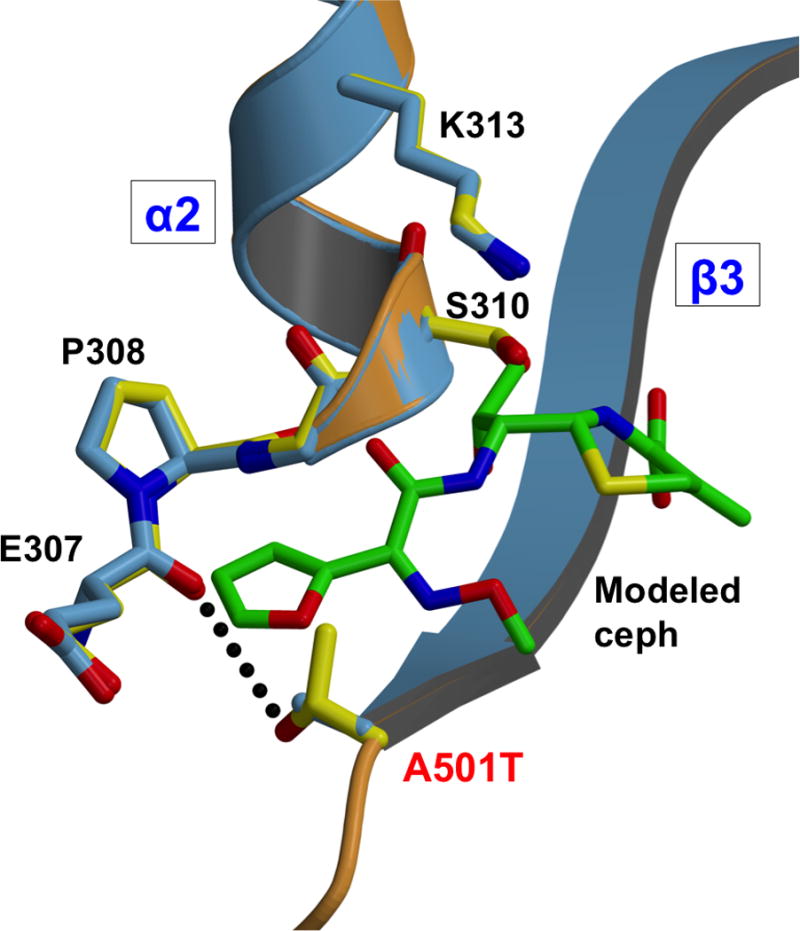
Resistance of Neisseria gonorrhoeae to expanded-spectrum cephalosporins such as ceftriaxone and cefixime has increased markedly in the past decade. The primary cephalosporin resistance determinant is a mutated penA gene, which encodes the essential peptidoglycan transpeptidase, penicillin-binding protein 2 (PBP2). Decreased susceptibility and resistance can be conferred by mosaic penA alleles containing upward of 60 amino acid changes relative to wild-type PBP2, or by nonmosaic alleles with relatively few mutations, the most important of which occurs at Ala501 located near the active site of PBP2. Recently, fully cefixime- and ceftriaxone-resistant clinical isolates that harbored a mosaic penA allele with an A501P mutation were identified. To examine the potential of mutations at Ala501 to increase resistance to expanded-spectrum cephalosporins, we randomized codon 501 in a mosaic penA allele and transformed N. gonorrhoeae to increased cefixime resistance. Interestingly, only five substitutions of Ala501 (A501V, A501T, A501P, A501R, and A501S) that increased resistance and preserved essential transpeptidase function were isolated. To understand their structural implications, these mutations were introduced into the nonmosaic PBP2-6140CT, which contains four C-terminal mutations present in PBP2 from the penicillin-resistant strain FA6140. The crystal structure of PBP2-6140CT-A501T was determined and revealed ordering of a loop near the active site and a new hydrogen bond involving Thr501 that connects the loop and the SxxK conserved active site motif. The structure suggests that increased rigidity in the active site region is a mechanism for cephalosporin resistance mediated by Ala501 mutations in PBP2.
在过去十年中,淋病奈瑟菌对头孢曲松和头孢克肟等广谱头孢菌素的耐药性显著增加。主要的头孢菌素耐药决定因素是一个发生突变的penA基因,该基因编码必需的肽聚糖转肽酶——青霉素结合蛋白2(PBP2)。相对于野生型PBP2,含有60多个氨基酸变化的嵌合penA等位基因,或具有相对较少突变的非嵌合等位基因(其中最重要的突变发生在位于PBP2活性位点附近的Ala501),均可导致敏感性降低和耐药性产生。最近,发现了携带具有A501P突变的嵌合penA等位基因、对头孢克肟和头孢曲松完全耐药的临床分离株。为了研究Ala501处的突变增加对广谱头孢菌素耐药性的可能性,我们将嵌合penA等位基因中的密码子501随机化,并将淋病奈瑟菌转化为对头孢克肟耐药性增加的菌株。有趣的是,仅分离出了增加耐药性并保留必需转肽酶功能的Ala501的五个替代突变(A501V、A501T、A501P、A501R和A501S)。为了解它们的结构影响,将这些突变引入非嵌合PBP2-6140CT,该蛋白包含来自耐青霉素菌株FA6140的PBP2中存在的四个C末端突变。确定了PBP2-6140CT-A501T的晶体结构,该结构揭示了活性位点附近一个环的有序排列以及涉及Thr501的一个新氢键,该氢键连接该环和SxxK保守活性位点基序。该结构表明,活性位点区域刚性增加是PBP2中Ala501突变介导的头孢菌素耐药机制。