van Haastert Peter J M, Keizer-Gunnink Ineke, Kortholt Arjan
Department of Cell Biochemistry, University of Groningen, 9747 AG Groningen, Netherlands
Department of Cell Biochemistry, University of Groningen, 9747 AG Groningen, Netherlands.
Mol Biol Cell. 2017 Apr 1;28(7):922-934. doi: 10.1091/mbc.E16-10-0733. Epub 2017 Feb 1.
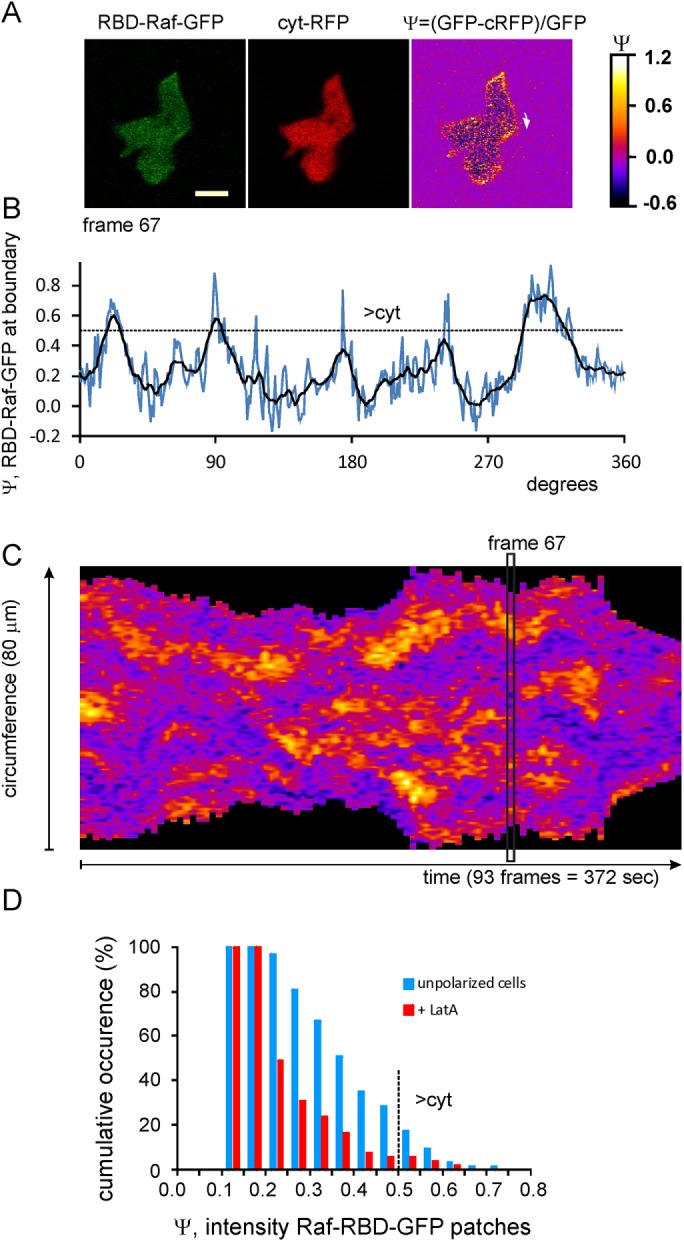
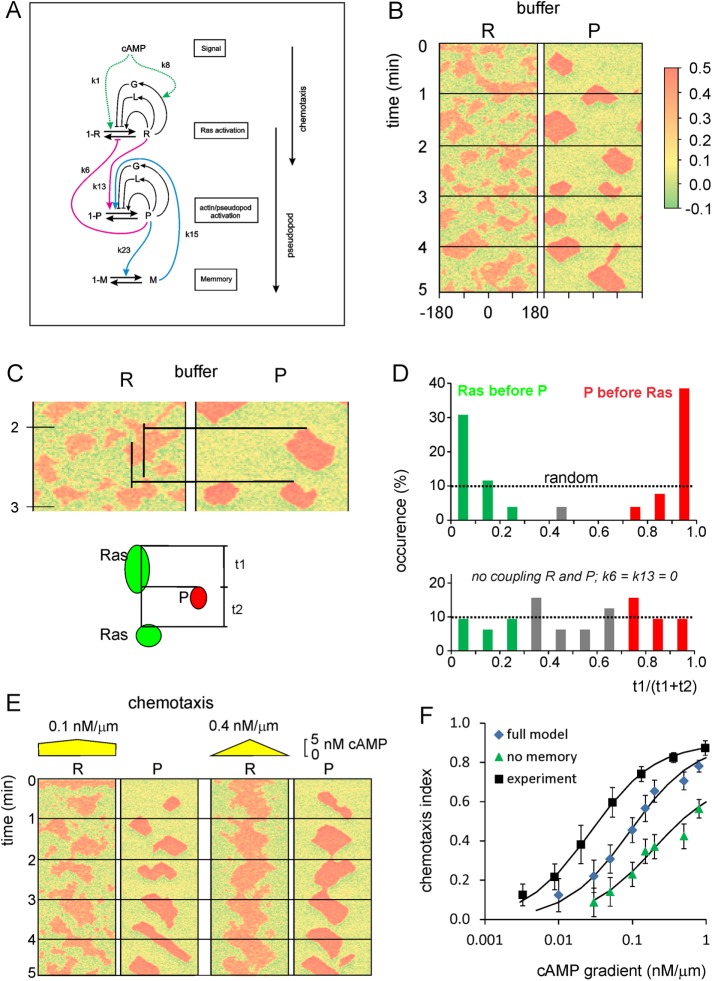
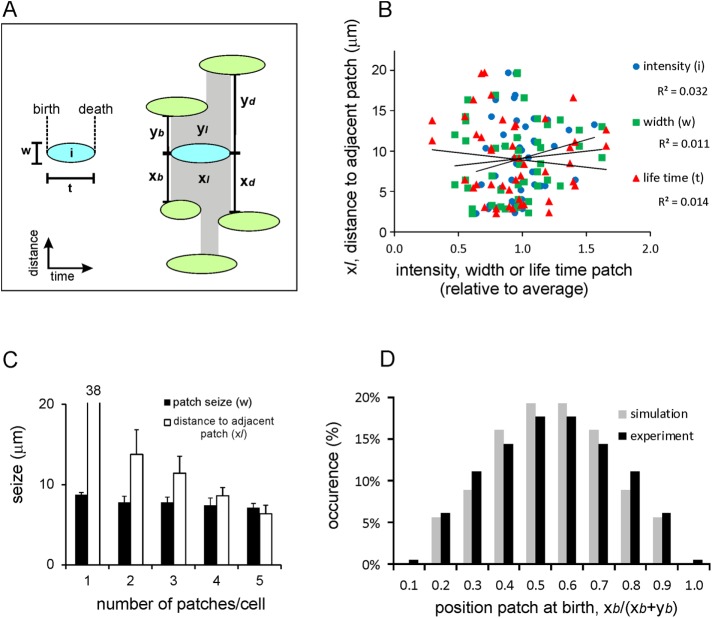
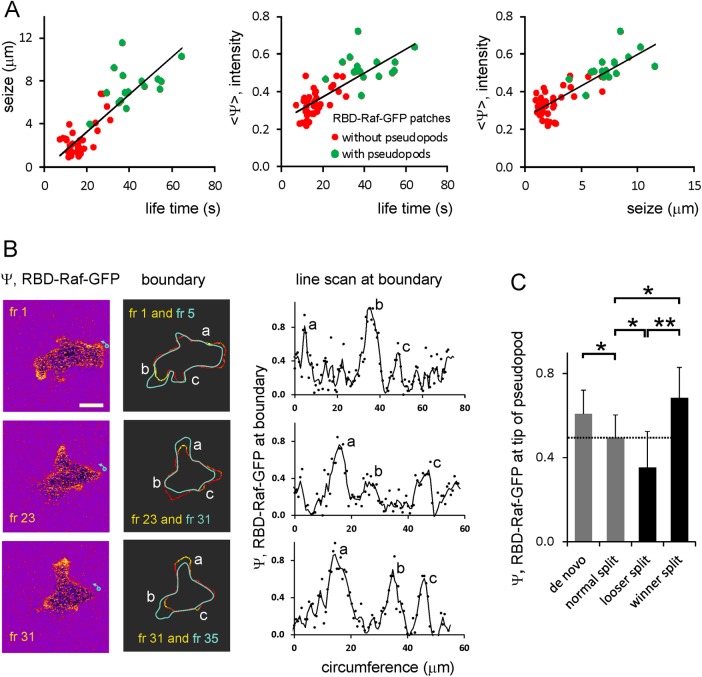
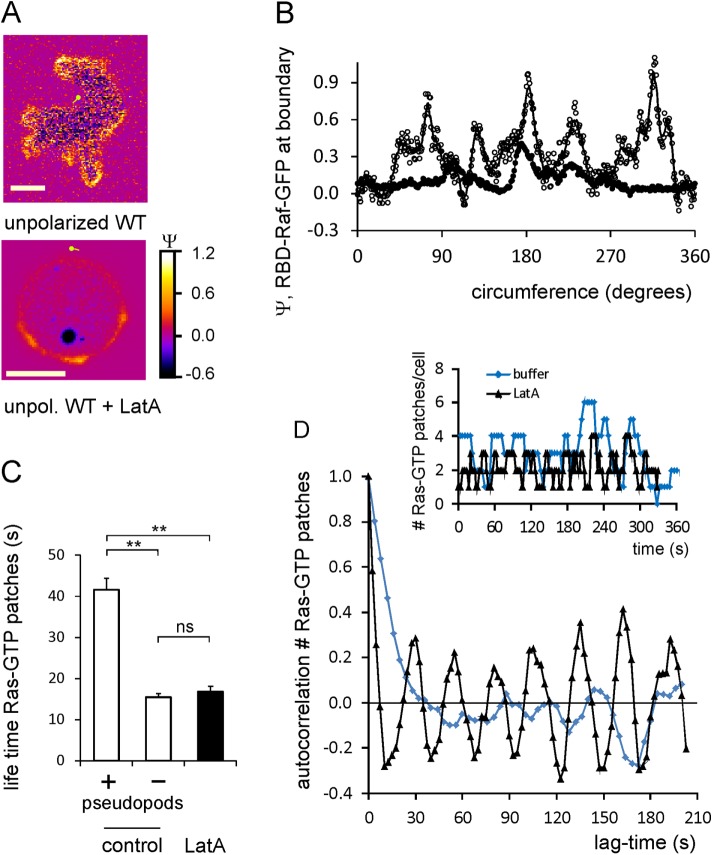
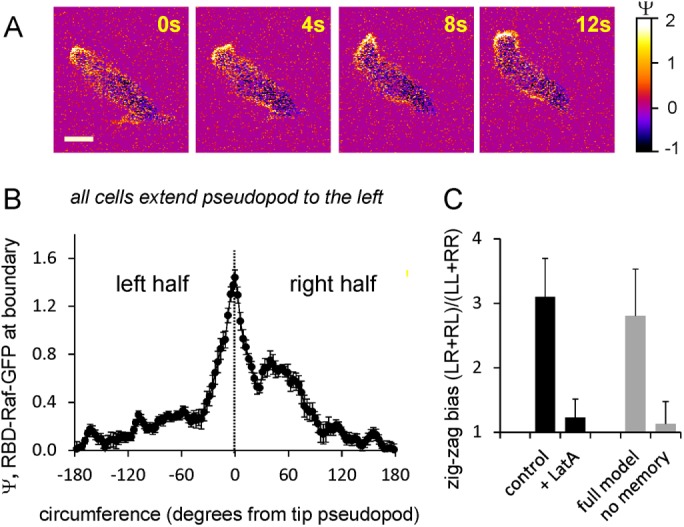
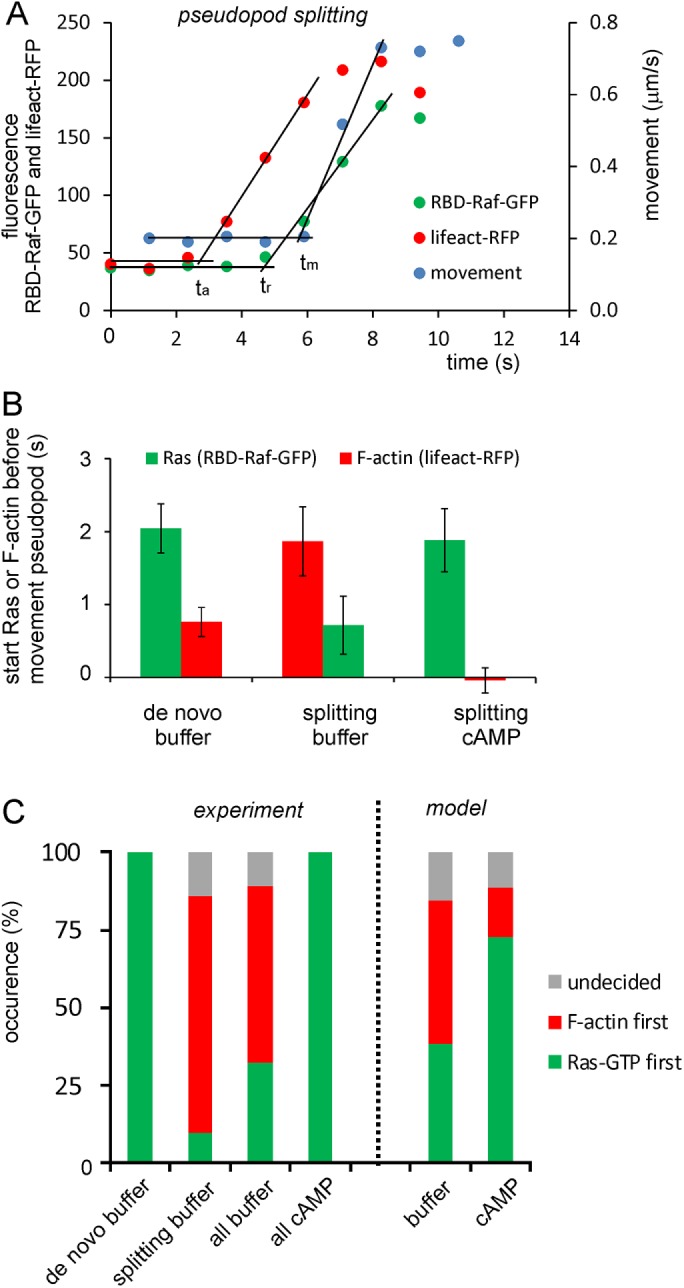
Many eukaryotic cells regulate their mobility by external cues. Genetic studies have identified >100 components that participate in chemotaxis, which hinders the identification of the conceptual framework of how cells sense and respond to shallow chemical gradients. The activation of Ras occurs during basal locomotion and is an essential connector between receptor and cytoskeleton during chemotaxis. Using a sensitive assay for activated Ras, we show here that activation of Ras and F-actin forms two excitable systems that are coupled through mutual positive feedback and memory. This coupled excitable system leads to short-lived patches of activated Ras and associated F-actin that precede the extension of protrusions. In buffer, excitability starts frequently with Ras activation in the back/side of the cell or with F-actin in the front of the cell. In a shallow gradient of chemoattractant, local Ras activation triggers full excitation of Ras and subsequently F-actin at the side of the cell facing the chemoattractant, leading to directed pseudopod extension and chemotaxis. A computational model shows that the coupled excitable Ras/F-actin system forms the driving heart for the ordered-stochastic extension of pseudopods in buffer and for efficient directional extension of pseudopods in chemotactic gradients.
许多真核细胞通过外部信号来调节自身的移动性。遗传学研究已鉴定出100多种参与趋化作用的成分,这阻碍了对细胞如何感知和响应浅化学梯度的概念框架的识别。Ras的激活发生在基础运动过程中,并且是趋化作用期间受体与细胞骨架之间的重要连接物。通过使用一种针对活化Ras的灵敏检测方法,我们在此表明,Ras和F-肌动蛋白的激活形成了两个可兴奋系统,它们通过相互正反馈和记忆而耦合。这种耦合的可兴奋系统导致在突起延伸之前出现短暂的活化Ras和相关F-肌动蛋白斑块。在缓冲液中,兴奋性通常始于细胞后部/侧面的Ras激活或细胞前部的F-肌动蛋白激活。在趋化因子的浅梯度中,局部Ras激活会触发Ras的完全兴奋,随后导致面对趋化因子一侧的细胞中的F-肌动蛋白兴奋,从而导致定向伪足延伸和趋化作用。一个计算模型表明,耦合的可兴奋Ras/F-肌动蛋白系统构成了缓冲液中伪足有序随机延伸以及趋化梯度中伪足有效定向延伸的驱动核心。