Kam Richard Kin Ting, Ho Chung Shun, Chan Michael Ho Ming
Department of Chemical Pathology, The Chinese University of Hong Kong, Prince of Wales Hospital , Shatin, Hong Kong SAR, China.
EJIFCC. 2016 Dec 1;27(4):318-330. eCollection 2016 Dec.
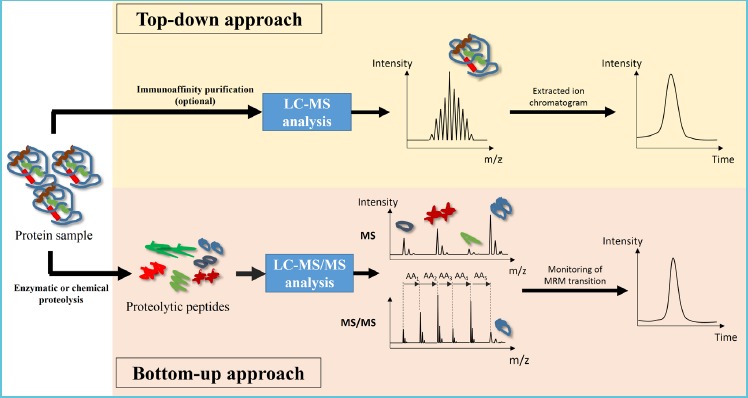
Liquid chromatography mass spectrometry (LC-MS) is a widely used technique in the clinical laboratory, especially for small molecule quantitation in biological specimens, for example, steroid hormones and therapeutic drugs. Analysis of circulating macromolecules, including proteins and peptides, is largely dominated by traditional enzymatic, spectrophotometric, or immunological assays in clinical laboratories. However, these methodologies are known to be subjected to interfering substances, for example heterophilic antibodies, as well as subjected to non-specificity issues. In recent years, there has been a growing interest in using LC-MS platforms for protein analysis in the clinical setting, due to the superior specificity compared to immunoassay, and the possibility of simultaneous quantitation of multiple proteins. Different analytical approaches are possible using LC-MS-based methodology, including accurate mass measurement of intact molecules, protein digestion followed by detection of proteolytic peptides, and in combination with immunoaffinity purification. Proteins with different complexity, isoforms, variants, or chemical alteration can be simultaneously analysed by LC-MS, either by targeted or non-targeted approaches. While the LC-MS platform offers a more specific determination of proteins, there remain issues of LC-MS assay harmonization, correlation with current existing platforms, and the potential impact in making clinical decision. In this review, the clinical utility, historical aspect, and challenges in using LC-MS for protein analysis in the clinical setting will be discussed, using insulin-like growth factor (IGF) as an example.
液相色谱-质谱联用(LC-MS)是临床实验室中广泛使用的技术,尤其用于生物样本中小分子的定量分析,例如类固醇激素和治疗药物。临床实验室中,对包括蛋白质和肽在内的循环大分子的分析,很大程度上由传统的酶法、分光光度法或免疫分析法主导。然而,已知这些方法容易受到干扰物质(例如嗜异性抗体)的影响,并且存在非特异性问题。近年来,由于与免疫分析相比具有更高的特异性,以及能够同时对多种蛋白质进行定量分析,因此在临床环境中使用LC-MS平台进行蛋白质分析的兴趣日益浓厚。基于LC-MS的方法可以采用不同的分析方法,包括完整分子的精确质量测量、蛋白质消化后对蛋白水解肽的检测,以及与免疫亲和纯化相结合。具有不同复杂性、异构体、变体或化学改变的蛋白质,可以通过靶向或非靶向方法,利用LC-MS同时进行分析。虽然LC-MS平台能够更特异性地测定蛋白质,但仍然存在LC-MS分析方法的标准化、与现有平台的相关性以及对临床决策潜在影响等问题。在本综述中,将以胰岛素样生长因子(IGF)为例,讨论在临床环境中使用LC-MS进行蛋白质分析的临床应用、历史背景和挑战。