Ly Luong Dai, Xu Shanhua, Choi Seong-Kyung, Ha Chae-Myeong, Thoudam Themis, Cha Seung-Kuy, Wiederkehr Andreas, Wollheim Claes B, Lee In-Kyu, Park Kyu-Sang
Department of Physiology, Institute of Lifestyle Medicine, Yonsei University Wonju College of Medicine, Gangwon-Do, Republic of Korea.
Mitohormesis Translational Research Center, Yonsei University Wonju College of Medicine, Wonju, Republic of Korea.
Exp Mol Med. 2017 Feb 3;49(2):e291. doi: 10.1038/emm.2016.157.
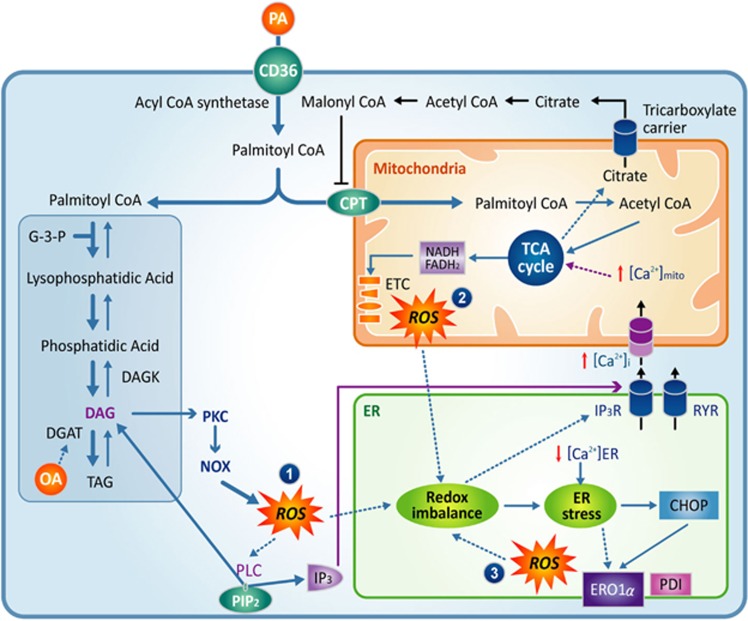
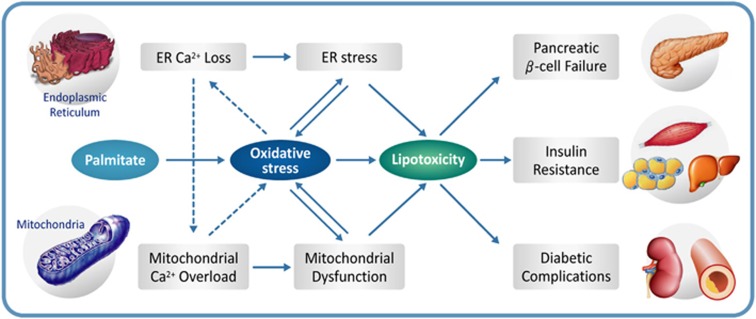
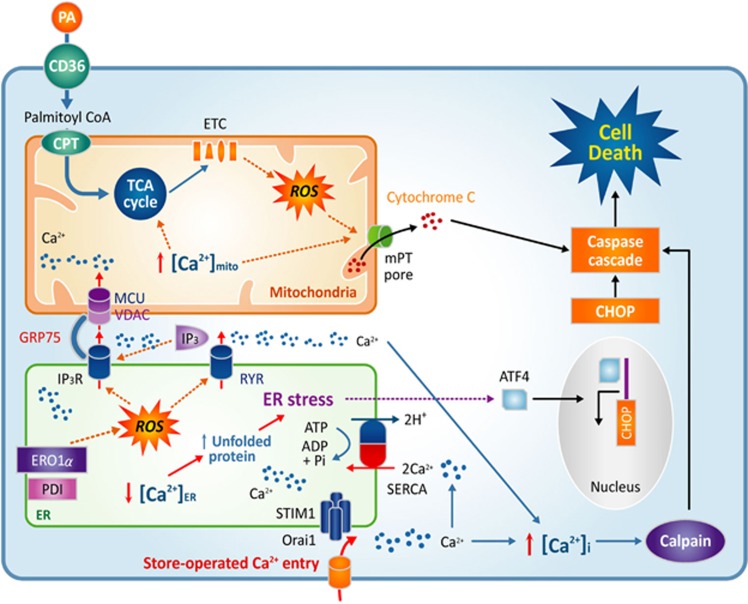
Free fatty acids (FFAs) are important substrates for mitochondrial oxidative metabolism and ATP synthesis but also cause serious stress to various tissues, contributing to the development of metabolic diseases. CD36 is a major mediator of cellular FFA uptake. Inside the cell, saturated FFAs are able to induce the production of cytosolic and mitochondrial reactive oxygen species (ROS), which can be prevented by co-exposure to unsaturated FFAs. There are close connections between oxidative stress and organellar Ca homeostasis. Highly oxidative conditions induced by palmitate trigger aberrant endoplasmic reticulum (ER) Ca release and thereby deplete ER Ca stores. The resulting ER Ca deficiency impairs chaperones of the protein folding machinery, leading to the accumulation of misfolded proteins. This ER stress may further aggravate oxidative stress by augmenting ER ROS production. Secondary to ER Ca release, cytosolic and mitochondrial matrix Ca concentrations can also be altered. In addition, plasmalemmal ion channels operated by ER Ca depletion mediate persistent Ca influx, further impairing cytosolic and mitochondrial Ca homeostasis. Mitochondrial Ca overload causes superoxide production and functional impairment, culminating in apoptosis. This vicious cycle of lipotoxicity occurs in multiple tissues, resulting in β-cell failure and insulin resistance in target tissues, and further aggravates diabetic complications.
游离脂肪酸(FFAs)是线粒体氧化代谢和ATP合成的重要底物,但也会给各种组织带来严重应激,促进代谢性疾病的发展。CD36是细胞摄取FFA的主要介质。在细胞内,饱和FFA能够诱导胞质和线粒体活性氧(ROS)的产生,而同时暴露于不饱和FFA可防止这种情况发生。氧化应激与细胞器钙稳态之间存在密切联系。棕榈酸酯诱导的高氧化状态会引发内质网(ER)钙异常释放,从而耗尽ER钙储备。由此产生的ER钙缺乏会损害蛋白质折叠机制的伴侣蛋白,导致错误折叠蛋白的积累。这种ER应激可能会通过增加ER ROS的产生进一步加重氧化应激。继ER钙释放之后,胞质和线粒体基质中的钙浓度也会发生改变。此外,由ER钙耗竭驱动的质膜离子通道介导持续的钙内流,进一步损害胞质和线粒体钙稳态。线粒体钙超载会导致超氧化物产生和功能障碍,最终导致细胞凋亡。这种脂毒性的恶性循环发生在多个组织中,导致β细胞功能衰竭和靶组织中的胰岛素抵抗,并进一步加重糖尿病并发症。