Liebers Monique, Grübler Björn, Chevalier Fabien, Lerbs-Mache Silva, Merendino Livia, Blanvillain Robert, Pfannschmidt Thomas
Laboratoire de Physiologie Cellulaire et Végétale, Institut de Biosciences et Biotechnologies de Grenoble, CNRS, CEA, INRA, Université Grenoble Alpes Grenoble, France.
Front Plant Sci. 2017 Jan 19;8:23. doi: 10.3389/fpls.2017.00023. eCollection 2017.
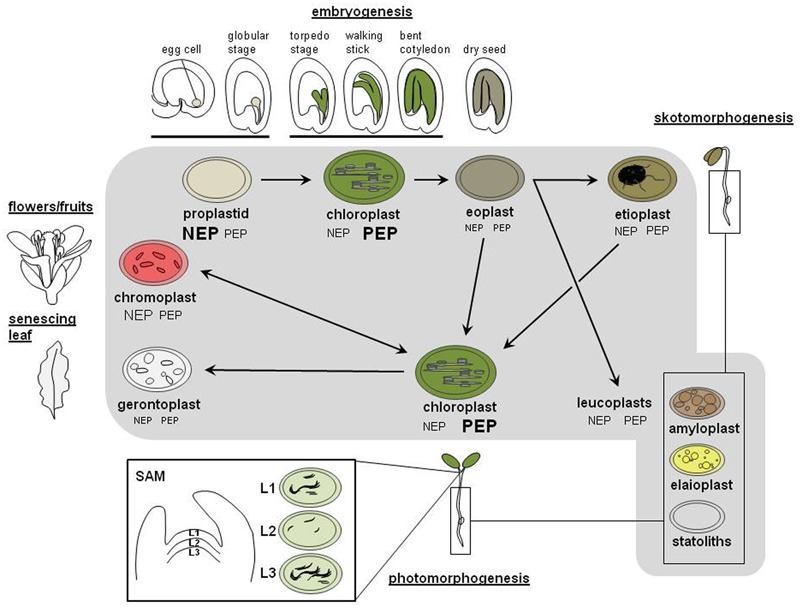
Plastids display a high morphological and functional diversity. Starting from an undifferentiated small proplastid, these plant cell organelles can develop into four major forms: etioplasts in the dark, chloroplasts in green tissues, chromoplasts in colored flowers and fruits and amyloplasts in roots. The various forms are interconvertible into each other depending on tissue context and respective environmental condition. Research of the last two decades uncovered that each plastid type contains its own specific proteome that can be highly different from that of the other types. Composition of these proteomes largely defines the enzymatic functionality of the respective plastid. The vast majority of plastid proteins is encoded in the nucleus and must be imported from the cytosol. However, a subset of proteins of the photosynthetic and gene expression machineries are encoded on the plastid genome and are transcribed by a complex transcriptional apparatus consisting of phage-type nuclear-encoded RNA polymerases and a bacterial-type plastid-encoded RNA polymerase. Both types recognize specific sets of promoters and transcribe partly over-lapping as well as specific sets of genes. Here we summarize the current knowledge about the sequential activity of these plastid RNA polymerases and their relative activities in different types of plastids. Based on published plastid gene expression profiles we hypothesize that each conversion from one plastid type into another is either accompanied or even preceded by significant changes in plastid transcription suggesting that these changes represent important determinants of plastid morphology and protein composition and, hence, the plastid type.
质体呈现出高度的形态和功能多样性。从未分化的小前质体开始,这些植物细胞器可发育成四种主要形式:黑暗中的黄化质体、绿色组织中的叶绿体、有色花朵和果实中的有色体以及根中的造粉体。根据组织环境和各自的环境条件,各种形式可相互转化。过去二十年的研究发现,每种质体类型都有其自身特定的蛋白质组,与其他类型的蛋白质组可能有很大差异。这些蛋白质组的组成在很大程度上决定了各个质体的酶促功能。绝大多数质体蛋白由细胞核编码,必须从细胞质中导入。然而,光合和基因表达机制中的一部分蛋白质由质体基因组编码,并由一个复杂的转录装置转录,该装置由噬菌体类型的核编码RNA聚合酶和细菌类型的质体编码RNA聚合酶组成。这两种类型都识别特定的启动子组,并转录部分重叠以及特定的基因集。在这里,我们总结了关于这些质体RNA聚合酶的顺序活性及其在不同类型质体中的相对活性的当前知识。基于已发表的质体基因表达谱,我们假设从一种质体类型到另一种质体类型的每次转变要么伴随着质体转录的显著变化,甚至在其之前发生,这表明这些变化代表了质体形态和蛋白质组成的重要决定因素,因此也是质体类型的重要决定因素。