Nora Anni, Karvonen Leena, Renvall Hanna, Parviainen Tiina, Kim Jeong-Young, Service Elisabet, Salmelin Riitta
Department of Neuroscience and Biomedical Engineering, and Aalto NeuroImaging, Aalto University, Espoo, Finland.
Department of Psychology, University of Jyväskylä, Jyväskylä, Finland.
PLoS One. 2017 Feb 3;12(2):e0171034. doi: 10.1371/journal.pone.0171034. eCollection 2017.
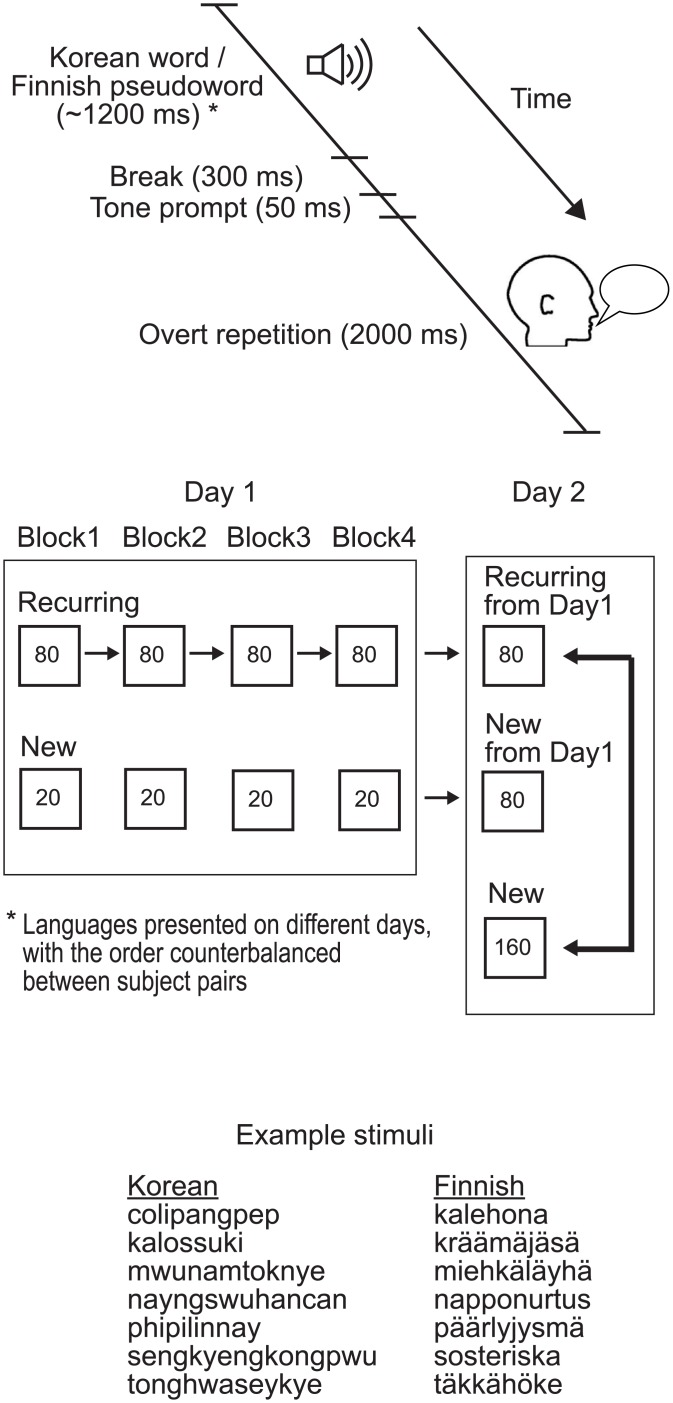
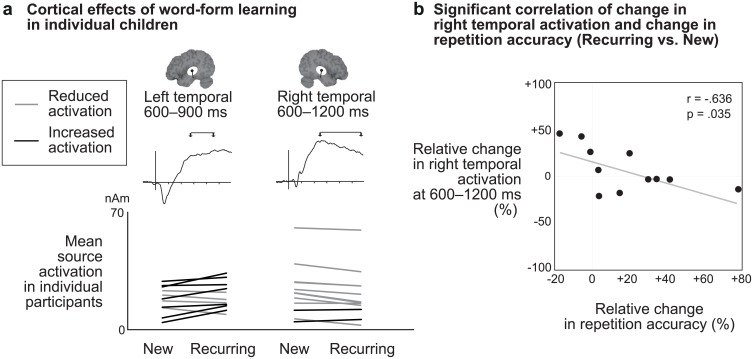
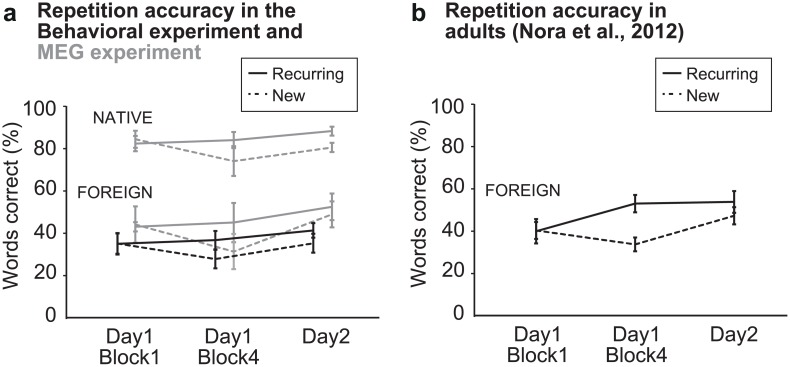
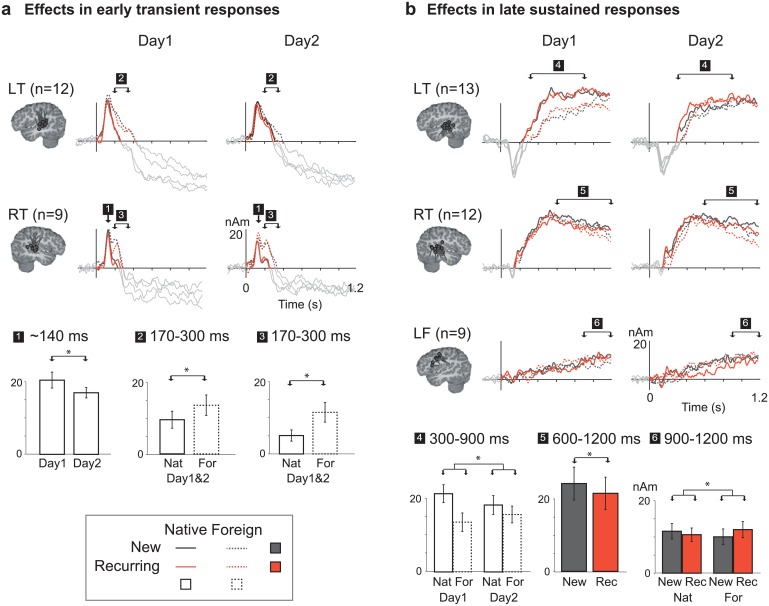
It is commonly thought that phonological learning is different in young children compared to adults, possibly due to the speech processing system not yet having reached full native-language specialization. However, the neurocognitive mechanisms of phonological learning in children are poorly understood. We employed magnetoencephalography (MEG) to track cortical correlates of incidental learning of meaningless word forms over two days as 6-8-year-olds overtly repeated them. Native (Finnish) pseudowords were compared with words of foreign sound structure (Korean) to investigate whether the cortical learning effects would be more dependent on previous proficiency in the language rather than maturational factors. Half of the items were encountered four times on the first day and once more on the following day. Incidental learning of these recurring word forms manifested as improved repetition accuracy and a correlated reduction of activation in the right superior temporal cortex, similarly for both languages and on both experimental days, and in contrast to a salient left-hemisphere emphasis previously reported in adults. We propose that children, when learning new word forms in either native or foreign language, are not yet constrained by left-hemispheric segmental processing and established sublexical native-language representations. Instead, they may rely more on supra-segmental contours and prosody.
人们普遍认为,与成年人相比,幼儿的语音学习有所不同,这可能是由于语音处理系统尚未达到完全的母语专业化。然而,儿童语音学习的神经认知机制却鲜为人知。我们采用脑磁图(MEG)技术,在两天时间里追踪6至8岁儿童在公开重复无意义单词形式时的附带学习的皮层相关性。将母语(芬兰语)假词与具有外国语音结构(韩语)的单词进行比较,以研究皮层学习效应是否更依赖于先前的语言熟练程度而非成熟因素。一半的项目在第一天出现四次,在第二天再出现一次。这些重复出现的单词形式的附带学习表现为重复准确性提高,以及右侧颞上叶皮层激活的相应减少,两种语言在两个实验日都是如此,这与之前报道的成年人中显著的左半球优势形成对比。我们提出,儿童在学习母语或外语的新单词形式时,尚未受到左半球分段处理和已建立的母语亚词汇表征的限制。相反,他们可能更多地依赖于超音段轮廓和韵律。