Liu Zhao, Jing Hui, Han Xue, Shao Hua, Sun Yi-Xin, Wang Qiu-Cheng, Cheng Wen
Department of Medical Ultrasound, Harbin Medical University Cancer Hospital, Harbin, Heilongjiang, China.
Oncotarget. 2017 Jun 27;8(26):43406-43416. doi: 10.18632/oncotarget.15018.
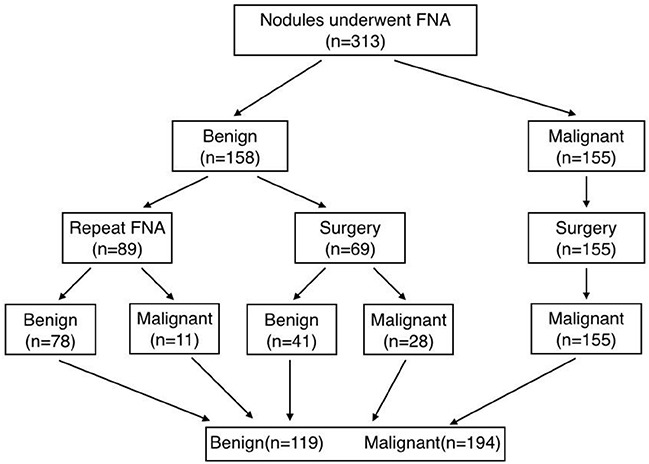
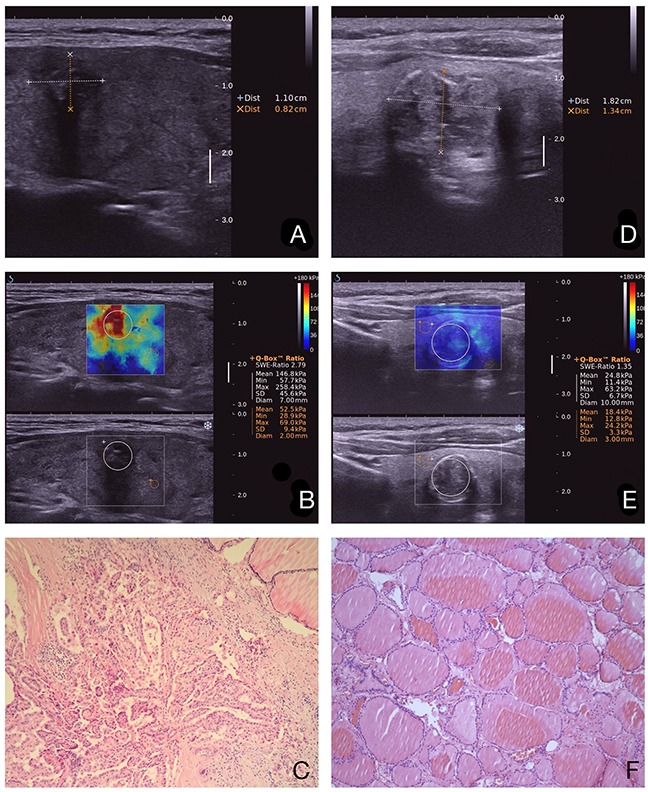
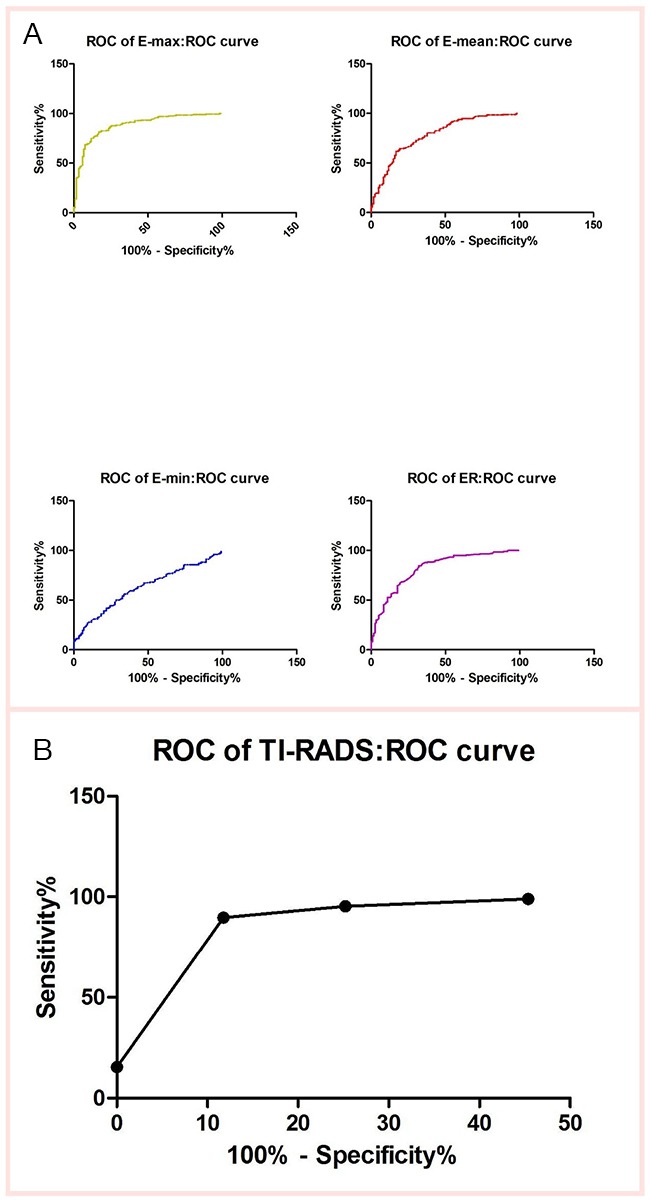
To retrospectively evaluate the diagnostic performance of shear wave elastography (SWE) and thyroid imaging reporting and data system (TI-RADS) in differentiating malignant and benign thyroid nodules. A total of 313 thyroid nodules in 227 patients were included. All thyroid nodules were underwent SWE and TI-RADS before fine needle aspiration biopsy and/or surgery. SWE elasticity indices of the maximum (Emax), mean (Emean), minimum (Emin) and elastic ratio (ER) in thyroid nodules were measured. Nodules with solid component, marked hypoechogenicity, poorly defined margins, micro-calcifications, and a taller-than-wide shape were classified as suspicious at gray-scale ultrasonography. The level of TI-RADS was determined according to the number of suspicious ultrasonography features. The combined methods of SWE and TI-RADS in thyroid nodules were calculated. In the 313 nodules, 194 were malignant, and 119 were benign. SWE and TI-RADS were significantly higher in malignant nodules than benign nodules (P < 0.001). The most accurate SWE cut-off value, 51.95 kPa for Emax, achieved a sensitivity of 81.44% and a specificity of 83.19% for discriminating malignant nodules from benign nodules. There are two methods in combination with SWE and TI-RADS. The one is "tandem" method, which has a higher specificity (95.80%), positive likelihood ratio (18.16) and positive predictive value (96.73%). The other one is "parallel" method, which shows sensitivity (94.85%), negative likelihood ratio (0.07) and negative predictive value (90.00%).We believe that the methods could be used as a simple tool to stratify the risk of thyroid nodules accurately.
回顾性评估剪切波弹性成像(SWE)和甲状腺影像报告和数据系统(TI-RADS)在鉴别甲状腺良恶性结节中的诊断性能。纳入了227例患者的313个甲状腺结节。所有甲状腺结节在细针穿刺活检和/或手术前均接受了SWE和TI-RADS检查。测量甲状腺结节的最大弹性指数(Emax)、平均弹性指数(Emean)、最小弹性指数(Emin)和弹性比(ER)。在灰阶超声检查中,具有实性成分、显著低回声、边界不清、微钙化和纵横比大于1的结节被分类为可疑结节。根据可疑超声特征的数量确定TI-RADS分级。计算SWE和TI-RADS在甲状腺结节中的联合方法。在313个结节中,194个为恶性,119个为良性。恶性结节的SWE和TI-RADS明显高于良性结节(P<0.001)。Emax最准确的SWE截断值为51.95 kPa,鉴别恶性结节与良性结节的灵敏度为81.44%,特异度为83.19%。SWE和TI-RADS有两种联合方法。一种是“串联”法,具有较高的特异度(95.80%)、阳性似然比(18.16)和阳性预测值(96.73%)。另一种是“并联”法,显示出灵敏度(94.85%)、阴性似然比(0.07)和阴性预测值(90.00%)。我们认为这些方法可作为一种简单工具来准确分层甲状腺结节的风险。