Sedghi Maryam, Esfandiari Elham, Fazel-Najafabadi Esmat, Salehi Mansoor, Salavaty Abbas, Fattahpour Shirin, Dehghani Leila, Nouri Nayerossadat, Mokarian Fariborz
Medical Genetics Laboratory, Alzahra University Hospital, Isfahan University of Medical Sciences, Isfahan, Iran; Pediatric Inherited Diseases Research Center, Research Institute for Primordial Prevention of Non-communicable Disease, Isfahan University of Medical Sciences, Isfahan, Iran.
Medical Genetics Laboratory, Alzahra University Hospital, Isfahan University of Medical Sciences, Isfahan, Iran.
J Res Med Sci. 2016 Nov 2;21:95. doi: 10.4103/1735-1995.193167. eCollection 2016.
The second leading cause of cancer deaths in women is breast cancer. Germline mutations in susceptibility breast cancer gene increase the lifetime risk of breast cancer. Eighty-one large genomic rearrangements (LGRs) have been reported up to date in gene, and evaluation of these rearrangements helps with precise risk assessment in high-risk individuals. In this study, we have investigated LGRs in among Iranian high-risk breast cancer families.
Seventy patients with breast cancer who were identified negative for point mutations or small deletions/insertions of gene were selected. Deletions and duplications of gene were evaluated using multiplex ligation-dependent probe amplification (MLPA).
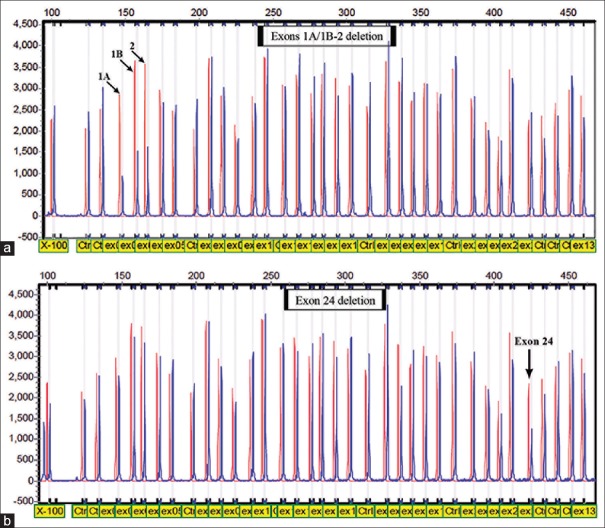
Two deletions, deletion of exons 1A/1B-2 and exon 24, were detected in two patients with breast cancer. The former alteration was found in a woman with a strong family history of breast cancer while the latter one was detected in a woman with early onset of breast cancer.
Although our data confirm that LGRs in comprise a relatively small proportion of mutations in hereditary breast cancer in the Iranian population, MLPA analysis might be considered for screening of LGRs in high-risk individuals. It is worth to note that our results are consistent with previous studies in various Asian and European countries.
乳腺癌是女性癌症死亡的第二大主要原因。乳腺癌易感基因的种系突变会增加患乳腺癌的终生风险。截至目前,已报道了该基因中的81种大型基因组重排(LGR),对这些重排的评估有助于对高危个体进行精确的风险评估。在本研究中,我们调查了伊朗高危乳腺癌家族中该基因的LGR。
选择70例经检测基因点突变或小缺失/插入为阴性的乳腺癌患者。使用多重连接依赖探针扩增(MLPA)评估该基因的缺失和重复情况。
在两名乳腺癌患者中检测到两个缺失,即外显子1A/1B - 2和外显子24的缺失。前一种改变在一名有强烈乳腺癌家族史的女性中发现,而后一种在一名乳腺癌早发的女性中检测到。
尽管我们的数据证实该基因的LGR在伊朗人群遗传性乳腺癌突变中所占比例相对较小,但对于高危个体的LGR筛查可考虑采用MLPA分析。值得注意的是,我们的结果与之前在亚洲和欧洲各国的研究一致。