Department of Earth and Atmospheric Sciences, University of Houston, Houston, TX 77204-5007, USA.
Department of Earth and Atmospheric Sciences, University of Houston, Houston, TX 77204-5007, USA.; Department of Geoscience, Aarhus University, Aarhus, Denmark.
Sci Adv. 2017 Feb 1;3(2):e1600922. doi: 10.1126/sciadv.1600922. eCollection 2017 Feb.
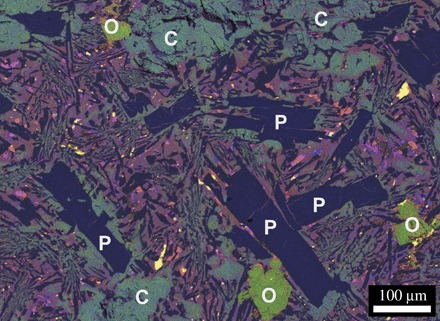
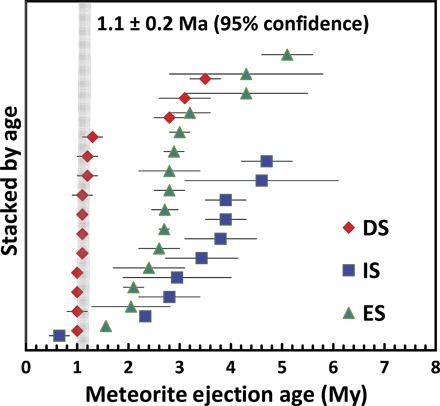
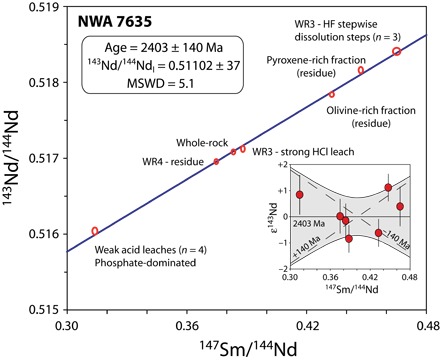
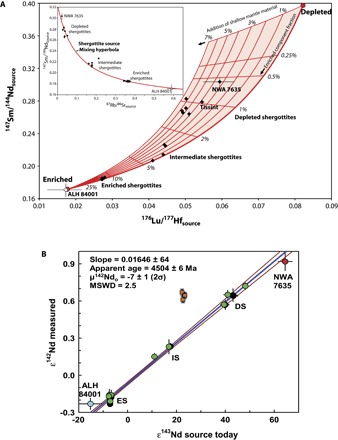
The timing and nature of igneous activity recorded at a single Mars ejection site can be determined from the isotope analyses of Martian meteorites. Northwest Africa (NWA) 7635 has an Sm-Nd crystallization age of 2.403 ± 0.140 billion years, and isotope data indicate that it is derived from an incompatible trace element-depleted mantle source similar to that which produced a geochemically distinct group of 327- to 574-million-year-old "depleted" shergottites. Cosmogenic nuclide data demonstrate that NWA 7635 was ejected from Mars 1.1 million years ago (Ma), as were at least 10 other depleted shergottites. The shared ejection age is consistent with a common ejection site for these meteorites. The spatial association of 327- to 2403-Ma depleted shergottites indicates >2 billion years of magmatism from a long-lived and geochemically distinct volcanic center near the ejection site.
通过对火星陨石的同位素分析,可以确定单个火星喷发地点记录的火成岩活动的时间和性质。西北非(NWA)7635 的 Sm-Nd 结晶年龄为 24.03 ± 0.140 亿年,同位素数据表明它源自与产生一组具有独特地球化学特征的 3.27 亿至 5.74 亿年“贫化”辉玻陨石的不相容微量元素贫化地幔源相似。宇宙成因核素数据表明,NWA 7635 是在 110 万年前从火星上抛出的,至少还有 10 块其他贫化辉玻陨石也是如此。共同的抛射年龄与这些陨石的共同抛射地点一致。3.27 亿至 2403 万年贫化辉玻陨石的空间关联表明,在抛射地点附近存在一个长期存在且地球化学特征独特的火山中心,其岩浆活动持续了超过 20 亿年。