Clarke Laurence J, Beard Jason M, Swadling Kerrie M, Deagle Bruce E
Antarctic Climate & Ecosystems Cooperative Research Centre University of Tasmania Hobart Tas. Australia; Australian Antarctic Division Kingston Tas. Australia.
Institute for Marine and Antarctic Studies University of Tasmania Hobart Tas. Australia.
Ecol Evol. 2017 Jan 12;7(3):873-883. doi: 10.1002/ece3.2667. eCollection 2017 Feb.
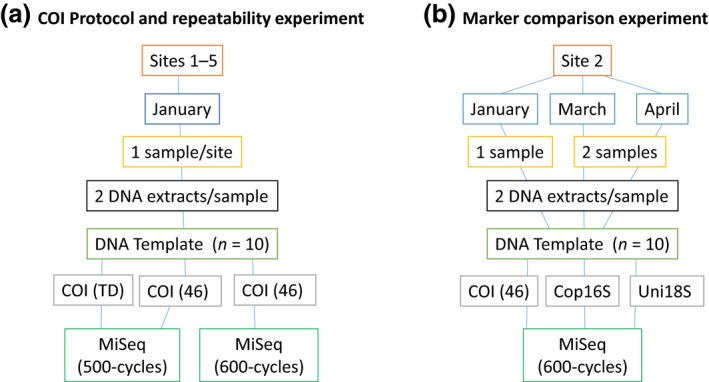
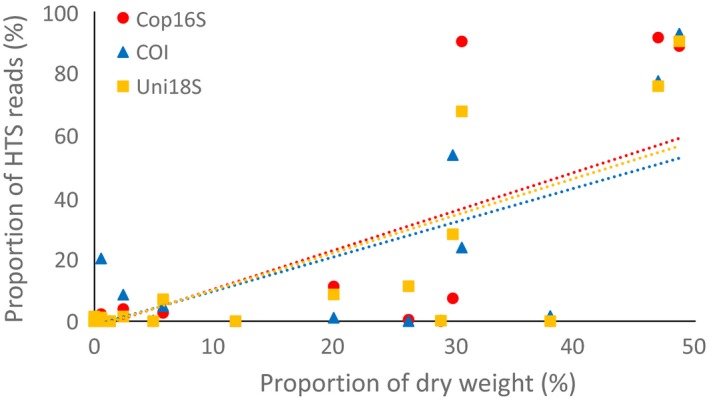
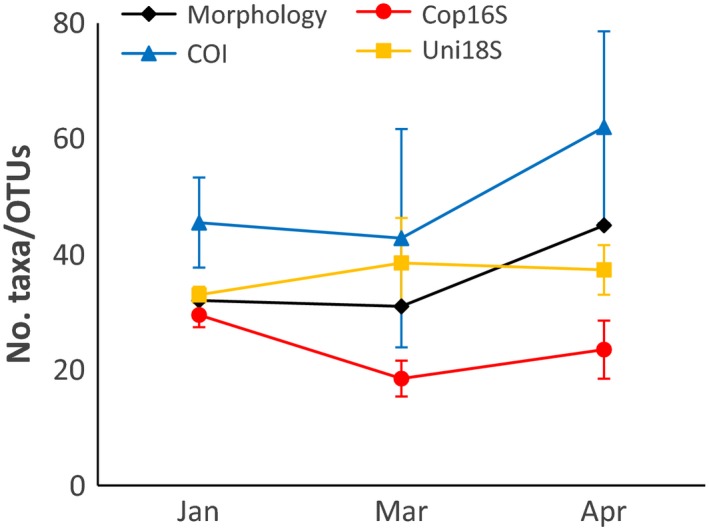
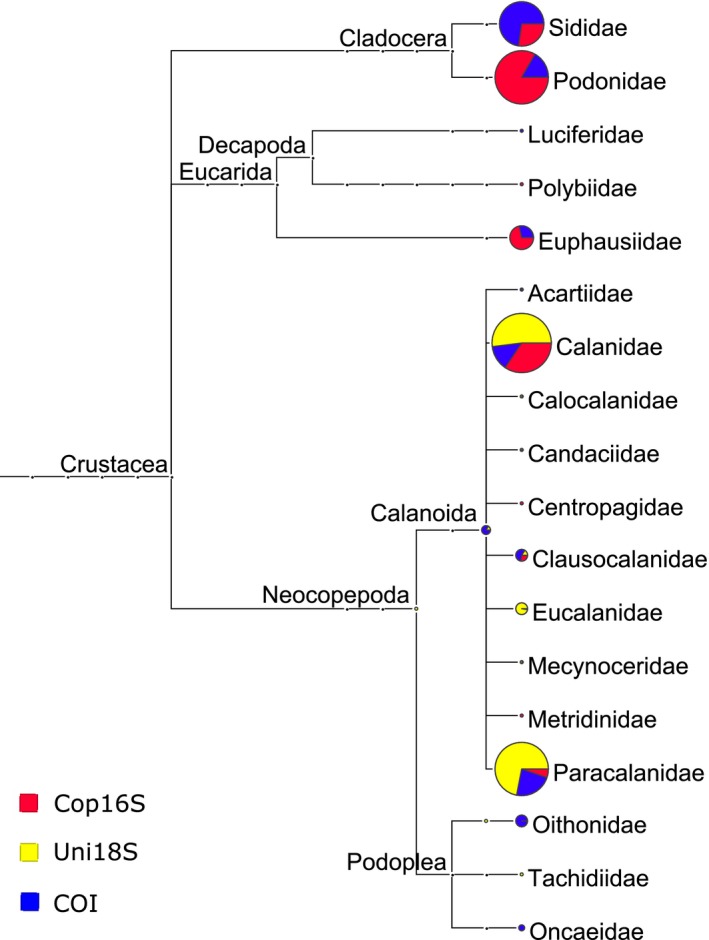
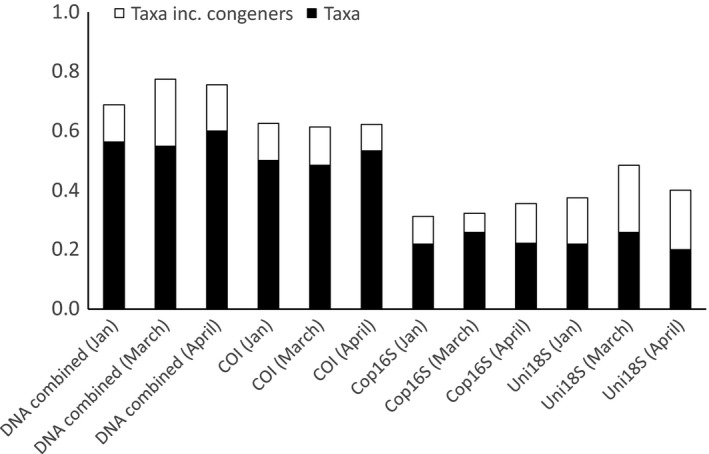
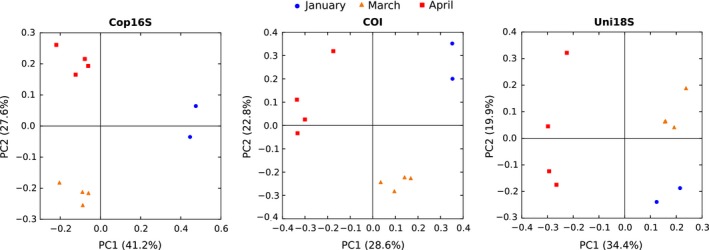
DNA metabarcoding is a promising approach for rapidly surveying biodiversity and is likely to become an important tool for measuring ecosystem responses to environmental change. Metabarcoding markers need sufficient taxonomic coverage to detect groups of interest, sufficient sequence divergence to resolve species, and will ideally indicate relative abundance of taxa present. We characterized zooplankton assemblages with three different metabarcoding markers (nuclear 18S rDNA, mitochondrial COI, and mitochondrial 16S rDNA) to compare their performance in terms of taxonomic coverage, taxonomic resolution, and correspondence between morphology- and DNA-based identification. COI amplicons sequenced on separate runs showed that operational taxonomic units representing >0.1% of reads per sample were highly reproducible, although slightly more taxa were detected using a lower annealing temperature. Mitochondrial COI and nuclear 18S showed similar taxonomic coverage across zooplankton phyla. However, mitochondrial COI resolved up to threefold more taxa to species compared to 18S. All markers revealed similar patterns of beta-diversity, although different taxa were identified as the greatest contributors to these patterns for 18S. For calanoid copepod families, all markers displayed a positive relationship between biomass and sequence reads, although the relationship was typically strongest for 18S. The use of COI for metabarcoding has been questioned due to lack of conserved primer-binding sites. However, our results show the taxonomic coverage and resolution provided by degenerate COI primers, combined with a comparatively well-developed reference sequence database, make them valuable metabarcoding markers for biodiversity assessment.
DNA 宏条形码技术是一种快速调查生物多样性的很有前景的方法,并且很可能成为衡量生态系统对环境变化响应的重要工具。宏条形码标记需要有足够的分类学覆盖范围以检测感兴趣的类群,有足够的序列差异以区分物种,并且理想情况下能指示所存在分类单元的相对丰度。我们用三种不同的宏条形码标记(核 18S rDNA、线粒体 COI 和线粒体 16S rDNA)对浮游动物群落进行了特征分析,以比较它们在分类学覆盖范围、分类学分辨率以及基于形态学和基于 DNA 的鉴定之间的对应关系方面的表现。在单独的测序运行中对 COI 扩增子进行测序表明,代表每个样本读数 >0.1% 的操作分类单元具有高度可重复性,尽管使用较低的退火温度检测到的类群略多一些。线粒体 COI 和核 18S 在浮游动物门类中显示出相似的分类学覆盖范围。然而,与 18S 相比,线粒体 COI 能区分出多至三倍的物种分类单元。所有标记都揭示了相似的β多样性模式,尽管对于 18S 而言,不同的分类单元被确定为这些模式的最大贡献者。对于哲水蚤科,所有标记在生物量和序列读数之间都呈现出正相关关系,尽管这种关系通常对 18S 来说最强。由于缺乏保守的引物结合位点,COI 用于宏条形码技术受到了质疑。然而,我们的结果表明,简并 COI 引物提供的分类学覆盖范围和分辨率,结合相对完善的参考序列数据库,使其成为生物多样性评估中有价值的宏条形码标记。