Patel Rupal M, Misra Ranjita, Raj Sudha, Balasubramanyam Ashok
School of Physical Therapy, Texas Woman's University, 6700 Fannin Street, Houston, TX 77030, USA.
Department of Social & Behavioral Sciences, Room No. 3313A, Robert C Byrd Health Science Center, School of Public Health, West Virginia University, Morgantown, WV 26506-9190, USA.
J Diabetes Res. 2017;2017:2751980. doi: 10.1155/2017/2751980. Epub 2017 Jan 11.
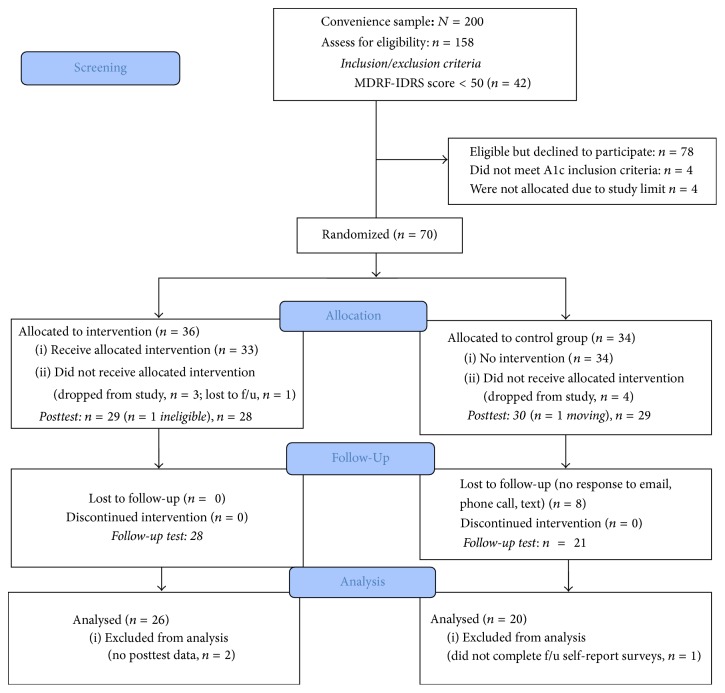
This study used an experimental, pretest-posttest control group repeated measures design to evaluate the effectiveness of a community-based culturally appropriate lifestyle intervention program to reduce the risk for type 2 diabetes (T2DM) among Asian Indians (AIs) in an urban community in the US. Participants included 70 adult AIs in the greater Houston metropolitan area. The primary outcomes were reduction in weight and hemoglobin A1c (HbA1c) and improvement in physical activity. Participants were screened for risk factors and randomly assigned to a 12-week group-based lifestyle intervention program ( = 34) or a control group ( = 36) that received standard print material on diabetes prevention. Participants also completed clinical measures and self-reported questionnaires about physical activity, social, and lifestyle habits at 0, 3, and 6 months. No significant baseline differences were noted between groups. While a significant decline in weight and increase in physical activity was observed in all participants, the intervention group lowered their HbA1c ( < 0.0005) and waist circumference ( = 0.04) significantly as compared to the control group. Findings demonstrated that participation in a culturally tailored, lifestyle intervention program in a community setting can effectively reduce weight, waist circumference, and HbA1c among AIs living in the US.
本研究采用实验性、前测-后测控制组重复测量设计,以评估一项基于社区的、符合文化背景的生活方式干预项目在美国一个城市社区中降低亚洲印度裔(AI)2型糖尿病(T2DM)风险的有效性。参与者包括大休斯顿都会区的70名成年亚洲印度裔。主要结局指标为体重减轻、糖化血红蛋白(HbA1c)降低以及身体活动改善。对参与者进行风险因素筛查,并随机分为接受为期12周的基于小组的生活方式干预项目的干预组(n = 34)或接受关于糖尿病预防的标准印刷材料的对照组(n = 36)。参与者还在0、3和6个月时完成了临床测量以及关于身体活动、社交和生活方式习惯的自我报告问卷。两组之间未观察到显著的基线差异。虽然所有参与者的体重均显著下降且身体活动增加,但与对照组相比,干预组的HbA1c(P < 0.0005)和腰围(P = 0.04)显著降低。研究结果表明,参与社区环境中符合文化特点的生活方式干预项目可有效降低居住在美国的亚洲印度裔的体重、腰围和HbA1c。