Donahue's Consulting Inc., New Orleans, Louisiana, USA.
Department of Veterinary Medicine, Tulane National Primate Research Center, Covington, Louisiana, USA.
Stem Cells Transl Med. 2017 Jan;6(1):99-109. doi: 10.5966/sctm.2015-0317. Epub 2016 Aug 24.
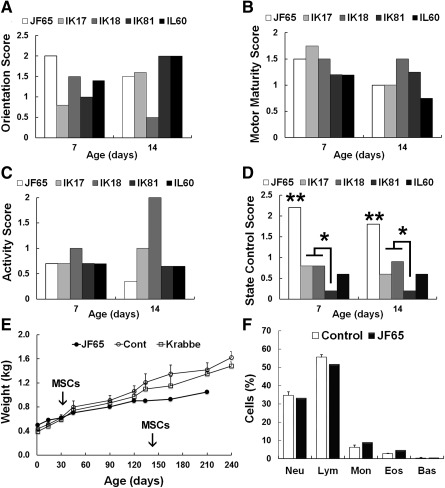
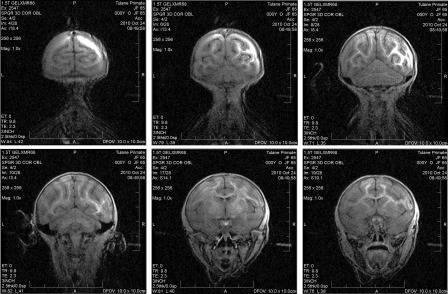
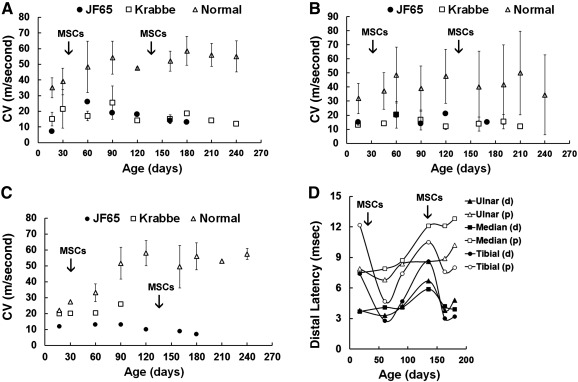
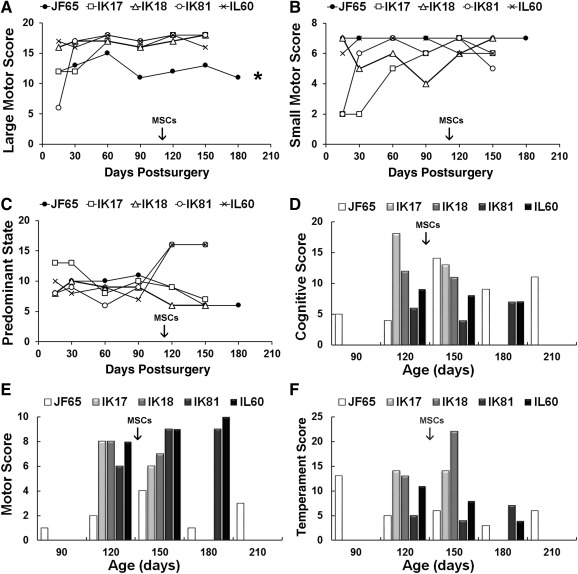
Krabbe disease, or globoid cell leukodystrophy, is a rare disorder caused by deficient galactosylceramidase activity and loss of myelin-forming oligodendrocytes, resulting in progressive demyelination and severely impaired motor function. Disease symptoms in humans appear within 3-6 months of age (early infantile) and manifest as marked irritability, spasticity, and seizures. The disease is often fatal by the second year of life, with few effective treatment options. Herein we evaluated the therapeutic potential of mesenchymal stem cells (MSCs) administered intracranially to a 1-month-old rhesus macaque diagnosed with severe early-onset Krabbe disease that displayed neurologic and behavioral symptoms similar to those of human patients. The infant was subjected to physical and neurological behavior examinations and nerve conduction velocity tests to assess efficacy, and outcomes were compared with age-matched normal infants and Krabbe-affected rhesus monkeys with late-onset disease. Changes in major blood lymphocyte populations were also monitored to assess host immune cell responses. MSC administration resulted in transient improvements in coordination, ambulation, cognition, and large motor skills, which correlated with increased peripheral nerve conduction velocities and decreased latencies. Improvements also corresponded to transient increases in peripheral blood lymphocyte counts, but secondary challenge failed to elicit allo-antibody production. Nevertheless, white cell and neutrophil counts showed dramatic increases, and CD20 B cell counts underwent a precipitous decline at late stages of disease progression. Correlative data linking MSC administration to transient improvements in motor function suggest that MSCs should be evaluated further as an experimental therapy for rare neurodegenerative diseases. Stem Cells Translational Medicine 2017;6:99-109.
克拉伯病,又称球形细胞脑白质营养不良,是一种由半乳糖脑苷脂酶活性缺乏和髓鞘形成少突胶质细胞缺失引起的罕见疾病,导致进行性脱髓鞘和严重运动功能障碍。人类疾病症状在出生后 3-6 个月(早发性婴儿)出现,并表现为明显的易激惹、痉挛和癫痫发作。这种疾病在出生后的第二年通常是致命的,治疗方法有限。在此,我们评估了间充质干细胞(MSCs)经颅注射治疗 1 月龄恒河猴严重早发性克拉伯病的治疗潜力,该恒河猴表现出与人类患者相似的神经和行为症状。对婴儿进行了身体和神经行为检查以及神经传导速度测试,以评估疗效,并将结果与年龄匹配的正常婴儿和晚发性疾病的克拉伯病恒河猴进行比较。还监测了主要血液淋巴细胞群的变化,以评估宿主免疫细胞反应。MSC 给药导致协调、步行、认知和大运动技能的短暂改善,与周围神经传导速度的增加和潜伏期的缩短相关。改善也与外周血淋巴细胞计数的短暂增加相关,但二次挑战未能引起同种抗体产生。尽管如此,白细胞和中性粒细胞计数急剧增加,CD20 B 细胞计数在疾病进展的后期急剧下降。将 MSC 给药与运动功能的短暂改善相关联的相关数据表明,应该进一步评估 MSC 作为治疗罕见神经退行性疾病的实验疗法。《干细胞转化医学》2017 年;6:99-109.