• 文献检索
  • 文档翻译
  • 深度研究
  • 学术资讯
  • Suppr Zotero 插件Zotero 插件
  • 邀请有礼
  • 套餐&价格
  • 历史记录
应用&插件
Suppr Zotero 插件Zotero 插件浏览器插件Mac 客户端Windows 客户端微信小程序
定价
高级版会员购买积分包购买API积分包
服务
文献检索文档翻译深度研究API 文档MCP 服务
关于我们
关于 Suppr公司介绍联系我们用户协议隐私条款
关注我们

Suppr 超能文献

核心技术专利:CN118964589B侵权必究
粤ICP备2023148730 号-1Suppr @ 2026

文献检索

告别复杂PubMed语法,用中文像聊天一样搜索,搜遍4000万医学文献。AI智能推荐,让科研检索更轻松。

立即免费搜索

文件翻译

保留排版,准确专业,支持PDF/Word/PPT等文件格式,支持 12+语言互译。

免费翻译文档

深度研究

AI帮你快速写综述,25分钟生成高质量综述,智能提取关键信息,辅助科研写作。

立即免费体验

经阴道分娩时会阴切开术的选择性使用与常规使用

Selective versus routine use of episiotomy for vaginal birth.

作者信息

Jiang Hong, Qian Xu, Carroli Guillermo, Garner Paul

机构信息

Department of Maternal, Child and Adolescent Health, School of Public Health, Fudan University, Mailbox 175, No. 138 Yi Xue Yuan Road, Shanghai, Shanghai, China, 200032.

Centro Rosarino de Estudios Perinatales (CREP), Moreno 878 piso 6, Rosario, Santa Fe, Argentina, 2000.

出版信息

Cochrane Database Syst Rev. 2017 Feb 8;2(2):CD000081. doi: 10.1002/14651858.CD000081.pub3.

DOI:10.1002/14651858.CD000081.pub3
PMID:28176333
原文链接:https://pmc.ncbi.nlm.nih.gov/articles/PMC5449575/
Abstract

BACKGROUND

Some clinicians believe that routine episiotomy, a surgical cut of the vagina and perineum, will prevent serious tears during childbirth. On the other hand, an episiotomy guarantees perineal trauma and sutures.

OBJECTIVES

To assess the effects on mother and baby of a policy of selective episiotomy ('only if needed') compared with a policy of routine episiotomy ('part of routine management') for vaginal births.

SEARCH METHODS

We searched Cochrane Pregnancy and Childbirth's Trials Register (14 September 2016) and reference lists of retrieved studies.

SELECTION CRITERIA

Randomised controlled trials (RCTs) comparing selective versus routine use of episiotomy, irrespective of parity, setting or surgical type of episiotomy. We included trials where either unassisted or assisted vaginal births were intended. Quasi-RCTs, trials using a cross-over design or those published in abstract form only were not eligible for inclusion in this review.

DATA COLLECTION AND ANALYSIS

Two authors independently screened studies, extracted data, and assessed risk of bias. A third author mediated where there was no clear consensus. We observed good practice for data analysis and interpretation where trialists were review authors. We used fixed-effect models unless heterogeneity precluded this, expressed results as risk ratios (RR) and 95% confidence intervals (CI), and assessed the certainty of the evidence using GRADE.

MAIN RESULTS

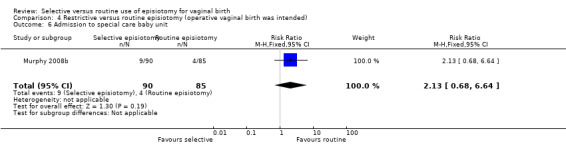
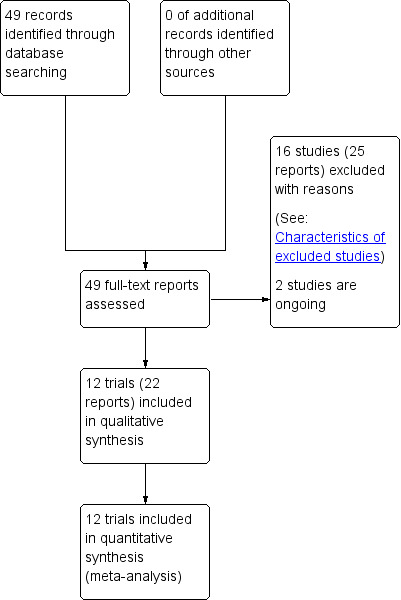
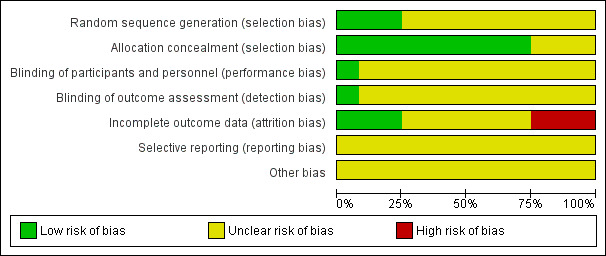
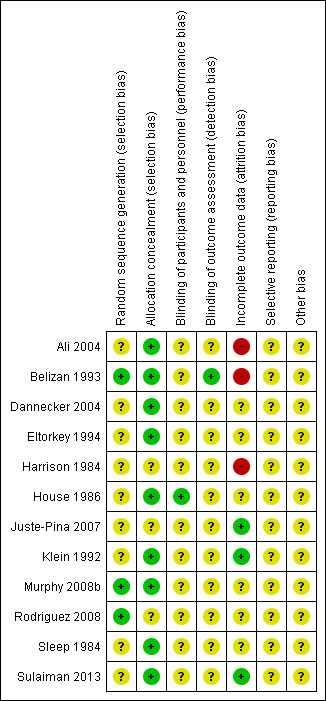
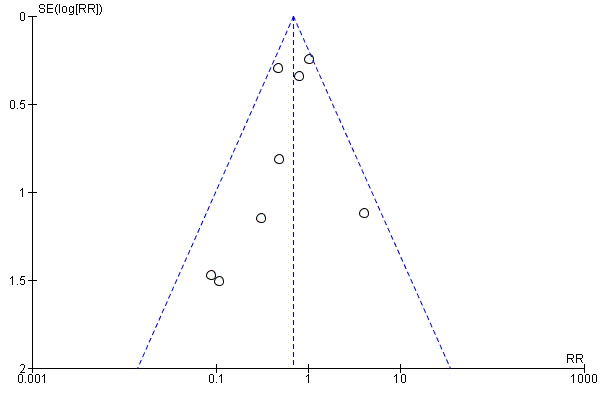
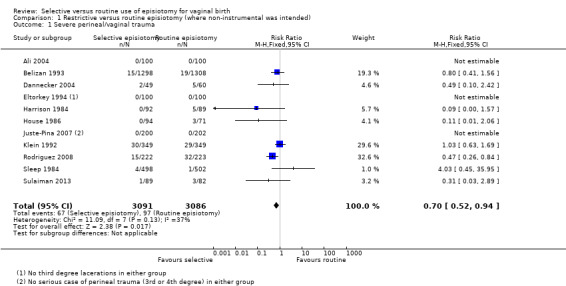
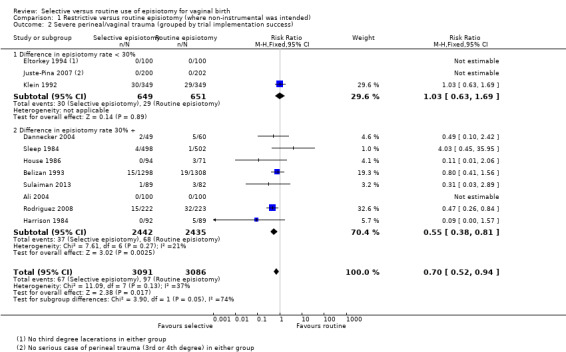
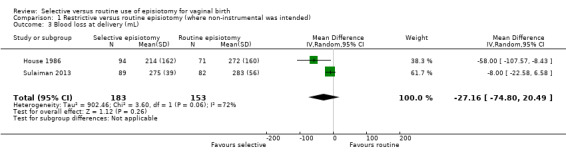
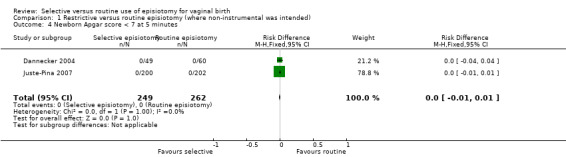
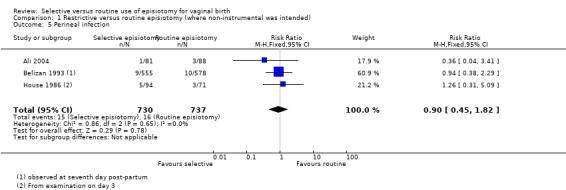
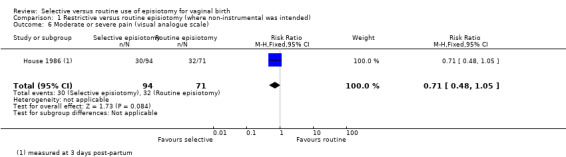
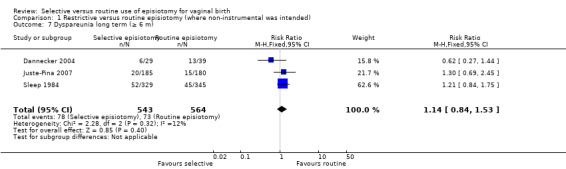
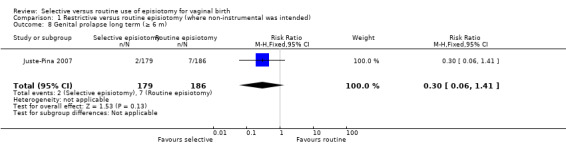
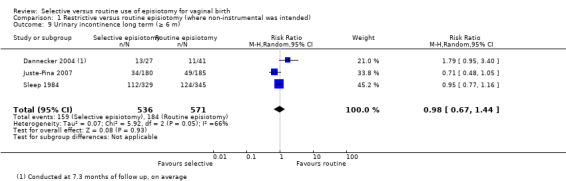
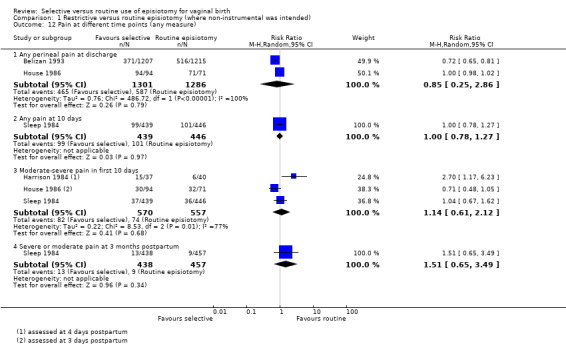
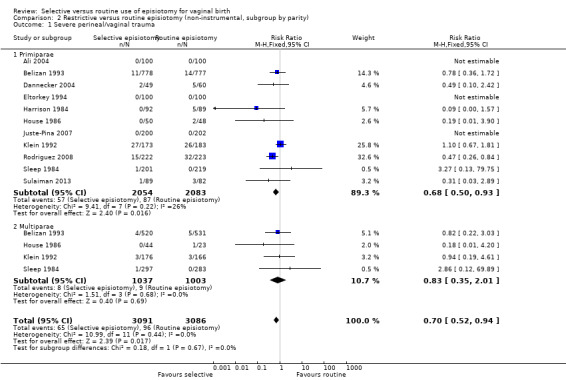
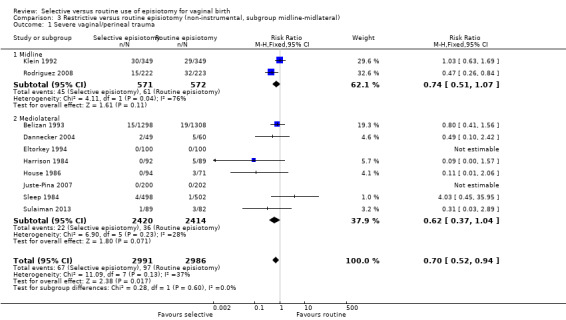
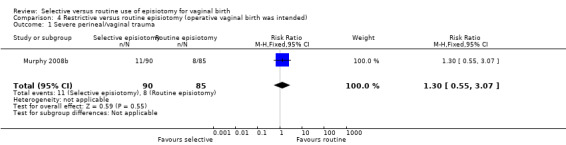
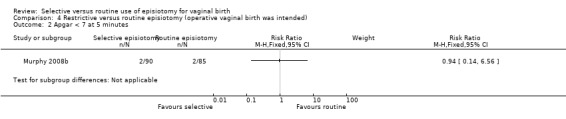
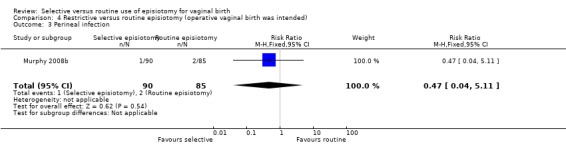
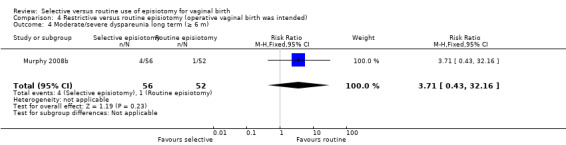
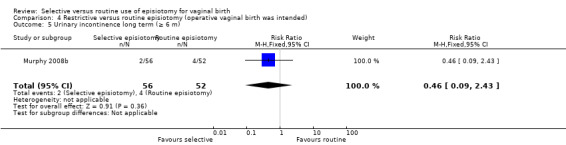
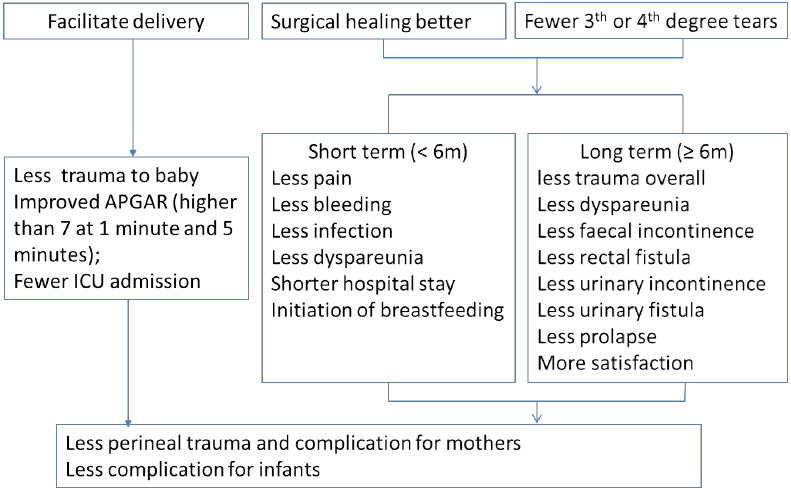
This updated review includes 12 studies (6177 women), 11 in women in labour for whom a vaginal birth was intended, and one in women where an assisted birth was anticipated. Two were trials each with more than 1000 women (Argentina and the UK), and the rest were smaller (from Canada, Germany, Spain, Ireland, Malaysia, Pakistan, Columbia and Saudi Arabia). Eight trials included primiparous women only, and four trials were in both primiparous and multiparous women. For risk of bias, allocation was adequately concealed and reported in nine trials; sequence generation random and adequately reported in three trials; blinding of outcomes adequate and reported in one trial, blinding of participants and personnel reported in one trial.For women where an unassisted vaginal birth was anticipated, a policy of selective episiotomy may result in 30% fewer women experiencing severe perineal/vaginal trauma (RR 0.70, 95% CI 0.52 to 0.94; 5375 women; eight RCTs; low-certainty evidence). We do not know if there is a difference for blood loss at delivery (an average of 27 mL less with selective episiotomy, 95% CI from 75 mL less to 20 mL more; two trials, 336 women, very low-certainty evidence). Both selective and routine episiotomy have little or no effect on infants with Apgar score less than seven at five minutes (four trials, no events; 3908 women, moderate-certainty evidence); and there may be little or no difference in perineal infection (RR 0.90, 95% CI 0.45 to 1.82, three trials, 1467 participants, low-certainty evidence).For pain, we do not know if selective episiotomy compared with routine results in fewer women with moderate or severe perineal pain (measured on a visual analogue scale) at three days postpartum (RR 0.71, 95% CI 0.48 to 1.05, one trial, 165 participants, very low-certainty evidence). There is probably little or no difference for long-term (six months or more) dyspareunia (RR1.14, 95% CI 0.84 to 1.53, three trials, 1107 participants, moderate-certainty evidence); and there may be little or no difference for long-term (six months or more) urinary incontinence (average RR 0.98, 95% CI 0.67 to 1.44, three trials, 1107 participants, low-certainty evidence). One trial reported genital prolapse at three years postpartum. There was no clear difference between the two groups (RR 0.30, 95% CI 0.06 to 1.41; 365 women; one trial, low certainty evidence). Other outcomes relating to long-term effects were not reported (urinary fistula, rectal fistula, and faecal incontinence). Subgroup analyses by parity (primiparae versus multiparae) and by surgical method (midline versus mediolateral episiotomy) did not identify any modifying effects. Pain was not well assessed, and women's preferences were not reported.One trial examined selective episiotomy compared with routine episiotomy in women where an operative vaginal delivery was intended in 175 women, and did not show clear difference on severe perineal trauma between the restrictive and routine use of episiotomy, but the analysis was underpowered.

AUTHORS' CONCLUSIONS: In women where no instrumental delivery is intended, selective episiotomy policies result in fewer women with severe perineal/vaginal trauma. Other findings, both in the short or long term, provide no clear evidence that selective episiotomy policies results in harm to mother or baby.The review thus demonstrates that believing that routine episiotomy reduces perineal/vaginal trauma is not justified by current evidence. Further research in women where instrumental delivery is intended may help clarify if routine episiotomy is useful in this particular group. These trials should use better, standardised outcome assessment methods.

摘要

背景

一些临床医生认为,常规会阴切开术(一种对阴道和会阴的外科切割)可预防分娩时的严重撕裂伤。另一方面,会阴切开术会导致会阴创伤和缝合。

目的

评估选择性会阴切开术(“仅在必要时”)与常规会阴切开术(“常规处理的一部分”)策略对阴道分娩母婴的影响。

检索方法

我们检索了Cochrane妊娠与分娩试验注册库(2016年9月14日)以及检索到的研究的参考文献列表。

入选标准

比较选择性与常规使用会阴切开术的随机对照试验(RCT),不考虑产次、分娩环境或会阴切开术的手术类型。我们纳入了旨在进行非助产或助产阴道分娩的试验。准RCT、采用交叉设计的试验或仅以摘要形式发表的试验均不符合本综述的纳入标准。

数据收集与分析

两位作者独立筛选研究、提取数据并评估偏倚风险。在没有明确共识的情况下,由第三位作者进行协调。当试验者为综述作者时,我们观察到了良好的数据分析和解释方法。除非存在异质性,否则我们使用固定效应模型,将结果表示为风险比(RR)和95%置信区间(CI),并使用GRADE评估证据的确定性。

主要结果

本更新综述纳入了12项研究(6177名女性),其中11项针对计划进行阴道分娩的分娩期女性,1项针对预计进行助产分娩的女性。两项试验每项涉及超过1000名女性(阿根廷和英国),其余试验规模较小(来自加拿大、德国、西班牙、爱尔兰、马来西亚、巴基斯坦、哥伦比亚和沙特阿拉伯)。八项试验仅纳入初产妇,四项试验纳入了初产妇和经产妇。关于偏倚风险,九项试验中分配方案得到了充分隐藏和报告;三项试验中随机序列生成随机且报告充分;一项试验中结局盲法充分且报告充分,一项试验中参与者和人员盲法得到报告。对于预计进行非助产阴道分娩的女性,选择性会阴切开术策略可能会使经历严重会阴/阴道创伤的女性减少30%(RR 0.70,95%CI 0.52至0.94;5375名女性;八项RCT;低确定性证据)。我们不知道分娩时失血是否存在差异(选择性会阴切开术平均少27 mL,95%CI从少75 mL至多20 mL;两项试验,336名女性;极低确定性证据)。选择性和常规会阴切开术对5分钟时阿氏评分低于7分的婴儿几乎没有影响(四项试验,无事件发生;3908名女性;中等确定性证据);会阴感染可能几乎没有差异(RR 0.90,95%CI 从0.45至1.82;三项试验,1467名参与者;低确定性证据)。对于疼痛,我们不知道与常规会阴切开术相比,选择性会阴切开术是否会使产后三天出现中度或重度会阴疼痛(采用视觉模拟评分法测量)的女性更少(RR 0.71,95%CI 0.48至1.05;一项试验,165名参与者;极低确定性证据)。长期(六个月或更长时间)性交困难可能几乎没有差异(RR 1.14,95%CI 0.84至1.53;三项试验,1107名参与者;中等确定性证据);长期(六个月或更长时间)尿失禁可能几乎没有差异(平均RR 0.98,95%CI 0.67至1.44;三项试验,1107名参与者;低确定性证据)。一项试验报告了产后三年的生殖器脱垂情况。两组之间没有明显差异(RR 0.30,95%CI 0.06至1.41;365名女性;一项试验;低确定性证据)。未报告其他与长期影响相关的结局(尿瘘、直肠瘘和大便失禁)。按产次(初产妇与经产妇)和手术方法(中线会阴切开术与侧斜会阴切开术)进行的亚组分析未发现任何修饰效应。疼痛评估不佳,且未报告女性的偏好。一项试验在175名计划进行手术阴道分娩女性中比较了选择性会阴切开术与常规会阴切开术,在会阴切开术的限制性使用和常规使用之间,严重会阴创伤方面未显示出明显差异,但分析的效力不足。

作者结论

对于不打算进行器械助产的女性,选择性会阴切开术策略可减少严重会阴/阴道创伤的女性数量。短期或长期的其他研究结果均未提供明确证据表明选择性会阴切开术策略会对母婴造成伤害。因此,本综述表明,目前的证据并不支持认为常规会阴切开术可减少会阴/阴道创伤的观点。对计划进行器械助产的女性进行进一步研究,可能有助于明确常规会阴切开术在这一特定群体中是否有用。这些试验应采用更好的、标准化的结局评估方法。
https://cdn.ncbi.nlm.nih.gov/pmc/blobs/7699/6464395/320397835545/nCD000081-CMP-004-06.jpg
https://cdn.ncbi.nlm.nih.gov/pmc/blobs/7699/6464395/15b37382dbb2/nCD000081-AFig-FIG01.jpg
https://cdn.ncbi.nlm.nih.gov/pmc/blobs/7699/6464395/d68632eed6aa/nCD000081-AFig-FIG02.jpg
https://cdn.ncbi.nlm.nih.gov/pmc/blobs/7699/6464395/ea442419746b/nCD000081-AFig-FIG03.jpg
https://cdn.ncbi.nlm.nih.gov/pmc/blobs/7699/6464395/01b438035e69/nCD000081-AFig-FIG04.jpg
https://cdn.ncbi.nlm.nih.gov/pmc/blobs/7699/6464395/fe4fbdadc7f0/nCD000081-AFig-FIG05.jpg
https://cdn.ncbi.nlm.nih.gov/pmc/blobs/7699/6464395/a1281501c3ec/nCD000081-CMP-001-01.jpg
https://cdn.ncbi.nlm.nih.gov/pmc/blobs/7699/6464395/0fd43aa39a7a/nCD000081-CMP-001-02.jpg
https://cdn.ncbi.nlm.nih.gov/pmc/blobs/7699/6464395/a668bd56068b/nCD000081-CMP-001-03.jpg
https://cdn.ncbi.nlm.nih.gov/pmc/blobs/7699/6464395/c35c1b9c6ca2/nCD000081-CMP-001-04.jpg
https://cdn.ncbi.nlm.nih.gov/pmc/blobs/7699/6464395/e1a975b1583c/nCD000081-CMP-001-05.jpg
https://cdn.ncbi.nlm.nih.gov/pmc/blobs/7699/6464395/e86f5723b890/nCD000081-CMP-001-06.jpg
https://cdn.ncbi.nlm.nih.gov/pmc/blobs/7699/6464395/d801f36472c8/nCD000081-CMP-001-07.jpg
https://cdn.ncbi.nlm.nih.gov/pmc/blobs/7699/6464395/77cee532d400/nCD000081-CMP-001-08.jpg
https://cdn.ncbi.nlm.nih.gov/pmc/blobs/7699/6464395/9ac48e0e31b1/nCD000081-CMP-001-09.jpg
https://cdn.ncbi.nlm.nih.gov/pmc/blobs/7699/6464395/eeae4f0d13dc/nCD000081-CMP-001-10.jpg
https://cdn.ncbi.nlm.nih.gov/pmc/blobs/7699/6464395/f2b8c9f63e1b/nCD000081-CMP-001-11.jpg
https://cdn.ncbi.nlm.nih.gov/pmc/blobs/7699/6464395/3a565757103d/nCD000081-CMP-001-12.jpg
https://cdn.ncbi.nlm.nih.gov/pmc/blobs/7699/6464395/9b96b3d88859/nCD000081-CMP-002-01.jpg
https://cdn.ncbi.nlm.nih.gov/pmc/blobs/7699/6464395/001edfaee74d/nCD000081-CMP-003-01.jpg
https://cdn.ncbi.nlm.nih.gov/pmc/blobs/7699/6464395/72e055927fa7/nCD000081-CMP-004-01.jpg
https://cdn.ncbi.nlm.nih.gov/pmc/blobs/7699/6464395/6f84f7fae444/nCD000081-CMP-004-02.jpg
https://cdn.ncbi.nlm.nih.gov/pmc/blobs/7699/6464395/92ca87ab3667/nCD000081-CMP-004-03.jpg
https://cdn.ncbi.nlm.nih.gov/pmc/blobs/7699/6464395/10f26297ceee/nCD000081-CMP-004-04.jpg
https://cdn.ncbi.nlm.nih.gov/pmc/blobs/7699/6464395/70212de91c99/nCD000081-CMP-004-05.jpg
https://cdn.ncbi.nlm.nih.gov/pmc/blobs/7699/6464395/320397835545/nCD000081-CMP-004-06.jpg
https://cdn.ncbi.nlm.nih.gov/pmc/blobs/7699/6464395/15b37382dbb2/nCD000081-AFig-FIG01.jpg
https://cdn.ncbi.nlm.nih.gov/pmc/blobs/7699/6464395/d68632eed6aa/nCD000081-AFig-FIG02.jpg
https://cdn.ncbi.nlm.nih.gov/pmc/blobs/7699/6464395/ea442419746b/nCD000081-AFig-FIG03.jpg
https://cdn.ncbi.nlm.nih.gov/pmc/blobs/7699/6464395/01b438035e69/nCD000081-AFig-FIG04.jpg
https://cdn.ncbi.nlm.nih.gov/pmc/blobs/7699/6464395/fe4fbdadc7f0/nCD000081-AFig-FIG05.jpg
https://cdn.ncbi.nlm.nih.gov/pmc/blobs/7699/6464395/a1281501c3ec/nCD000081-CMP-001-01.jpg
https://cdn.ncbi.nlm.nih.gov/pmc/blobs/7699/6464395/0fd43aa39a7a/nCD000081-CMP-001-02.jpg
https://cdn.ncbi.nlm.nih.gov/pmc/blobs/7699/6464395/a668bd56068b/nCD000081-CMP-001-03.jpg
https://cdn.ncbi.nlm.nih.gov/pmc/blobs/7699/6464395/c35c1b9c6ca2/nCD000081-CMP-001-04.jpg
https://cdn.ncbi.nlm.nih.gov/pmc/blobs/7699/6464395/e1a975b1583c/nCD000081-CMP-001-05.jpg
https://cdn.ncbi.nlm.nih.gov/pmc/blobs/7699/6464395/e86f5723b890/nCD000081-CMP-001-06.jpg
https://cdn.ncbi.nlm.nih.gov/pmc/blobs/7699/6464395/d801f36472c8/nCD000081-CMP-001-07.jpg
https://cdn.ncbi.nlm.nih.gov/pmc/blobs/7699/6464395/77cee532d400/nCD000081-CMP-001-08.jpg
https://cdn.ncbi.nlm.nih.gov/pmc/blobs/7699/6464395/9ac48e0e31b1/nCD000081-CMP-001-09.jpg
https://cdn.ncbi.nlm.nih.gov/pmc/blobs/7699/6464395/eeae4f0d13dc/nCD000081-CMP-001-10.jpg
https://cdn.ncbi.nlm.nih.gov/pmc/blobs/7699/6464395/f2b8c9f63e1b/nCD000081-CMP-001-11.jpg
https://cdn.ncbi.nlm.nih.gov/pmc/blobs/7699/6464395/3a565757103d/nCD000081-CMP-001-12.jpg
https://cdn.ncbi.nlm.nih.gov/pmc/blobs/7699/6464395/9b96b3d88859/nCD000081-CMP-002-01.jpg
https://cdn.ncbi.nlm.nih.gov/pmc/blobs/7699/6464395/001edfaee74d/nCD000081-CMP-003-01.jpg
https://cdn.ncbi.nlm.nih.gov/pmc/blobs/7699/6464395/72e055927fa7/nCD000081-CMP-004-01.jpg
https://cdn.ncbi.nlm.nih.gov/pmc/blobs/7699/6464395/6f84f7fae444/nCD000081-CMP-004-02.jpg
https://cdn.ncbi.nlm.nih.gov/pmc/blobs/7699/6464395/92ca87ab3667/nCD000081-CMP-004-03.jpg
https://cdn.ncbi.nlm.nih.gov/pmc/blobs/7699/6464395/10f26297ceee/nCD000081-CMP-004-04.jpg
https://cdn.ncbi.nlm.nih.gov/pmc/blobs/7699/6464395/70212de91c99/nCD000081-CMP-004-05.jpg
https://cdn.ncbi.nlm.nih.gov/pmc/blobs/7699/6464395/320397835545/nCD000081-CMP-004-06.jpg

相似文献

1
Selective versus routine use of episiotomy for vaginal birth.经阴道分娩时会阴切开术的选择性使用与常规使用
Cochrane Database Syst Rev. 2017 Feb 8;2(2):CD000081. doi: 10.1002/14651858.CD000081.pub3.
2
Perineal techniques during the second stage of labour for reducing perineal trauma.第二产程中减少会阴创伤的会阴技术。
Cochrane Database Syst Rev. 2017 Jun 13;6(6):CD006672. doi: 10.1002/14651858.CD006672.pub3.
3
Aspirin (single dose) for perineal pain in the early postpartum period.产后早期使用阿司匹林(单次剂量)治疗会阴部疼痛。
Cochrane Database Syst Rev. 2017 Feb 9;2(2):CD012129. doi: 10.1002/14651858.CD012129.pub2.
4
Immersion in water during labour and birth.分娩过程中浸泡在水中。
Cochrane Database Syst Rev. 2018 May 16;5(5):CD000111. doi: 10.1002/14651858.CD000111.pub4.
5
Instruments for assisted vaginal birth.用于辅助阴道分娩的器械。
Cochrane Database Syst Rev. 2021 Sep 24;9(9):CD005455. doi: 10.1002/14651858.CD005455.pub3.
6
Fundal pressure during the second stage of labour.第二产程中的宫底压力。
Cochrane Database Syst Rev. 2017 Mar 7;3(3):CD006067. doi: 10.1002/14651858.CD006067.pub3.
7
Pushing/bearing down methods for the second stage of labour.第二产程的屏气/用力方法
Cochrane Database Syst Rev. 2017 Mar 26;3(3):CD009124. doi: 10.1002/14651858.CD009124.pub3.
8
Routine vaginal examinations compared to other methods for assessing progress of labour to improve outcomes for women and babies at term.常规阴道检查与其他评估分娩进展的方法相比,以改善足月妇女和婴儿的结局。
Cochrane Database Syst Rev. 2022 Mar 4;3(3):CD010088. doi: 10.1002/14651858.CD010088.pub3.
9
Induction of labour for improving birth outcomes for women at or beyond term.引产以改善足月及过期妊娠女性的分娩结局。
Cochrane Database Syst Rev. 2018 May 9;5(5):CD004945. doi: 10.1002/14651858.CD004945.pub4.
10
Assessment and support during early labour for improving birth outcomes.分娩早期的评估与支持以改善分娩结局
Cochrane Database Syst Rev. 2017 Apr 20;4(4):CD011516. doi: 10.1002/14651858.CD011516.pub2.

引用本文的文献

1
An Evaluation of Polish Women's Knowledge of Perineal Incision: A Cross-Sectional Study.波兰女性会阴切开术知识评估:一项横断面研究。
J Clin Med. 2025 Jul 19;14(14):5142. doi: 10.3390/jcm14145142.
2
[Monitoring and evaluation indicators of Freestanding Birth Centers: results of the study Births in Brazilian Birthing Centers].[独立分娩中心的监测与评估指标:巴西分娩中心分娩情况研究结果]
Cad Saude Publica. 2025 Jul 21;41(7):e00175024. doi: 10.1590/0102-311XPT175024. eCollection 2025.
3
The episiotomy self-efficacy scale: a scale development study.

本文引用的文献

1
Mediolateral versus lateral episiotomy and their effect on postpartum coital activity and dyspareunia rate 3 and 6 months postpartum.会阴正中切开术与侧方切开术及其对产后 3 个月和 6 个月性生活和性交痛发生率的影响。
Sex Reprod Healthc. 2016 Jun;8:25-30. doi: 10.1016/j.srhc.2016.01.004. Epub 2016 Feb 12.
2
Randomized trial comparing episiotomies with Braun-Stadler episiotomy scissors and EPISCISSORS-60(®).使用Braun-Stadler会阴侧切剪和EPISCISSORS-60(®)进行会阴侧切术的随机试验。
Med Devices (Auckl). 2015 Jun 1;8:251-4. doi: 10.2147/MDER.S83360. eCollection 2015.
3
When trial authors write Cochrane Reviews: competing interests need to be better managed.
会阴切开术自我效能感量表:一项量表编制研究。
BMC Nurs. 2025 Jul 17;24(1):931. doi: 10.1186/s12912-025-03578-9.
4
A Preliminary Study of Intravaginal Lactic Acid Gel (Canesbalance) for Post-Episiotomy Healing: A Randomized Clinical Trial.阴道内乳酸凝胶(Canesbalance)用于会阴切开术后愈合的初步研究:一项随机临床试验。
Healthcare (Basel). 2025 Jul 1;13(13):1581. doi: 10.3390/healthcare13131581.
5
Postpartum Anorectal and Pelvic Floor Disorders: Evaluation, Treatment, and Prevention.产后肛门直肠及盆底疾病:评估、治疗与预防
Curr Gastroenterol Rep. 2025 Jul 3;27(1):48. doi: 10.1007/s11894-025-01000-7.
6
Effectiveness of education and training programmes to help clinicians assess and classify perineal tears: a systematic review.帮助临床医生评估和分类会阴撕裂的教育培训项目的有效性:一项系统综述
BMJ Open. 2025 Jun 25;15(6):e095961. doi: 10.1136/bmjopen-2024-095961.
7
Perspective on Perinatal Birth Canal Injuries: An Analysis of Risk Factors, Injury Mechanisms, Treatment Methods, and Patients' Quality of Life: A Literature Review.围产期产道损伤的研究视角:危险因素、损伤机制、治疗方法及患者生活质量分析:文献综述
J Clin Med. 2025 May 20;14(10):3583. doi: 10.3390/jcm14103583.
8
The PLUS study: efficacy of triclosan coated suture (VicrylPlus) to reduce infection in primary suture of childbirth related perineal tears - a randomized controlled trial.PLUS研究:三氯生涂层缝线(VicrylPlus)在减少分娩相关会阴撕裂一期缝合感染方面的疗效——一项随机对照试验
Matern Health Neonatol Perinatol. 2025 May 5;11(1):13. doi: 10.1186/s40748-025-00211-0.
9
The Role of Lactic Acid in Episiotomy Wound Healing: A Systematic Review.乳酸在会阴切开术伤口愈合中的作用:一项系统评价
Healthcare (Basel). 2025 Apr 21;13(8):956. doi: 10.3390/healthcare13080956.
10
Accurate prediction of mediolateral episiotomy risk during labor: development and verification of an artificial intelligence model.分娩期间会阴侧切术风险的准确预测:一种人工智能模型的开发与验证
BMC Pregnancy Childbirth. 2025 Mar 29;25(1):370. doi: 10.1186/s12884-025-07441-2.
当试验作者撰写Cochrane系统评价时:利益冲突需要得到更好的管理。
Cochrane Database Syst Rev. 2014 Sep 10;2014(9):ED000089. doi: 10.1002/14651858.ED000089.
4
Selective episiotomy vs. implementation of a non episiotomy protocol: a randomized clinical trial.选择性会阴切开术与非会阴切开术方案的实施:一项随机临床试验。
Reprod Health. 2014 Aug 14;11:66. doi: 10.1186/1742-4755-11-66.
5
Clinical evaluation of early postpartum pain and healing outcomes after mediolateral versus lateral episiotomy.会阴侧切术与侧方会阴切开术对产后早期疼痛及愈合结果的临床评估
Int J Gynaecol Obstet. 2014 Nov;127(2):152-6. doi: 10.1016/j.ijgo.2014.05.025. Epub 2014 Jul 17.
6
Comparison between two incision angles of mediolateral episiotomy in primiparous women: a randomized controlled trial.初产妇会阴侧切两种切口角度的比较:一项随机对照试验
J Obstet Gynaecol Res. 2014 Jul;40(7):1877-82. doi: 10.1111/jog.12432.
7
Curved versus straight scissors to avoid 3rd and 4th degree perineal tears: a randomised feasibility study.曲刀与直剪在避免 3 度和 4 度会阴撕裂中的应用:一项随机可行性研究。
Women Birth. 2014 Sep;27(3):163-7. doi: 10.1016/j.wombi.2014.06.001. Epub 2014 Jun 25.
8
Clinical evaluation of peripartum outcomes of mediolateral versus lateral episiotomy.会阴侧切术中外侧与中侧会阴切开术围产期结局的临床评估
Int J Gynaecol Obstet. 2014 Jan;124(1):72-6. doi: 10.1016/j.ijgo.2013.07.011. Epub 2013 Sep 25.
9
A randomized control trial evaluating the prevalence of obstetrical anal sphincter injuries in primigravida in routine versus selective mediolateral episiotomy.一项随机对照试验,评估初产妇在常规与选择性会阴侧切术情况下产科肛门括约肌损伤的发生率。
Saudi Med J. 2013 Aug;34(8):819-23.
10
Publicly funded homebirth in Australia: a review of maternal and neonatal outcomes over 6 years.澳大利亚公共资助的家庭分娩:6 年母婴结局回顾。
Med J Aust. 2013 Jun 17;198(11):616-20. doi: 10.5694/mja12.11665.