School of Public Health and Community Medicine, Hebrew University-Hadassah, Jerusalem, Israel.
Division of Quality of Care, University Hospitals of Geneva, Geneva, Switzerland.
Eur J Public Health. 2017 Feb 1;27(1):167-173. doi: 10.1093/eurpub/ckw113.
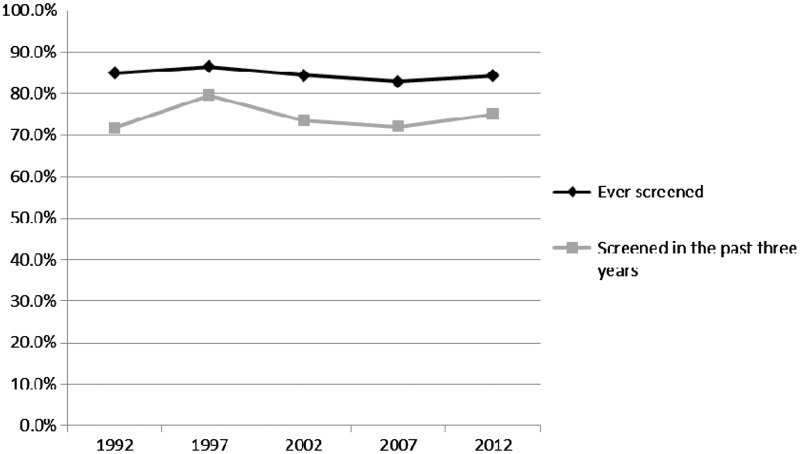
Incidence and mortality of cervical cancer declined thanks to Pap smear screening. However cervical cancer screening (CCS) inequalities are documented, including in high income countries. This population-based study aims to assess the importance and 20-year trends of CCS inequalities in Switzerland, where healthcare costs and medical coverage are among the highest in the world. We analyzed data from five waves of the population-based Swiss Health Interview Survey (SHIS) covering the period 1992–2012. Multivariable Poisson regression were used to estimate weighted prevalence ratios (PR) of CCS and 95% Confidence Intervals (CI) adjusting for socio-economic, socio-demographic characteristics, family status, health status, and use of healthcare. The study included 32’651 women aged between 20 and 70 years old. Between 1992 and 2012, rates of CCS over the past 3 years fluctuated between 71.7 and 79.6% (adjusted < 0.001). Lower CCS was observed among women with low education, low income, those having limited emotional support, who were non-Swiss, single, older, living in non-metropolitan area or in the French-speaking region, overweight. Over the analyzed period, differences in CCS across age groups diminished while rates among women who visited a GP over the previous year, versus those who did not, increased. : While important changes occurred in screening recommendations and in social circumstances of the targeted population, CCS rates remained fairly stable in Switzerland between 1992 and 2012. At the same time, inequalities in CCS persisted over that period.
巴氏涂片筛查降低了宫颈癌的发病率和死亡率。然而,在包括高收入国家在内的许多国家,都存在宫颈癌筛查(CCS)不平等的现象。本项基于人群的研究旨在评估瑞士 CCS 不平等的重要性及其 20 年的变化趋势,该国的医疗保健费用和医疗保障水平均处于世界领先地位。我们分析了涵盖 1992-2012 年期间的五次基于人群的瑞士健康访谈调查(SHIS)的数据。采用多变量泊松回归,在调整了社会经济、社会人口特征、家庭状况、健康状况和医疗保健使用情况等因素后,估计了 CCS 的加权患病率比(PR)和 95%置信区间(CI)。该研究纳入了 32651 名年龄在 20-70 岁之间的女性。1992 年至 2012 年期间,过去 3 年 CCS 的比例在 71.7%至 79.6%之间波动(调整后 <0.001)。在受教育程度低、收入低、情绪支持有限、非瑞士籍、单身、年龄较大、居住在非城市地区或法语区、超重的女性中,CCS 的比例较低。在分析期间,各年龄段之间的 CCS 差异有所缩小,而过去一年中看过全科医生的女性与未看过的女性之间,CCS 的比例有所增加。尽管筛查建议和目标人群的社会环境发生了重大变化,但瑞士在 1992 年至 2012 年期间,CCS 的比例相对稳定。与此同时,在这段时间内,CCS 的不平等现象仍然存在。