da Costa Leandro Menezes Alves, Hueb Whady, Nomura Cesar Higa, Hueb Alexandre Ciappina, Villa Alexandre Volney, Oikawa Fernando Teiichi Costa, Vieira de Melo Rodrigo Morel, Rezende Paulo Cury, Segre Carlos Alexandre Wainrober, Garzillo Cibele Larrosa, Lima Eduardo Gomes, Ramires Jose Antonio Franchini, Kalil Filho Roberto
Department of Atherosclerosis, Heart Institute (InCor), University of São Paulo Medical School, São Paulo, SP, Brazil.
Medicine (Baltimore). 2017 Feb;96(6):e6053. doi: 10.1097/MD.0000000000006053.
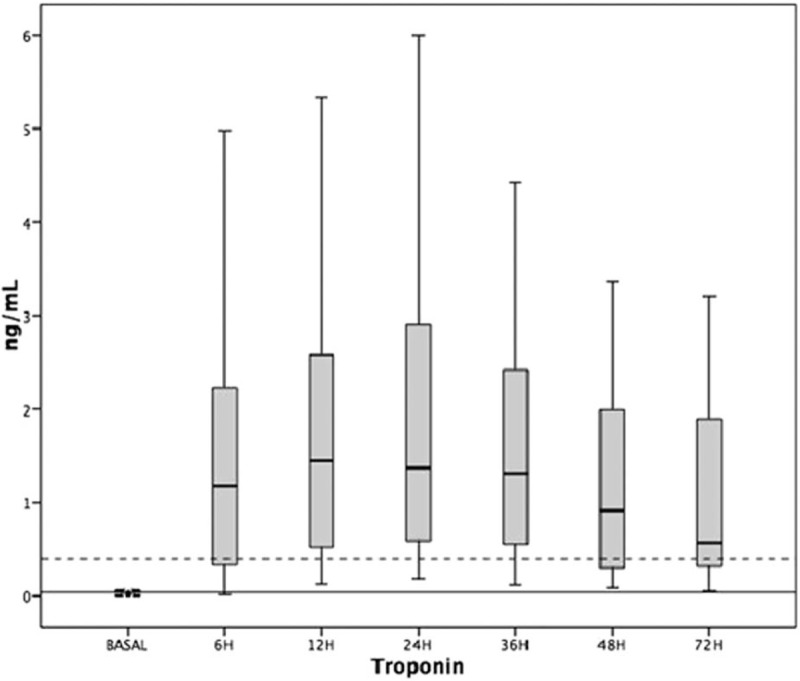
The release of myocardial necrosis biomarkers after off-pump coronary artery bypass grafting (OPCAB) frequently occurs. However, the correlation between biomarker release and the diagnosis of procedure-related myocardial infarction (MI) (type 5) has been controversial. This study aimed to evaluate the amount and pattern of cardiac biomarker release after elective OPCAB in patients without evidence of a new MI on cardiac magnetic resonance (CMR) imaging with late gadolinium enhancement (LGE).Patients with normal baseline cardiac biomarkers referred for elective OPCAB were prospectively included. CMR with LGE was performed in all patients before and after interventions. Measurements of troponin I (cTnI) and creatine kinase MB fraction (CK-MB) were systematically performed before and after the procedure. Patients with new LGE on the postprocedure CMR were excluded.All of the 53 patients without CMR evidence of a procedure-related MI after OPCAB exhibited a cTnI elevation peak above the 99th percentile. In 48 (91%), the peak value was >10 times this threshold. However, 41 (77%) had a CK-MB peak above the limit of the 99th percentile, and this peak was >10 times the 99th percentile in only 7 patients (13%). The median peak release of cTnI was 0.290 (0.8-3.7) ng/mL, which is 50-fold higher than the 99th percentile.In contrast with CK-MB, considerable cTnI release often occurs after an elective OPCAB procedure, despite the absence of new LGE on CMR.
非体外循环冠状动脉搭桥术(OPCAB)后心肌坏死生物标志物经常会释放。然而,生物标志物释放与手术相关心肌梗死(5型)诊断之间的相关性一直存在争议。本研究旨在评估在心脏磁共振(CMR)成像延迟钆增强(LGE)检查中无新发心肌梗死证据的患者,择期OPCAB术后心脏生物标志物的释放量及模式。前瞻性纳入基线心脏生物标志物正常且接受择期OPCAB的患者。所有患者在干预前后均进行了LGE的CMR检查。在手术前后系统地检测肌钙蛋白I(cTnI)和肌酸激酶同工酶MB(CK-MB)。术后CMR出现新发LGE的患者被排除。所有53例OPCAB术后无CMR证据显示与手术相关心肌梗死的患者,其cTnI升高峰值均高于第99百分位数。其中48例(91%)峰值大于该阈值的10倍。然而,41例(77%)的CK-MB峰值高于第99百分位数的上限,且仅7例(13%)患者的该峰值大于第99百分位数的10倍。cTnI的中位峰值释放量为0.290(0.8 - 3.7)ng/mL,比第99百分位数高50倍。与CK-MB不同,尽管CMR上无新发LGE,但择期OPCAB术后常出现大量cTnI释放。