Nishiumi Shin, Kobayashi Takashi, Kawana Shuichi, Unno Yumi, Sakai Takero, Okamoto Koji, Yamada Yasuhide, Sudo Kazuki, Yamaji Taiki, Saito Yutaka, Kanemitsu Yukihide, Okita Natsuko Tsuda, Saito Hiroshi, Tsugane Shoichiro, Azuma Takeshi, Ojima Noriyuki, Yoshida Masaru
Division of Metabolomics Research, Department of Internal Related, Kobe University Graduate School of Medicine, Chuo-ku, Kobe, Hyogo 650-0017, Japan.
Analytical and Measuring Instruments Division, Shimadzu Corporation, Nakagyo-ku, Kyoto 604-8511, Japan.
Oncotarget. 2017 Mar 7;8(10):17115-17126. doi: 10.18632/oncotarget.15081.
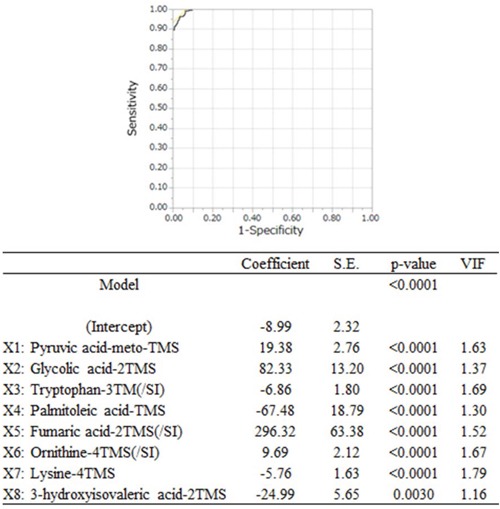
In developed countries, the number of patients with colorectal cancer has been increasing, and colorectal cancer is one of the most common causes of cancer death. To improve the quality of life of colorectal cancer patients, it is necessary to establish novel screening methods that would allow early detection of colorectal cancer. We performed metabolome analysis of a plasma sample set from 282 stage 0/I/II colorectal cancer patients and 291 healthy volunteers using gas chromatography/triple-quadrupole mass spectrometry in an attempt to identify metabolite biomarkers of stage 0/I/II colorectal cancer. The colorectal cancer patients included patients with stage 0 (N=79), I (N=80), and II (N=123) in whom invasion and metastasis were absent. Our analytical system detected 64 metabolites in the plasma samples, and the levels of 29 metabolites differed significantly (Bonferroni-corrected p=0.000781) between the patients and healthy volunteers. Based on these results, a multiple logistic regression analysis of various metabolite biomarkers was carried out, and a stage 0/I/II colorectal cancer prediction model was established. The area under the curve, sensitivity, and specificity values of this model for detecting stage 0/I/II colorectal cancer were 0.996, 99.3%, and 93.8%, respectively. The model's sensitivity and specificity values for each disease stage were >90%, and surprisingly, its sensitivity for stage 0, specificity for stage 0, and sensitivity for stage II disease were all 100%. Our predictive model can aid early detection of colorectal cancer and has potential as a novel screening test for cases of colorectal cancer that do not involve lymph node or distant metastasis.
在发达国家,结直肠癌患者数量一直在增加,结直肠癌是癌症死亡的最常见原因之一。为了提高结直肠癌患者的生活质量,有必要建立能够早期检测结直肠癌的新型筛查方法。我们使用气相色谱/三重四极杆质谱对282例0/I/II期结直肠癌患者和291名健康志愿者的血浆样本进行了代谢组分析,试图识别0/I/II期结直肠癌的代谢物生物标志物。结直肠癌患者包括0期(N = 79)、I期(N = 80)和II期(N = 123)且无侵袭和转移的患者。我们的分析系统在血浆样本中检测到64种代谢物,患者和健康志愿者之间29种代谢物的水平存在显著差异(Bonferroni校正p = 0.000781)。基于这些结果,对各种代谢物生物标志物进行了多元逻辑回归分析,并建立了0/I/II期结直肠癌预测模型。该模型检测0/I/II期结直肠癌的曲线下面积、敏感性和特异性值分别为0.996、99.3%和93.8%。该模型对每个疾病阶段的敏感性和特异性值均>90%,令人惊讶的是,其对0期的敏感性、对0期的特异性以及对II期疾病的敏感性均为100%。我们的预测模型有助于早期检测结直肠癌,并且作为一种针对不涉及淋巴结或远处转移的结直肠癌病例的新型筛查测试具有潜力。