Martínez Steele Euridice, Popkin Barry M, Swinburn Boyd, Monteiro Carlos A
Department of Nutrition, School of Public Health, University of São Paulo, Av. Dr. Arnaldo, 715, 01246-907, São Paulo, Brazil.
Center for Epidemiological Studies in Health and Nutrition, University of São Paulo, São Paulo, Brazil.
Popul Health Metr. 2017 Feb 14;15(1):6. doi: 10.1186/s12963-017-0119-3.
Recent population dietary studies indicate that diets rich in ultra-processed foods, increasingly frequent worldwide, are grossly nutritionally unbalanced, suggesting that the dietary contribution of these foods largely determines the overall nutritional quality of contemporaneous diets. Yet, these studies have focused on individual nutrients (one at a time) rather than the overall nutritional quality of the diets. Here we investigate the relationship between the energy contribution of ultra-processed foods in the US diet and its content of critical nutrients, individually and overall.
We evaluated dietary intakes of 9,317 participants from 2009 to 2010 NHANES aged 1+ years. Food items were classified into unprocessed or minimally processed foods, processed culinary ingredients, processed foods, and ultra-processed foods. First, we examined the average dietary content of macronutrients, micronutrients, and fiber across quintiles of the energy contribution of ultra-processed foods. Then, we used Principal Component Analysis (PCA) to identify a nutrient-balanced dietary pattern to enable the assessment of the overall nutritional quality of the diet. Linear regression was used to explore the association between the dietary share of ultra-processed foods and the balanced-pattern PCA factor score. The scores were thereafter categorized into tertiles, and their distribution was examined across ultra-processed food quintiles. All models incorporated survey sample weights and were adjusted for age, sex, race/ethnicity, family income, and educational attainment.
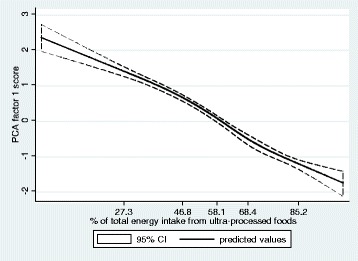
The average content of protein, fiber, vitamins A, C, D, and E, zinc, potassium, phosphorus, magnesium, and calcium in the US diet decreased significantly across quintiles of the energy contribution of ultra-processed foods, while carbohydrate, added sugar, and saturated fat contents increased. An inverse dose-response association was found between ultra-processed food quintiles and overall dietary quality measured through a nutrient-balanced-pattern PCA-derived factor score characterized by being richer in fiber, potassium, magnesium and vitamin C, and having less saturated fat and added sugars.
This study suggests that decreasing the dietary share of ultra-processed foods is a rational and effective way to improve the nutritional quality of US diets.
近期的人群饮食研究表明,富含超加工食品的饮食在全球范围内日益普遍,其营养严重不均衡,这表明这些食品在饮食中的占比在很大程度上决定了同期饮食的整体营养质量。然而,这些研究关注的是单一营养素(每次一种),而非饮食的整体营养质量。在此,我们分别及综合研究美国饮食中超加工食品的能量贡献与其关键营养素含量之间的关系。
我们评估了2009年至2010年美国国家健康与营养检查调查(NHANES)中9317名1岁及以上参与者的饮食摄入量。食品被分为未加工或最低加工食品、加工烹饪原料、加工食品和超加工食品。首先,我们研究了超加工食品能量贡献五分位数中常量营养素、微量营养素和纤维的平均饮食含量。然后,我们使用主成分分析(PCA)来确定一种营养均衡的饮食模式,以便评估饮食的整体营养质量。线性回归用于探讨超加工食品的饮食占比与均衡模式PCA因子得分之间的关联。此后,得分被分为三分位数,并研究其在超加工食品五分位数中的分布情况。所有模型均纳入了调查样本权重,并根据年龄、性别、种族/民族、家庭收入和教育程度进行了调整。
在美国饮食中,随着超加工食品能量贡献五分位数的增加,蛋白质、纤维、维生素A、C、D和E、锌、钾、磷、镁和钙的平均含量显著下降,而碳水化合物、添加糖和饱和脂肪的含量则增加。通过以富含纤维、钾、镁和维生素C且饱和脂肪和添加糖较少为特征的营养均衡模式PCA得出的因子得分来衡量,超加工食品五分位数与整体饮食质量之间存在负剂量反应关联。
这项研究表明,减少超加工食品在饮食中的占比是提高美国饮食营养质量的合理且有效方式。